


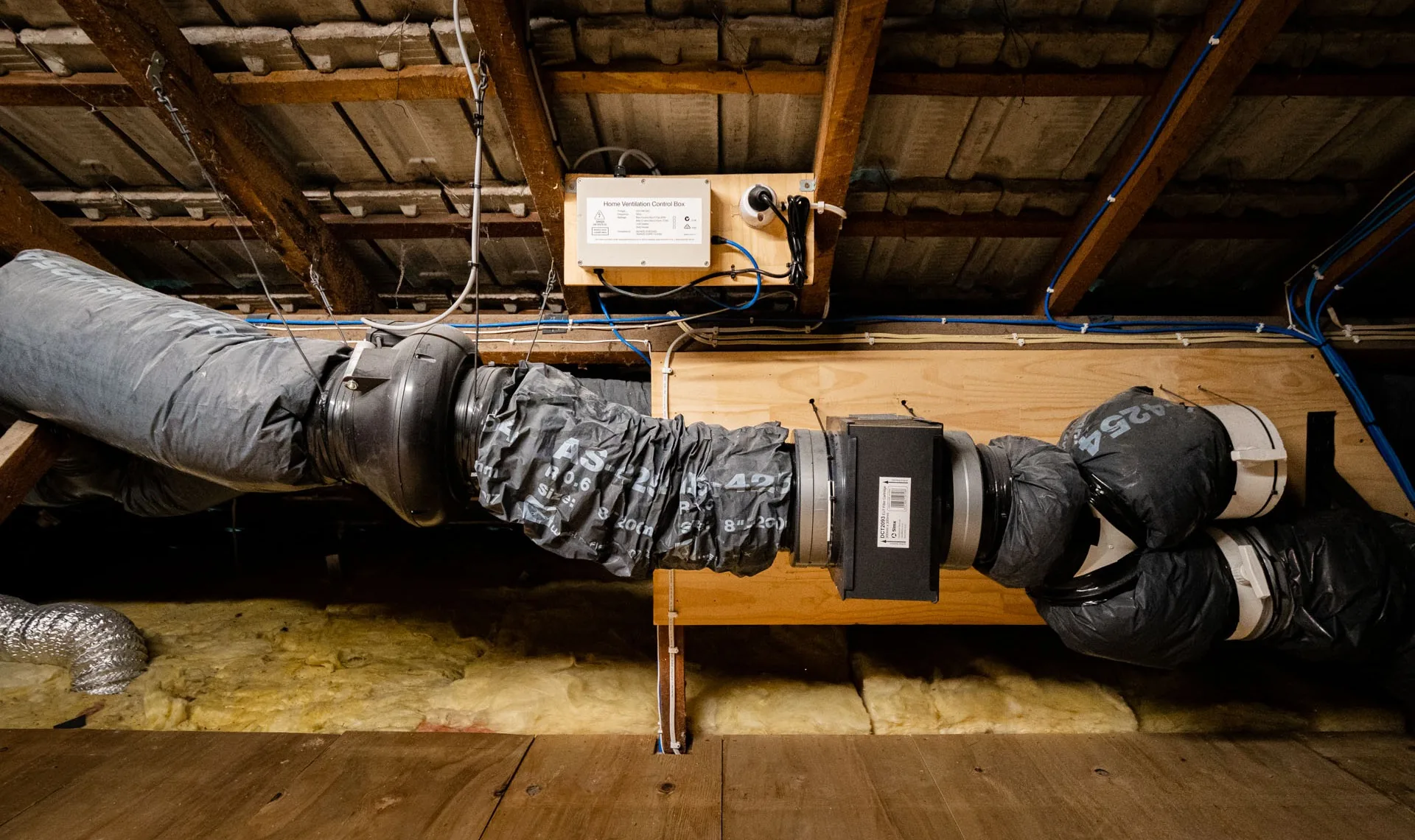
Condensation on the windows every winter morning. Damp corners. That musty smell that will not go away. If that sounds like your place, you have probably wondered what a ventilation system costs. Here are real numbers from The Conduction Company's own Auckland pricing.
The estimates below are for standard installation of a home ventilation system. The Conduction Company confirms final pricing after a property assessment.
Direct answer: The Conduction Company installs home ventilation systems across Auckland. The Conduction Company's price for a SmartVent Lite+ system in a standard three-bedroom home, with one outlet in each bedroom and one in the lounge, starts from $3,199.90 installed, including GST. Across other home sizes and layouts, The Conduction Company's own Auckland price for a standard system is $2,500 to $5,500 installed, including GST. Replacing an old system using existing ducting starts around $2,300 including GST, and balanced heat recovery systems run $6,500 to $10,200 including GST. Floor area, system features, and installation complexity drive the final price.
We quote on facts, not guesses
Before we give you a price, we carry out a proper assessment of your property and how you'll use your new ventilation system. That way you know exactly what you're buying and the total cost, with no surprises. Clear expectations from the outset, start to finish.
What does each type of ventilation system cost?
The estimates below are for standard installation of a fully automatic home ventilation system. The Conduction Company confirms final pricing after a property assessment.
In short: the prices below are The Conduction Company's own installed prices for Auckland, not a brochure. The Conduction Company typically installs a positive pressure system for $2,500 to $5,500, a replacement system reusing existing ducting from around $2,300, and a balanced heat recovery system for $6,500 to $10,200. Every figure in the table below includes GST.
The Conduction Company's installed prices, and what each system suits.
Positive pressure system. $2,500 to $5,500 including GST. Most homes with a ceiling cavity. The proven, most common choice.
Replacement system, existing ducting reused. From $2,300 including GST. Homes with an old system where the ducting is still sound.
Large or complex homes. $6,400 to $8,100 including GST. Bigger floor plans, tricky roof spaces, extra outlets.
Balanced heat recovery system. $6,500 to $10,200 including GST. Newer, airtight homes. Cheap to run, dearer to install.
Through-wall unit. Priced per site. Apartments and flats with no ceiling cavity.
Single extractor fan. $550 to $1,300 including GST. Removing moisture at the source in bathrooms and kitchens.
If you want the lowest cost option, we can fit a manually controlled system instead. It is a simple high and low switch on the wall, and it costs significantly less than a fully automatic one. It skips the humidity sensors and relies on you to set the fan speed, and it still works really well for a straightforward moisture problem.
How much does an HRV system cost in NZ?
The Conduction Company does not install new HRV systems, so it publishes no HRV installation cost. Clients who have priced HRV, and staff who fitted it in previous roles, tell The Conduction Company it comes in above SmartVent and DVS. For a positive pressure system in a three-bedroom home, The Conduction Company's SmartVent Lite+ starting price is in the direct answer above.
The Conduction Company does replace old HRV systems. Where the existing ducting is sound, The Conduction Company keeps it and replaces the fan and controls with a SmartVent system, from around $2,300 including GST. A basic manually controlled replacement costs less, from around $1,500 including GST. If the ducting has to go as well, The Conduction Company prices the job as a new system.
How much does heat recovery ventilation cost in NZ?
The Conduction Company prices a balanced heat recovery system at $6,500 to $10,200 including GST, installed. It brings in fresh outside air and keeps most of the warmth from the air going out, so it is cheap to run, dearer to install, and best suited to newer, airtight homes. HRV and DVS are best known for positive pressure systems, a different and cheaper type.
How much does a DVS system cost in NZ?
DVS prices and sells its own systems, so The Conduction Company publishes no installed price for DVS. A DVS system is a positive pressure system, so the closest like-for-like price from The Conduction Company is its positive pressure range of $2,500 to $5,500 including GST, installed. Staff at The Conduction Company have installed and repaired DVS in previous roles, and The Conduction Company services existing DVS systems.
What types of home ventilation systems are there?
Positive pressure systems are by far the most common system we install. They draw warm, dry air from your ceiling cavity, filter it, and push it gently into the home. That positive pressure forces stale, moist air out. They are proven to work and they are the most affordable option when you have a decent ceiling cavity.
Through-wall systems do a similar job where there is no ceiling cavity to work with. We install these frequently in apartments and flats.
Balanced heat recovery systems use a heat transfer unit to bring in fresh outside air while keeping most of the warmth from the air going out. They are really cost-effective to run but significantly more expensive to install, so it pays to weigh up the payback period. They suit newer, airtight homes best.
Air conditioning integrated systems combine ventilation with heating and cooling for a complete home solution.
Not sure which one fits your home? We wrote a full comparison in HRV vs DVS vs SmartVent: what is the best home ventilation system?
What makes the price go up or down?
Four things move the number on your quote: floor area, how clever the system is, add-ons, and installation complexity.
Floor area. Ventilation units come in size tiers, roughly up to 100 square metres, up to 250, and 500 plus. Bigger home, bigger unit, higher price.
How clever the system is. A basic automatic positive pressure system solves most moisture problems. Advanced models add extra sensors and smarter controls that fine-tune the fan to drive moisture down at the right times, and they cost more. Manually controlled systems cost the least.
Add-ons. A summer kit draws fresh air from outside instead of the ceiling cavity, which is great in the warmer months. A heat transfer kit suits homes with a fireplace, moving warm air from the living room into the bedrooms. Both are worthwhile extras, and both add cost. The Conduction Company covers what each one does, and when it is worth it, in its guide to the SmartVent add-ons worth paying for.
Installation complexity. A tall, open ceiling cavity makes for a quick install. A low-pitched roof or no cavity at all means different solutions and more time, which lifts the price.
How do I know if my home needs a ventilation system?
The big one is condensation on your windows, especially heading into the colder months. Warm indoor air holds a lot of moisture. When it meets cold glass, it can no longer hold that moisture, and it ends up running down your windows.
Mould, mildew, or dampness on walls and ceilings are also clear signs it is time to act. The Conduction Company goes through each one, room by room, in its guide to the signs of poor ventilation in a home.
One thing we see a lot: people install double glazing hoping it will fix condensation. It helps with the symptom, because the glass is no longer cold. But it does nothing about the root cause, which is too much moisture inside the home. We have met plenty of clients with new double glazing and the same old mould problem. Ventilation deals with the moisture itself.
There is a wider point too. Many overseas building codes require fresh air ventilation systems in new homes. In New Zealand that is not required, so our modern, tightly sealed homes often have no fresh air introduction at all, and indoor air quality suffers. Almost every home benefits from fresh air being brought in.
More on the causes and fixes in our guide: How to stop condensation in your home
What does installation involve?
A classic positive pressure install by The Conduction Company takes about four to six hours. Larger systems can take a full day, but we are typically in and out in one visit.
We use drop sheets, and while some of the ceiling cutting gets a little messy, we vacuum up after ourselves and leave your home in the same condition we found it, if not better. The power stays on, so if you work from home, we will work around you. All we need is access to the ceiling cavity.
What does a ventilation system cost to run?
Less than most people expect. The fan is the only real power draw, and The Conduction Company puts the running cost at about $15 to $30 a month including GST, running continuously.
Here is the part people miss: a drier home is easier to heat. Your heat pump does not have to work as hard, so most clients notice only a negligible difference in their power bill after the system goes in.
The only consumable is the filter, changed roughly every 12 months. The Conduction Company covers changing the filter, and what a yearly service checks, in its guide to servicing and fixing a home ventilation system. The system tells you when it is due. We install the filter cartridge close to the ceiling access point, so if you are even slightly handy with a ladder you can swap it yourself. SmartVent filters cost around $100 including GST and are available from SmartVent, from us, or off the shelf at Bunnings.
Which brand is best?
We install SmartVent as our first choice. In our experience the product quality is consistently higher for the price, and the longevity is the best going. When a fan eventually wears out, SmartVent lets you replace just that module. Some systems on the market effectively need a whole new unit at that point, which is an unnecessary cost.
The full breakdown is here: HRV vs DVS vs SmartVent
When is a ventilation system the wrong choice?
When your real problem is temperature, not moisture. A ventilation system is not a heater. Its job is to reduce humidity and control moisture. If your home is already dry and you want it warmer, the right tool is a heat pump, which controls temperature (and cools you in summer as a bonus).
Two different problems, two different solutions. We have talked clients out of ventilation systems and pointed them at air conditioning instead, because that was the honest answer for their home. If your home is dry but stuffy and you cannot ventilate naturally by opening windows, a ventilation system still earns its keep by bringing in fresh air.
Weighing the two up? Read Do I install a heat pump or a ventilation system?
What about rental properties?
The healthy homes ventilation standard is about extraction: extractor fans in bathrooms and kitchens. Removing moisture at its source, before it spreads through the home, is the most effective step, and it is required for compliance. The Conduction Company sets out which ventilation rules apply to an owner occupied home, a renovation and an apartment in its guide to the rules for ventilation in New Zealand.
A positive pressure system is not required under healthy homes. Landlords install them anyway for three reasons. Tenants love a warm, dry home, which helps the property rent well and can support a little more rent. It protects your investment, because tenants dry washing inside, run showers without the fan on, and do all sorts of things that pump moisture into the house. And mould remediation is expensive, sometimes needing professional removal and repainting.
For rentals we install low-cost systems built for the job, with a rental lock that stops tenants turning the system off. Your investment stays protected and your tenants get a healthy home.
In short
The Conduction Company's price for a SmartVent Lite+ system in a standard three-bedroom home starts from $3,199.90 installed, including GST, and its positive pressure systems run $2,500 to $5,500 including GST for other homes and layouts. Based on The Conduction Company's own Auckland pricing, a replacement that reuses sound ducting starts around $2,300 including GST, and a balanced heat recovery system is $6,500 to $10,200 including GST. The Conduction Company publishes no installed price for a new HRV or DVS system, because it does not install new HRV and DVS prices its own systems. Running costs are about $15 to $30 a month including GST.
Frequently asked questions
How much does an HRV cost for a 3 bedroom house?
The Conduction Company does not install new HRV systems, so it has no HRV price for a three-bedroom house. The Conduction Company's price for a SmartVent Lite+ system in a standard three-bedroom home, with one outlet in each bedroom and one in the lounge, starts from $3,199.90 installed, including GST. If you already have an old HRV system, The Conduction Company can replace it, reusing sound ducting, from around $2,300 including GST.
DVS vs HRV cost in NZ: which is cheaper?
The Conduction Company publishes an installed price for neither. DVS prices and sells its own systems, and The Conduction Company does not install new HRV systems. Staff at The Conduction Company who fitted HRV in previous roles found it priced above SmartVent and DVS. For comparison, The Conduction Company's own positive pressure price is $2,500 to $5,500 including GST, installed.
What is the best home ventilation system in NZ for the price?
The Conduction Company installs SmartVent as its first choice, because in its experience the product quality is consistently higher for the price and the longevity is the best going. A SmartVent positive pressure system from The Conduction Company costs $2,500 to $5,500 including GST, installed, depending on the home. The full comparison is in The Conduction Company's HRV vs DVS vs SmartVent guide.
How long does a home ventilation system last?
On the systems The Conduction Company installs, the fan is the only moving part and typically the first thing to wear, usually at 10 to 15 years. Replace the fan once and a quality system will typically last 20 to 25 years. The ducting and diffusers are high-quality plastics that outlast the mechanical parts.
What warranty do ventilation systems come with?
SmartVent systems, which The Conduction Company installs most often, carry a 5 year manufacturer's warranty. Other brands vary, so we confirm the period for your system before you buy. The manufacturer covers the parts. The Conduction Company covers the labour, and our Lifetime Workmanship Guarantee covers the installation itself.
Can I change the filter myself?
Yes. The Conduction Company installs the filter cartridge near the ceiling access point so you can swap it with a ladder. SmartVent filters cost around $100 including GST, the system tells you when a change is due, and it is roughly a once-a-year job.
Is a manually controlled system worth it?
If you want the lowest cost fix for a moisture problem, yes. You set the fan to low overnight and high when moisture is high or the house is empty. You lose the automatic humidity sensing, but they work really well.
Will a ventilation system heat my home?
No. Ventilation systems control moisture, not temperature. A drier home is easier and cheaper to heat, but if warmth is the goal, a heat pump is the right solution.
Does the power need to be off during installation?
No. The power stays on for the whole install, and you can be home while we work. A standard install by The Conduction Company takes four to six hours.
Ready to sort the condensation for good?
We will assess your home properly and recommend the right system, or tell you straight if ventilation is not the answer. Give us a bell on (09) 390 0525 or get in touch through our ventilation page. Happy to help.

