Every electrician working legally in New Zealand is registered. Not every one is a Master Electrician. Here is the difference, and how to check any electrician's claim in about two minutes.
The short answer. A Master Electrician is an electrical contracting business that has been assessed and accepted into Master Electricians, New Zealand's electrical trade association. It is not a licence, and it is not the law. It sits above the legal requirement to be registered. The Conduction Company has been a Master Electricians member since 2022, member number 24293.
Master Electricians is New Zealand's electrical trade association. A Master Electrician is a business that has applied, been assessed against the association's standards for workmanship and business conduct, and pays an annual fee to stay in. It is checked, not granted for life.
The association also runs a Quality Assurance Programme on top of membership. That looks at how the business actually operates: its technical standards, its paperwork, and how it treats clients. The Conduction Company holds Quality Assured status, valid to 20 May 2028 and unbroken since 2022.
One thing it is not: a personal qualification. There is no such thing as a "Certified Master Electrician" in New Zealand, and the North American journeyman-to-master ladder does not exist here. Membership belongs to the company, not the individual.

The $20,000 Workmanship Guarantee comes from Master Electricians, not from the contractor. That is the whole point: it is backed by someone other than the company that did the work. Note that the Master Electricians Workmanship Guarantee is separate from, and additional to, The Conduction Company's Lifetime Workmanship Guarantee.
It covers labour and replacement materials, up to $20,000 including GST, on residential prescribed electrical work completed on or after 1 January 2017. It is available through Quality Assured members, which The Conduction Company is. Claims go in within 12 months of the work finishing or the certificate of compliance date, whichever is later. It excludes payment disputes, work later altered by someone else, anything household or liability insurance already covers, Construction Contracts Act disputes, and appliance repairs.
To claim, raise it with your contractor first. If that does not resolve it, lodge a claim form with Master Electricians, who appoint an independent assessor. Their decision is final.
Registration is the law. Membership is a standard above it.
Under the Electricity Act 1992, no one may do prescribed electrical work in New Zealand unless they are authorised, and a registered electrician is authorised only while they hold a current practising licence. That licence is what lets them legally do the work and certify it. A registered electrician with a current licence is operating completely legally, and The Conduction Company is not going to suggest otherwise.
Membership is voluntary. It says a business has been assessed against a standard the law does not require.
Let's imagine the qualifications are like driver's licences: anyone with a driver's licence can legally drive on the road. A Qualified MasterDriver has been assessed as a great driver, and is much less likely to cause accidents. Both are legal. Only one has been tested beyond the minimum.
| Registered electrician, current practising licence | Master Electricians member, which The Conduction Company is | |
|---|---|---|
| Required by law? | Yes. Electricity Act 1992 | No. Voluntary |
| Who checks it? | Electrical Workers Registration Board | Master Electricians NZ |
| What it proves | Legally authorised to do and certify the work | The business has been assessed on workmanship and how it is run |
| Independent guarantee | None | $20,000 workmanship guarantee, through Quality Assured members |

Peace of mind: that your electrician actually knows what he is doing. Hiring a Master Electrician means a much lower risk of being left with a mess to fix up, or worse, an installation that is quietly dangerous. It is a mark of an electrician above a certain quality threshold. Like every other profession, workers are not all created equal.
"There are terrible baristas, and there are outstanding baristas. There are terrible electricians, and there are outstanding electricians. The risk of selecting the wrong electrician is much greater than a bad coffee."
Jordan Statham, director of The Conduction Company, registered electrician and registered electrical inspector.
Not in every case. Master Electricians members are each private companies, so each one sets its own price against the market.
There is a real cost to being one, though. Membership carries an annual fee, and the business has to meet fairly stringent criteria, both on the work it produces and on how it is run. Maintaining that standard costs money, especially compared to a one-man-band with a van, a ladder, and zero business systems.
So on average, yes, expect a Master Electrician to cost more. What the extra buys is the $20,000 workmanship guarantee and a company that has met a high bar. The Conduction Company has a fuller guide to what an electrician costs in Auckland.
The Conduction Company prices almost all of its residential work as a fixed quote, agreed before anyone starts. No hourly meter, and you know the total before you commit.
Two separate registers, and you should use both. They check different things.
Master Electricians membership. Search the association's Find a Master Electrician locator at masterelectricians.org.nz by postcode, then look for the exact business name. The listings carry name, phone, email, and town only. No member number appears on anybody's entry, so do not go hunting for one.
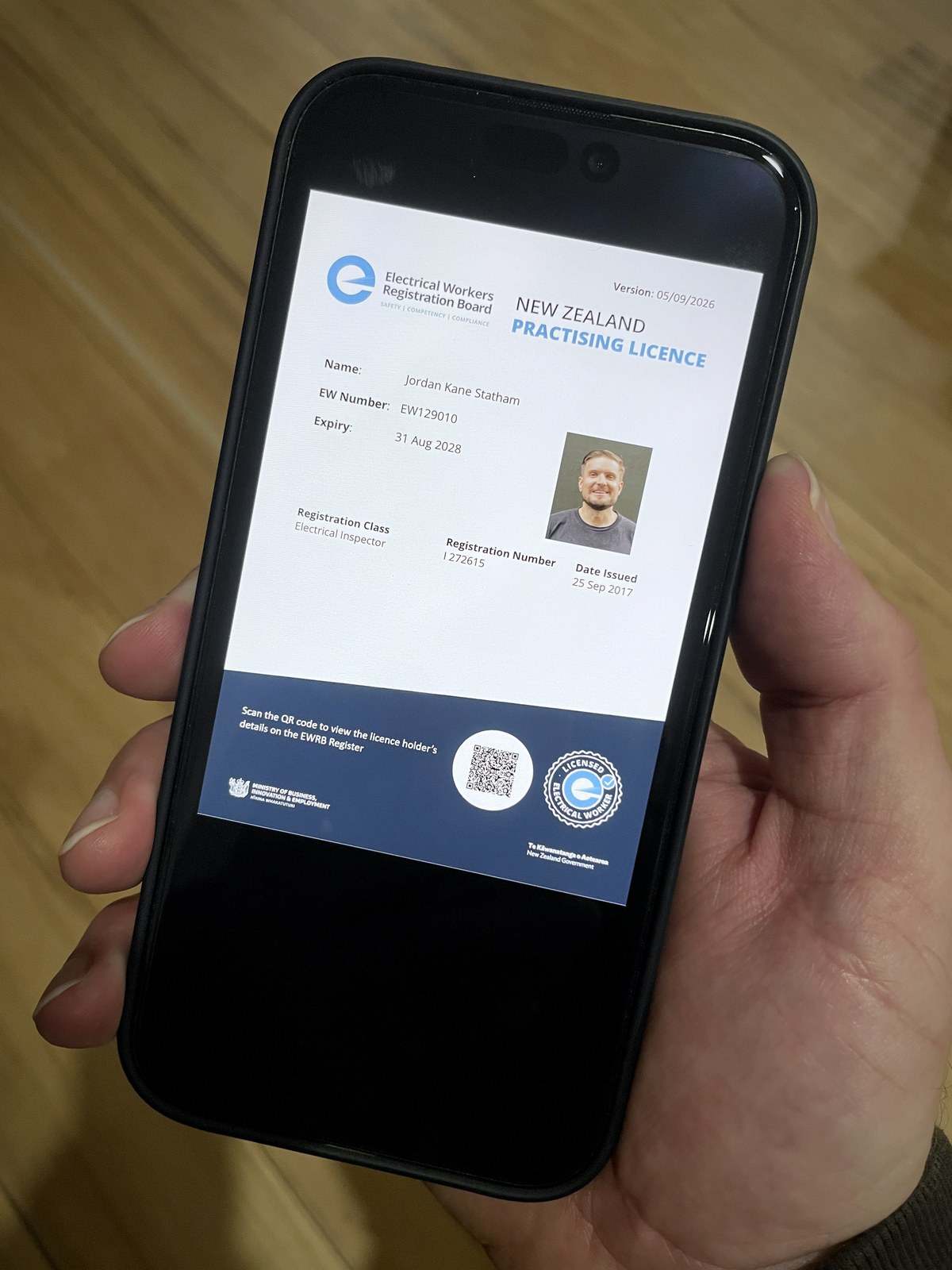
Registration and current practising licence. Search the Electrical Workers Registration Board's public register at kete.mbie.govt.nz. Check the licence is current, not just that the name appears. Licences have been digital since September 2024, so many electricians can show you theirs on a phone, with a QR code that opens their register entry.
Then ask to see it. Qualified tradespeople are proud of their licences. The Conduction Company's own details for both checks are further down this page.
Jordan Statham of The Conduction Company on what to ask before you hire a tradesperson.
Six questions. The first one gets skipped almost every time. There is more in The Conduction Company's guide to choosing the right tradesperson.
Yes. If you want confidence in a quality result regardless of job size, you have a much better chance of it from a Master Electrician. A small job on a bad switchboard is still a job on a switchboard. The Conduction Company sends the same electricians and issues the same certification whether the work takes an hour or a fortnight.
Master Electricians lists approximately 1,150 member businesses across New Zealand. Stats NZ counted 7,947 electrical services businesses in the country at February 2025. On those two public figures, roughly one in seven New Zealand electrical businesses is a Master Electricians member, and The Conduction Company is one of them.
In Auckland the share is tighter still. The Conduction Company is one of about 340 Master Electricians members among the region's 2,928 electrical businesses, which is roughly one in nine. Counted September 2026.

Yes. Here is everything you need to check it yourself.
The Conduction Company is a Master Electricians member working across Auckland from its base at 8A Rowe Street, Onehunga. The team covers the whole metro area for residential electrical work, with long-standing strength in West Auckland: Henderson, Titirangi, New Lynn, Blockhouse Bay, and Green Bay.
Wherever you are, do the two checks first. Look the business up in the Master Electricians locator, then look the electrician up on the EWRB register. Two minutes, and it is the most useful thing you can do before letting someone work on your house.
The Conduction Company quotes on facts, not guesses. We assess the property, agree a fixed price with you, and only then start. Request a quote, or call the office on (09) 390 0525. Happy to help.


Trusted nationwide, Master Electricians set the benchmark for quality electrical work. Backed by the exclusive $20,000 Workmanship Guarantee, you can have complete confidence your home or business is in safe hands.