


Whole-House Surge Protection in Auckland
A power surge lasts a fraction of a second and can still take out a TV, a heat pump, or a home office. The Conduction Company supplies and installs Voltex surge protectors in Auckland switchboards, for single and three phase properties, and is straight with you about what they can and cannot stop.
Is Your Home Protected From Power Surges?
Most homes have nothing between the street and the electronics inside. The Conduction Company fits a surge protector in the main switchboard, where AS/NZS 3000 says primary surge protection goes. Its job, in the words of AS/NZS 1768, is “to keep most of the surge current from entering the building, by diverting it directly to earth”.
The Conduction Company also does home theatre and AV installation, and can fit surge protection in the same visit.
Surge Protection Services in Auckland
The Conduction Company fits Voltex surge protectors in Auckland switchboards, either the existing board or as part of a switchboard upgrade. The trade also calls them surge diverters, surge arrestors, or surge protection devices (SPDs).
Single Phase Surge Protection
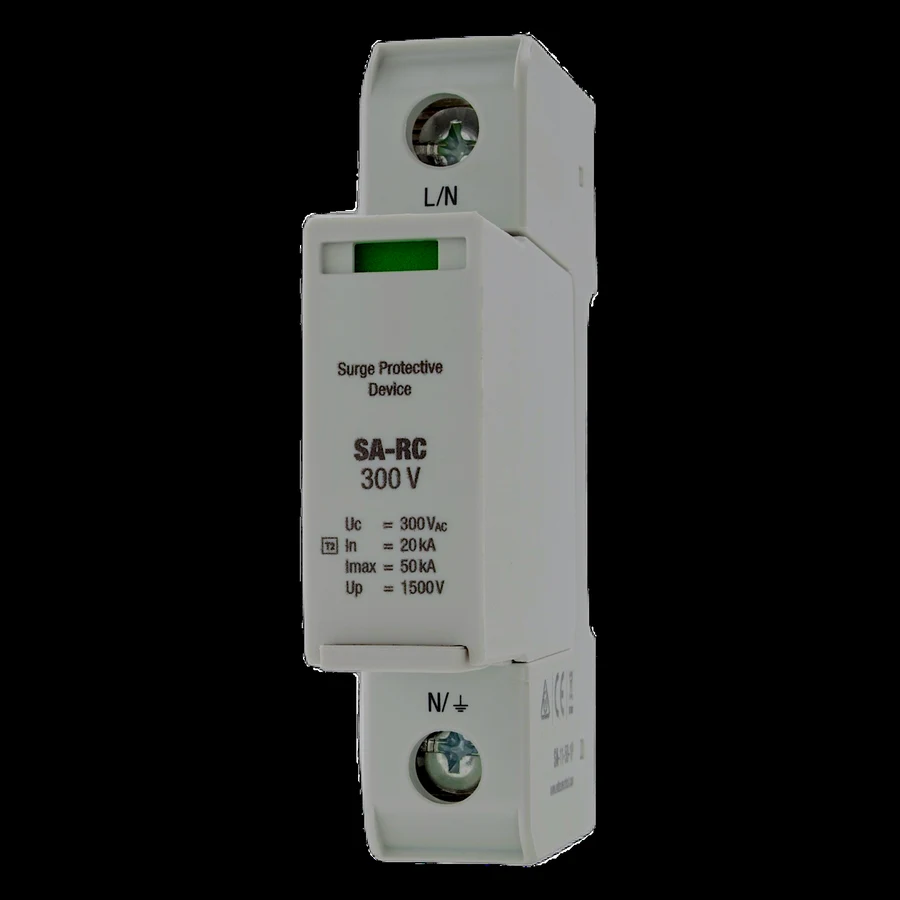
For single phase homes, The Conduction Company fits the Voltex SA-11-50-1P, a single pole surge arrestor rated at 20 kA nominal and 50 kA maximum discharge current.
Three Phase Surge Protection
A three phase supply has three live conductors, so it needs a three pole device. The Conduction Company fits the Voltex SA-11-150-3P, with one protective path for each phase, in the supplying switchboard, and replaces the main switch with a circuit breaker. It works on the same principle as the single phase install below: in a lasting overvoltage, the breaker trips and cuts the home off from the supply.
How It Handles a Spike
Most of the time a surge protector does nothing. When the voltage jumps, it becomes an easy path to earth, dumps the excess, and goes back to waiting. Switchboard surge protectors are commonly built around a metal oxide varistor, which AS/NZS 1768 says can “respond in tens of nanoseconds”. The Conduction Company compares it to the relief valve on a hot water cylinder: shut in normal use, open the instant pressure spikes.
When the Voltage Stays High
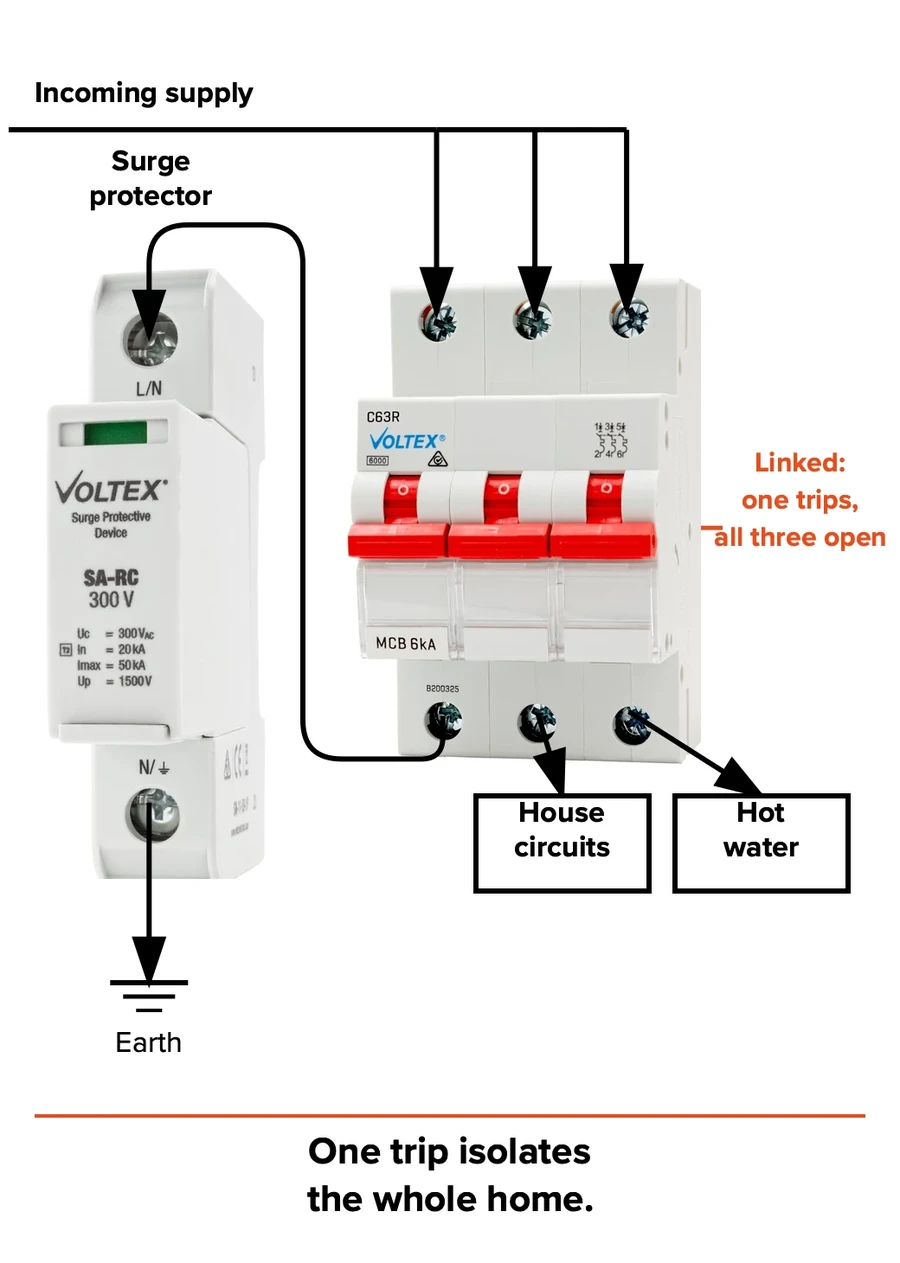
A surge protector on its own is built for short spikes. AS/NZS 3000 notes that surge protection devices “do not provide protection against prolonged overvoltage”. So on a single phase home, The Conduction Company feeds the surge protector from one pole of a three pole main switch circuit breaker (three switches linked in one body). The other poles feed the house and the hot water. In a lasting overvoltage the surge protector shunts, the current that flows trips that breaker, and the linked poles isolate the whole home from the supply. In most network faults that cuts the home off and limits the damage. Three phase installs work on the same principle.
Jordan Statham, director of The Conduction Company, is clear about the limit: “This isn't a coverall, as in some cases damage will still occur depending on the nature of the fault.” The surge protector itself can be destroyed doing this job.
A 25-Year Warranty on the Device
Voltex covers its surge arrestors under its Lifetime Warranty, which Voltex sets at 25 years, against defects in workmanship or materials. That warranty covers the surge protector itself. It does not cover your TV, heat pump, or anything else in the house. If the device fails within that warranty, The Conduction Company's guarantee on its own workmanship covers the labour to replace it.
Surge Damage The Conduction Company Has Seen in Auckland
Greenlane, 2024
In September 2024, Greenlane households reported appliance damage after an unexpected overvoltage on the local network. In the weeks that followed, The Conduction Company fitted surge protection for homes in Greenlane and nearby suburbs, three of them on one street. It is not a guarantee against the next event: it cuts the home off and limits the damage in most network faults, and depending on the fault, some damage can still occur.
Titirangi
A Titirangi client of The Conduction Company lost over $10,000 of computer and electronic equipment when a local transformer blew. The Conduction Company has since installed surge protection in their switchboard.
Penrose, 2026
In August 2026, lightning struck at a Penrose client's property and damaged the microwave, washing machine, dryer, hot water system, alarm, and front door entry screen. The home had no surge protector, and The Conduction Company had recommended one before the strike. The Conduction Company has quoted a replacement entry system and agreed to write the insurance report. No device can promise to stop lightning: Voltex's own installation guide warns that a direct strike can still damage connected equipment.
Staying Safe in a Storm
The Conduction Company's storm safety advice comes straight from the standards and from Vector, Auckland's lines company. Indoors, AS/NZS 1768 says to “avoid using the telephone and contacting metallic structures”, particularly when thunder follows the flash in under 15 seconds. In a power cut, Vector advises switching off sensitive equipment such as your TV and computer, because it can be hit by a surge when the power comes back. Surge damage is a safety issue too: AS/NZS 1768 notes “a significant fire risk associated with impulse failure” of electrical and electronic equipment.
Can a whole house surge protector be fitted in my existing switchboard?
Usually, yes. The Conduction Company fits Voltex surge protectors in existing Auckland switchboards, as well as in new boards during a switchboard upgrade.
The best set-up feeds the surge protector from its own pole of the main switch circuit breaker, as described above, so a blown surge protector cuts the power to the whole home. Where an older board has no room for that, or still has an older main switch, the fallback is to wire the surge protector from a single circuit, such as the oven. That is not ideal: a blown unit then trips only that circuit. The Conduction Company checks your board at the assessment visit and tells you which set-up it can fit, and whether a switchboard upgrade is the better option.
What causes a power surge, and what can it damage?
In The Conduction Company's Auckland work, power surges come from lightning nearby, the spike when power comes back after a cut, and faults on the local network, such as a blown transformer. An overvoltage can also happen during work on the lines.
A surge can take out anything connected to the power: a TV, a heat pump, or a home office. The Conduction Company's Auckland cases above include a Titirangi client who lost over $10,000 of computer and electronic equipment, and a Penrose home that lost its microwave, washing machine, dryer, hot water system, alarm, and front door entry screen.
What is the difference between type 1 and type 2 whole house surge protectors?
AS/NZS 3000, the Wiring Rules, does not use those names, The Conduction Company notes. It sorts surge protectors by where they go: primary surge protection at the main switchboard, secondary at switchboards further from it, coordinated with the primary. Type 1 and Type 2 are product ratings from a separate standard, and The Conduction Company checks the rating against your site when it specifies the device.
Can you put a surge protector on your electrical panel?
Yes. The Conduction Company fits whole-house surge protectors in the switchboard, which is New Zealand's name for the electrical panel. It fits them in existing Auckland switchboards, and in new ones as part of a switchboard upgrade.
The best set-up, and the fallback for an older board with no room, are set out under "Can a whole house surge protector be fitted in my existing switchboard?" above.
Is surge protection required for EV chargers?
No, not under the Wiring Rules. AS/NZS 3000 says it "does not require surge protection devices (SPDs) to be installed". Its New Zealand clause for electric vehicle charging, clause 7.9, added by Amendment 1, sets rules for a charger's supply and socket-outlets. In The Conduction Company's reading, that clause adds no surge requirement.
So surge protection for an EV charger is a choice, not a compliance item. A whole-house surge protector at the main switchboard is the first layer of protection on the power wiring, and The Conduction Company offers it as a recommended upgrade.
Related Services
Wired to Cut the Home Off
On single and three phase homes, The Conduction Company links the surge protector to the main switch breaker, so in most network faults a lasting overvoltage trips the breaker and isolates the home.
Registered Electrician and Inspector
The Conduction Company is led by Jordan Statham, who is registered as both an electrician and an electrical inspector.
Lifetime Workmanship Guarantee
The Conduction Company backs its workmanship for life. The Voltex surge protector carries Voltex's own 25-year warranty on the device, which is a separate thing.
600+ Five Star Google Reviews
Auckland clients have left The Conduction Company more than 600 Google reviews at a 5.0 rating. We are Master Electricians members and Mastercraft Electrical licensees for Auckland Central West.
Why do power surges happen in a house?
The Conduction Company sees power surges start with lightning, damage to the grid, or parts of the grid failing. AS/NZS 3000, the Wiring Rules, lists lightning and switching operations among the causes of overvoltage, the trade word for voltage above normal.
Jordan Statham, director of The Conduction Company, gives a common example. A car hits a power pole and takes out an overhead line feeding a street. When the lines company reconnects it, every home's load comes back at the same time, motors included. The voltage spikes very briefly as the power is restored, then settles.
Some surges are far bigger. The Conduction Company has seen wrong connections on transformers push 415 volts down the line, in place of the standard 230. It has also seen the high voltage side of a transformer put onto the low voltage side, an event AS/NZS 1768 lists as “HV contact on LV circuits”. Jordan says whole neighbourhoods have been affected that way, and that “electrical devices including the meters have been melted in some cases”.
Why surge protectors are important
The Conduction Company recommends surge protectors because they send voltage spikes down to earth, away from your electronics. Jordan Statham calls them “really clever devices”: most of a short spike never reaches anything plugged in and turned on. They are built for short spikes and they are not a guarantee. “When the Voltage Stays High” above sets out what they cannot stop.
What size whole house surge protector do I need?
The Conduction Company sizes a whole house surge protector to your supply, single phase or three phase. Most New Zealand homes have a standard 63 amp single phase supply, which takes a single pole surge protector. A standard three phase home also has 63 amps, and takes a three pole surge protector, one protecting each phase.
Anything over 63 amps is typically not a standard residential supply. Jordan Statham, director of The Conduction Company, says it will be an extremely large house or a commercial site, where “different mechanics apply”.
Sizing charts from America do not apply here, The Conduction Company says, because the supply is different. The figure that counts on the device is its surge rating. Guidance in AS/NZS 3000 gives 40 kA per phase as suitable for most urban homes, and the Voltex surge protectors The Conduction Company fits are rated at 50 kA maximum.
Do whole house surge protectors wear out?
Yes, The Conduction Company says, and how fast depends on the surges they take. AS/NZS 1768 notes that the parts inside “deteriorate with repeated operation”. Small spikes do little harm, and one surge protector can deal with many of them. One enormous surge can finish it immediately.
A surge protector that blows has done what it is there for. Jordan Statham, director of The Conduction Company, puts it this way: “It's done its job, it's protected your electronics, but it's time to swap it over.” A new one is a small cost next to tens of thousands of dollars of home electronics and the headache of an insurance claim. It limits the damage in most network faults and it is not a guarantee: depending on the fault, some damage can still occur.
How long will a whole house surge protector last?
A whole house surge protector has no fixed lifespan, The Conduction Company says. With small surges it can last a very long time. It depends on how many surges it takes, how large they are, and how long they last. AS/NZS 1768 sets the bar: a surge protector must withstand at least 15 impulses at its nominal rating, but its maximum rating only once. The Voltex units The Conduction Company fits are rated at 20 kA nominal and 50 kA maximum.
The indicator on the front tells you whether it is still working. If your whole neighbourhood has had a really bad surge, Jordan Statham of The Conduction Company says it is time to swap it out.
What are the common problems with whole house surge protectors?
The common problem The Conduction Company sees is a surge protector that has stopped protecting, and nobody knows. A surge big enough to trip the main breaker cuts your power, so you find out. A quieter failure leaves the power on, and you likely will not hear or see anything. The only sign is the red indicator on the device, inside the switchboard.
A home can sit unprotected for a good year or two if nobody opens the switchboard, The Conduction Company says. The next large surge could reach your electronics. So check the indicator after a big storm or power cut.
What are the downsides of using a surge protector?
That quiet failure is the only real downside The Conduction Company sees. Otherwise they are stable devices that do not take up much space. Jordan Statham, its director, says they are “just a really good protective device, so we recommend them for all homes and all businesses”.
What type of surge protector is best for my TV?
For a TV, The Conduction Company recommends a whole-house surge protector plus a good surge-protected power board. A power board works at device level: it covers what is plugged into it, and nothing else. A whole-house surge protector sits upstream and covers every device on your home's power wiring. For a TV cabinet full of sensitive electronics, Jordan Statham says surge-protected power boards are excellent, and he recommends getting one.
The Conduction Company's advice is to spend more rather than less. Super cheap multiboards with a surge protector built in are weak, in Jordan's experience. They blow often, they can cause nuisance tripping, and they might not protect against some surges. Look for a power board with multiple outlets, stated surge protection, and a decent rating online. You get what you pay for.
Why choose TCCO?
We get a kick out of exceeding clients expectations with a quality solution for a reasonable price, every time.

Lifetime Workmanship Guarantee

Decades of Combined Experience

Accredited & Qualified Professionals


Surge Protection Across Auckland











Don’t just take our word for it, we have a 5/5 rating on Google
and a 99.8% approval rating on NoCowboys




We had The conduction company involved with our bathroom renovation and we’re stoked with the service! Great communication and workmanship.
So these guys are GREAT. Everyone was helpful, responsive and professional. The job was sorted super quick and my boisterous doggo was given plenty of attention too. Totally recommend them and thanks everyone for being so lovely to deal with.
A nice friendly group to deal with. Prompt response and kept informed of what was being done. A couple of hiccups but dealt with promptly and with a smile.
Service was great. Before doing job suggested we contact Vector to see if it was their mistake. All communication was great and the young man that did the job was super efficient and helpful, explaining procedure as he went. Highly recommended A1
Have used the conduction company for a few jobs this year - including heat pump replacement, switchboard upgrade and LED striplight installation. Excellent comms and service, really happy with results. Quick turnaround and tidy on the job. Highly recommended.
Had a small job completed, tradesman was on time and completed the the work quickly. Communication was great especially around booking the work in and was kept up to date as to when they would be arriving.
Great service, pricing & communication. Warm & friendly electrician who did a great job repairing and dog-proofing some chewed wires. We have a very lucky (&naughty) dog.
Jordan and team recently did the re-wiring of our house, I’m very pleased with the quality of the work. I would give them a six star if I could! Highly recommend.
These guys are personable, professional and hugely patient with me and my questions. I was very impressed with the quality of workmanship and their attitude with works. Many thanks to the team for a seamless project and prompt communication!
The Conduction Company is great. Super quick, professional, friendly, reliable, know what they are doing. I’ve used these guys a few times over the years and always had a job done just as I needed. Highly recommended ⚡💥
Great service, am was very knowledgeable and listened to what I was teling him. Great Price and great service.
understood our problem, suggested the fix, quoted promptly, did the work without delay. all round good service
Such a good experience with The Conduction Company - they went above and beyond for us, managing to fit us in at short notice and doing a great job with the whole project, including the numerous parts we added. Really happy with these guys, will be using again for future projects
Affordable, professional! 100% recommend Thank you Keagan for a fab job, arrived on time, very respectful, tidied up. Will definitely use again 👍
They do what they say they will do and fix what they say they will fix. Very responsive and professional.
Great communication - knew that we needed job completed ASAP so they fitted us in around other jobs which was highly appreciated. Professional and friendly
What a great experience from start to finish. Jordan who came to quote was very helpful and knowledgeable, giving us great ideas for what we could apply in our home. The quote was thorough and detailed, booking was easy, kept us updated the whole time.
TCCO did a great work on our home. Heatpump, ventilation, cctv, security system, extractor all done by them. Professional and timely work. Thanks Jordan,. Keagan and team for a great work!
Just a small job of installing a new power outlet and a security light. Superb communication and quality of work. Would definitely use their services again.
This is the 3rd time we have used this local company & would recommend them . Definitely our 'go to' for any electrical work required.
Recent projects
Frequently Asked Questions
Whole-House Surge Protection in Auckland
What does surge protection (an SPD) mean?
SPD stands for surge protection device, the trade's name for a surge protector. It diverts a voltage spike to earth, so less of it reaches your appliances. The Conduction Company fits them in the main switchboard, where AS/NZS 3000 says primary surge protection goes. The trade also calls them surge diverters or surge arrestors.
How much does whole-house surge protection cost in Auckland?
The Conduction Company estimates $400 to $480 including GST to supply and install a single phase Voltex surge protector in an Auckland home, and $710 including GST for three phase. The Conduction Company confirms the final price after a property assessment.
Is a whole-house surge protector worth it?
The Conduction Company recommends one for homes with valuable electronics. AS/NZS 3000 lists a “home office, home theatre, computer network” among sites that could warrant surge protection, and some appliance warranties will not help: Mitsubishi Electric's NZ heat pump warranty excludes “over voltage transient spikes”. Auckland averages only about 900 cloud-to-ground strikes a year (MetService figures, reported by the NZ Herald), but storms are only one cause.
Can I fit a whole-house surge protector myself?
No. The homeowner exemption in regulation 57 of the Electricity (Safety) Regulations 2010 covers a short list of small jobs, and fitting a surge protector in a switchboard is not one of them. Voltex's warranty also requires a licensed electrician. The Conduction Company fits, tests, and certifies it for you.
Does a switchboard surge protector cover everything?
No. The Conduction Company fits it as the first layer, on the power wiring. AS/NZS 1768 lists other ways in, such as a TV aerial or a phone line, and AS/NZS 3000 says sensitive electronic equipment may warrant “additional protection at the equipment”, such as a surge-protected power board. On a solar power system it covers the AC side only, because AS/NZS 5033 says “SPDs designed for a.c. application shall not be used” on the DC side.
Will a surge protector protect my house from a lightning strike?
Not from a direct strike, and no device can promise that. The Conduction Company fits surge protectors to reduce the risk from surges caused by lightning nearby. Voltex's installation guide warns that a direct strike can still damage connected equipment.
Is a surge protector the same as an RCD?
No. An RCD protects people: AS/NZS 3000 says RCDs “provide additional protection against the effects of electric shock by automatically disconnecting supply”. A surge protector protects equipment from voltage spikes. A switchboard can have both, and The Conduction Company explains the safety switch side in its guide to RCDs and electrical safety.
How long does a surge protector last?
There is no fixed lifespan: AS/NZS 1768 notes these components “deteriorate with repeated operation”. The Voltex unit has an indicator window, green when working, so check it after a big storm or power cut. If it is not green, The Conduction Company can replace the cartridge and leave the base in place. Voltex covers the device itself against defects for 25 years.
Is surge protection required by New Zealand regulations?
No. AS/NZS 3000, the Wiring Rules, says it “does not require surge protection devices (SPDs) to be installed”. The Conduction Company offers surge protection as a recommended upgrade, not as a compliance item.
My appliances were damaged by a surge or lightning. What should I do?
Check your insurance policy wording first, because cover for surge damage varies between insurers. The Conduction Company can inspect the damage and write a report for your claim, as it has for clients after the 2024 Greenlane overvoltage.
Ready to talk about your next project?
Site Assessment
The Conduction Company checks your supply, your switchboard, and what you want to protect.
Fixed Price Quote
One price from The Conduction Company for the surge protector and the installation.
Install, Test, and Certify
Fitted, tested, and certified by The Conduction Company, with the power off at the main switch while the work is done.
What Does Surge Protection Cost in Auckland?
We quote on facts, not guesses
Before we give you a price, we carry out a proper assessment of your property and how you'll use your switchboard and surge protector.
That way you know exactly what you're buying and the total cost, with no surprises.
Clear expectations from the outset, start to finish.
The Conduction Company's Estimates for Surge Protection in Auckland
The estimates below are for standard installation of a Voltex surge protector. The Conduction Company confirms final pricing after a property assessment.
The Conduction Company estimates $400 to $480 including GST to supply and install single phase surge protection in an Auckland home, and $710 including GST for three phase. The single phase range runs from The Conduction Company's current price book up to the dearest single phase installation it completed in 2026. The three phase figure comes from its current price book, and a completed three phase installation was charged that same book price.
How much does a power surge protector cost for a house?
The Conduction Company estimates $400 to $480 including GST for a single phase house, and $710 including GST for three phase. The Conduction Company's estimates for a house are the figures directly above, confirmed after a property assessment. Once your supply is known, one thing moves the price: switchboard space. If the board does not have enough space, The Conduction Company can fit a separate, smaller distribution board, surface mounted or recessed. That adds some materials and about half an hour of work.
Need Surge Protection?
The Conduction Company supplies and installs Voltex surge protectors in Auckland switchboards, for single and three phase properties, and is straight with you about what they can and cannot stop.
Backed by our Lifetime Workmanship Guarantee. Get in touch and one of the team will come back to you the same day, depending on staff availability. The Conduction Company is reachable any hour of the day, every day of the week.