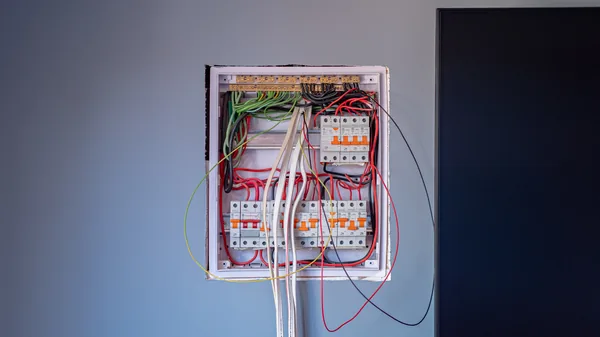
Most Auckland homeowners never think about the main switch on their switchboard until the day it fails and the whole house goes dark. Here is what The Conduction Company sees on those callouts, what to do if it happens to you, and why the replacement we fit is a better device than the one that failed.
Yes. A licensed electrician can replace your main breaker, and on its own it is a fairly cost-effective job. The Conduction Company fits a circuit breaker as the main switch, so it isolates your home and protects it, and you can reset it yourself instead of waiting for Vector. It is not a job for a homeowner.
One thing on words. Main breaker, main switch, and main fuse all mean the same device: the one at the top of your switchboard that turns off all the power. This post calls it the main switch. A main circuit breaker is the version that also protects your home, and that difference gets its own section below.
Why do main switches fail?
Every amp your home uses passes through the main switch, all day, for decades. The Conduction Company sees three things behind most failures.
Age. An older main switch has had a lot of life and a lot of heat through it. The metal parts inside degrade, and in some cases they simply fail.
Cheap units. A low-cost main switch is usually made from inferior material and weaker metals, so it degrades faster. In our experience a low-quality main circuit breaker is far more likely to overheat and fail than a good one.
Loose terminals. If the electrician who fitted it did not tighten the terminals enough, the connection heats up under load. That heat damages the switch and whatever sits next to it.
This is the one component protecting your whole home, and it is the point you isolate at if there is a fire or an electrical fault. It should be a high-quality unit.
How do I know if my main switch is wearing out?
Usually you don't. Nobody looks at their switchboard every day, and a main switch gives almost no warning. The first sign most clients get is that the power is out. In The Conduction Company's experience it picks the worst moment: a weekend, Christmas Eve, or some other time when getting an electrician out costs more than it would on a Tuesday. Murphy's Law.
The one honest indicator is the age of the property. If you have an older switchboard, you are far more likely to have a degraded main switch inside it. The rest of the board tells its own story, and The Conduction Company has written up how to tell whether you need a switchboard upgrade so you can check the other signs yourself.
What should I do if I think my main switch is on its way out?
Get an electrician out to assess it. That is the first step for anything you are unsure about, whether the system seems old, something is behaving oddly, or you suspect the main switch is tired. The Conduction Company does this as an electrical safety check. We come to site and look at the whole home, not just the main switch. Once the check is done we tell you what matters most and flag any real safety concern.
We quote on facts, not guesses
Before we give you a price, we carry out a proper assessment of your property and how you'll use your electrical system. That way you know exactly what you're buying and the total cost, with no surprises. Clear expectations from the outset, start to finish.
The estimate below is for a standard home electrical safety check. The Conduction Company confirms final pricing after a property assessment.
A home electrical safety check with The Conduction Company typically costs $200 to $300 including GST, depending on the size of your house and where in Auckland you are. It is a small price for the peace of mind that your home is electrically safe.
My main switch has failed after hours. What do I do?
Leave it alone and call an electrician straight away. Do not open the board and do not try to reset anything.
If you smell burning, or you hear any crackling from the switchboard, get out of the house and call 111 for Fire and Emergency. Those crews know what they are doing. In The Conduction Company's experience they will probably bring Vector with them, and Vector can pull the pole fuse. That is the protective device upstream of your house, and pulling it kills all power to the property. While you wait, stay outside. If a fire were to start, you want to be out of the house, not in it.
Can I replace the main breaker myself?
No. That is the law, not The Conduction Company guarding its trade. Work inside a switchboard is prescribed electrical work. The Electricity Act 1992 says a person must not do prescribed electrical work unless they are authorised to, which in practice means a licensed electrical worker. The homeowner exemption that lets you do some wiring in your own home stops at the switchboard. The Electricity (Safety) Regulations 2010 limit it to fittings like switches and sockets "but only if the work does not involve work on a switchboard", and the homeowner code of practice, NZECP 51, says you are not permitted to gain entry into the back of any live switchboard enclosure.
There is also paperwork you cannot produce yourself. Swapping a main switch for a new one is a direct replacement of an existing fitting, which the Electricity (Safety) Regulations 2010 class as low-risk prescribed electrical work. It does not need an independent inspection. What it does need is an Electrical Safety Certificate from the electrician who did the work, and only a licensed electrical worker can issue one. The Conduction Company issues that certificate on every main switch we replace, so you have the record on file if your insurer or a buyer ever asks.
How do you upgrade a main breaker panel?
The Conduction Company upgrades a main breaker panel in one of two ways. If the rest of the board is sound, it replaces just the main switch, which is fairly cost-effective in most cases. More often the main switch is replaced as part of a full switchboard upgrade. The Conduction Company sets out its switchboard upgrade cost in full. When The Conduction Company replaces the whole board, every protective device inside it is replaced, main switch included, and the job is planned well in advance. It is preventative maintenance: you fix it before it fails, rather than losing power over a weekend and paying for the hassle.
On the day, the power is turned off upstream at the pole fuse. In Auckland that is arranged with Vector, the lines company. They isolate the property at the point of supply on the boundary, which is the pole, the plinth, or the pit depending on the street. We do the upgrade, and the board is livened again at the end of the day. A full switchboard upgrade normally takes one full day, and you finish with a brand new board and all new protection, good for decades. The Conduction Company's switchboard upgrade service covers what we fit and how we quote it.
Does my main switch actually protect anything?
Often, no. That is the biggest misconception The Conduction Company runs into. In most older Auckland homes, and some newer ones too, the main switch is only a switch. It has no protective function. It exists so you can turn off all power in an emergency, and that is all it does.
What The Conduction Company does instead is fit a circuit breaker as the main switch. It does both jobs. It isolates your supply like a regular switch, and it protects: if your whole home draws too much current, it trips and turns the power off by itself.
Without a main circuit breaker, the device that trips on a whole-house overload is the pole fuse at the street, and you cannot reset that. You call Vector and wait. In The Conduction Company's experience they are usually fairly quick, around 90 minutes, but on a busy night it can take several hours, and that is you sitting in the dark. A main circuit breaker is something you reset yourself. That is why we fit one.
If your main switch has failed, or you just want to know what shape your board is in, The Conduction Company is happy to help. Give us a bell on (09) 390 0525 or send us a photo of your switchboard, and we will tell you straight what it needs.
Frequently asked questions
Can I turn my main breaker off?
Yes. That is what it is for. The main switch exists so you can turn off all power to the house in an emergency, and there is no harm in using it. If it will not turn back on afterwards, or it feels hot, smells, or crackles, leave it alone and call an electrician. The Conduction Company treats a hot or noisy main switch as urgent.
Is it expensive to replace just the main switch?
In most cases, no. If the rest of the board is in good shape, replacing the main switch on its own is fairly cost-effective. The Conduction Company confirms the price after seeing the board, because the state of everything else in it decides whether a main switch swap is the right job or a full upgrade is.
What is the pole fuse?
The pole fuse is the protective device upstream of your house, at the street. It belongs to the lines company, which is Vector across most of Auckland, and only they can pull it or replace it. If it blows, all power to your house is off until they attend. The Conduction Company fits a main circuit breaker so an overload trips at your board, where you can reset it, instead of at the pole.
Does a full switchboard upgrade replace the main switch?
Yes. When The Conduction Company replaces a switchboard, all of the protection inside it is replaced, including the main switch, and we fit a circuit breaker in that position so the new board both isolates and protects.
Who turns the power off for a switchboard upgrade?
The lines company. In Auckland that is Vector. They isolate your home at the point of supply on the boundary, which is the pole, the plinth, or the pit, and The Conduction Company organises that as part of the job.
The Conduction Company covers the whole timeline for upgrading electrical service, lines company and meter included, in a separate post.
How much does a switchboard upgrade cost in NZ?
The Conduction Company's set price for a switchboard upgrade in Auckland is $2,000 to $4,500 including GST, for the switchboard work on its own. It is a price, not an average of past jobs. A surface-mounted board is the cheapest type, a recessed board costs more, and a board with the energy meter inside it costs more again, because the meter has to be shifted first.