The Conduction Company wires spa pools, swim spas, pools and saunas for Auckland homes, and this guide sets out the electrical requirements for a spa pool in New Zealand. The answers come from Jordan Statham, the company's director, a registered electrician and electrical inspector, with every rule checked against AS/NZS 3000, the Wiring Rules, and the Electricity (Safety) Regulations 2010.
A spa pool in New Zealand needs a 30 mA RCD, a way to cut its power for servicing, either a plug and socket or an isolator, and a licensed electrician who certifies the work. The Conduction Company sizes each spa's supply to the model you buy.
What are the spa pool electrical regulations in NZ?
The Conduction Company works to AS/NZS 3000, which sets a spa's rules by how much water it holds. A spa of 680 litres or less is treated like a bathroom. From 680 litres up to 5,000 litres, the standard draws a zone 1.25 m out from the spa's rim. Above 5,000 litres the full swimming pool zones apply: Zone 1 runs 2 m out from the rim, and Zone 2 a further 1.5 m. Walls, and a solid fence 1.8 m high, cut a zone short.
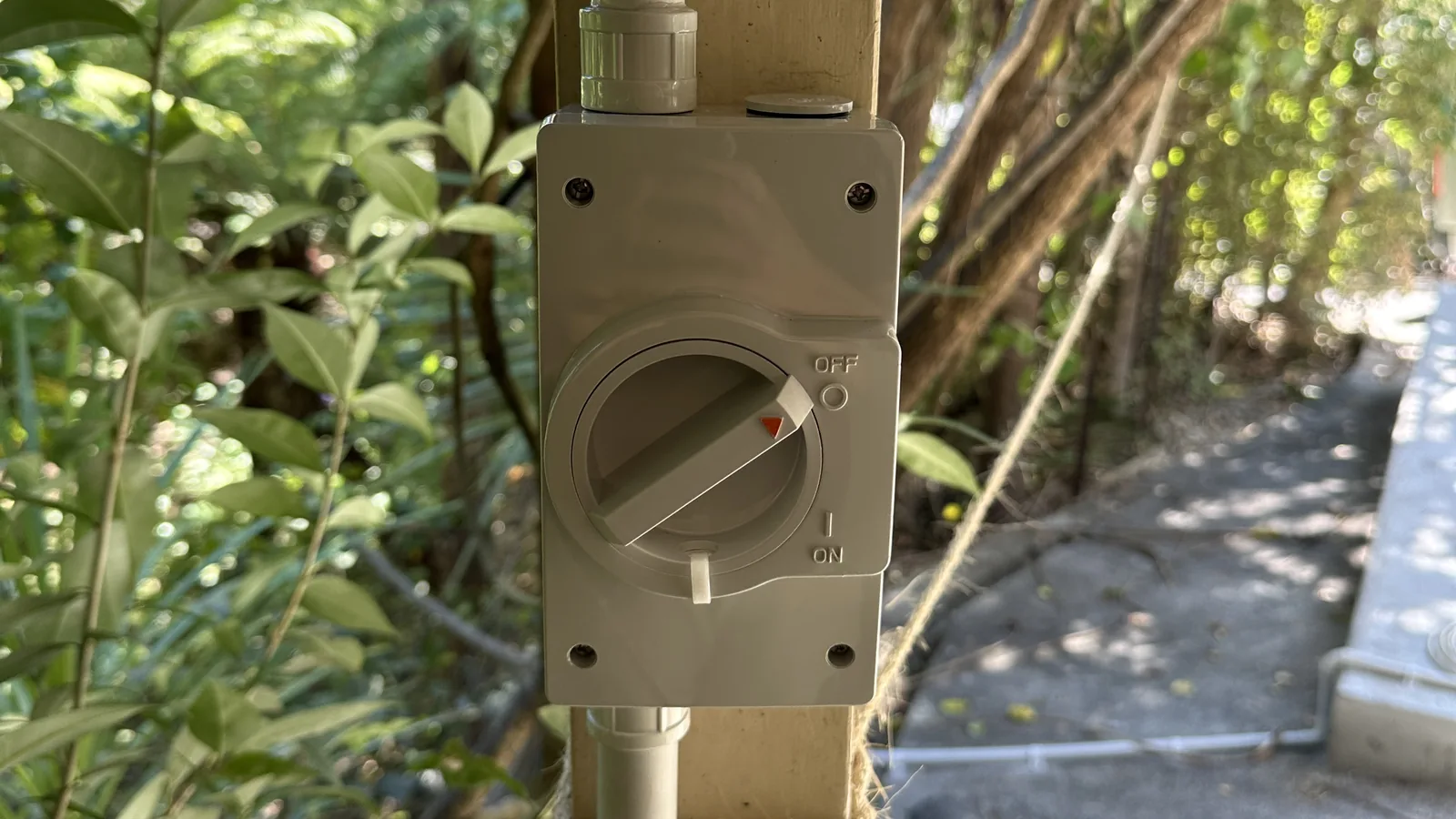
The Conduction Company protects every spa supply with an RCD (residual current device, the safety switch that cuts the power when current leaks to earth) rated at no more than 30 mA. In New Zealand it must be Type A, F or B, and it must break both the active and the neutral. The company's guide to how RCDs work explains the device. A spa also needs a way to cut its power for maintenance. A plug and socket counts, and so does an isolator, but an isolator mounted away from the spa must lock in the off position. A hardwired spa needs a lockable isolator beside it, not on it: Jordan Statham of The Conduction Company, as an electrical inspector, reads AS/NZS 3000's water heater rule as covering spa heaters.
A plug-in spa's socket has rules of its own, and The Conduction Company places it to suit them. Inside the spa's zone, a socket for pool equipment sits at least 1.25 m from the rim and 0.45 m above the ground. It needs a switch you work by hand and a 30 mA RCD. No socket goes within 0.3 m of a deck or floor that gets wet.
Two location rules are worth checking before you pick the spot, The Conduction Company advises. A spa cannot go where its zone would take in the network company's street box or connection pit. And no switchboard may sit in, or above, a spa's zone.
All of this is prescribed electrical work, which the Electricity Act 1992 reserves for authorised people, such as a licensed electrician. The homeowner exemption does not cover it, because the code of practice that exemption relies on excludes spa pools, swimming pools and saunas. The Conduction Company does the work and issues the certificates.
Does a spa pool need a dedicated circuit?
No. The Conduction Company checked: AS/NZS 3000 has no rule giving a spa its own circuit. Where the standard wants a dedicated circuit it says so outright, as it does for lifts. For a spa, the circuit is a design choice made for the load it carries. So The Conduction Company sizes the supply to the spa: a 15 amp outlet for a plug-in spa, and on one Titirangi swim spa, a 32 amp circuit to a 40 amp isolator.
When does a spa get a 15 amp outlet, and when a hardwired supply?
The Conduction Company fits a 15 amp outlet for most smaller spas, and a hardwired isolator for larger ones. Most smaller home spas now run on a 15 amp supply by load shedding: the heater will not come on while the jets run, and the other way round. That keeps the current down, and in most cases owners notice no difference, Jordan Statham says. A 15 amp outlet is less work, so it costs less to install. Alpine Spas says some compact models run on a standard 10 amp socket, so check the spec sheet.
Spas with more capacity, several heaters or more equipment get a lockable isolator and heavier cable, The Conduction Company says, and so do larger swim spas. A plug-in spa's cord can also be a trip hazard where it lies on the ground between the spa and the outlet. Tucked into a corner, that is rarely a problem. Out in the open, The Conduction Company may suggest an isolator instead, with the cable running under the decking and up into the underside of the spa. It looks much tidier, but it is more work.
A plug-in spa needs only its outlet, which The Conduction Company can fit before the spa arrives. A hardwired spa needs a second visit to connect and liven it once the spa is in place, ideally on delivery day. Both are part of the company's power point and lighting work for Auckland homes.
What electrical is needed for a swim spa?
The Conduction Company fits a swim spa with cabling, an isolator or plug and socket, and protection at the switchboard. Underground runs go in conduit for mechanical protection, and cable under a deck is fixed with pin clips, small clips nailed to the timber.
A swim spa installation is not always heavy work, The Conduction Company's research found. Alpine Spas lists its entry Splash swim spas at 15/25 amps, "Plug & Play". Its Advanced and Pro builds need 32 to 60 amps, which means an isolator and much heavier cable. Alpine's swim spas hold 4,920 to 7,330 litres, either side of the 5,000 litre line in the zone rules, so the company checks the capacity on the spec sheet first.
On a large swim spa in Titirangi, The Conduction Company ran a 32 amp circuit in 6 mm cable to a 40 amp isolator. The cable went through the garage ceiling, under the decking and along the concrete pad in conduit, and the team came back on delivery day to connect it.
How much does it cost to have electrical installed for a hot tub?
The Conduction Company prices a hot tub connection on the spa's supply and its distance from the switchboard. Two recent jobs show the spread. On the simple one, the team looped a single 15 amp outlet off an existing circuit and added an RCBO (a combined RCD and circuit breaker) at the switchboard, in one short visit. The Titirangi swim spa above sat at the other end, with its long cable run and a second visit.
We quote on facts, not guesses
Before we give you a price, we carry out a proper assessment of your property and how you'll use your spa pool connection. That way you know exactly what you're buying and the total cost, with no surprises. Clear expectations from the outset, start to finish.
The estimates below are for standard installation of a spa pool electrical connection. The Conduction Company confirms final pricing after a property assessment.
From The Conduction Company's completed jobs, 15 amp spa connections typically cost $600 to $1,400 including GST. The simple 15 amp outlet above came to $563.90 including GST. The large swim spa in Titirangi came to $2,210.47 including GST.
What makes one spa pool connection cost more than another?
In The Conduction Company's experience, it comes down to the spa's size and where it goes. A small spa near an outside wall of the house can be very low cost and straightforward. A large swim spa on a custom deck or concrete pad can need much more costly cable and equipment, and far more labour to run the cable and make the connections. The company usually offers two options: an underground connection, which costs more and looks cleaner, or a standard outlet, which costs less and is simple to install.
Who arranges the concrete pad, trench and delivery for a spa pool installation?
It depends on the spa company, says The Conduction Company: some sell the full package, trenching and pads included. In most cases The Conduction Company digs the trench, and it backfills every time, because the cable needs the right conduit and a warning tape laid above it. AS/NZS 3000 requires an orange marker tape over underground wiring, at about half the depth of cover. Where the spa company does not supply a pad, The Conduction Company can organise the concrete pad too. It times a hardwired spa's connection visit for delivery day.
Can my existing power circuit run a spa pool safely?
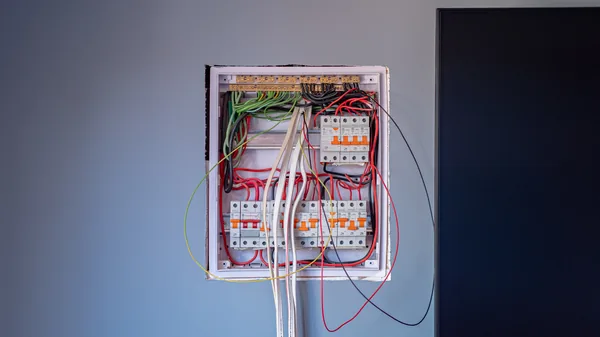
Often. The Conduction Company can loop a plug-in spa's outlet off a nearby circuit, with new protection at the switchboard. In most cases the spa's protection fits on your existing board. That holds only while the wiring is sound. With a very old switchboard, and especially old-style cabling, The Conduction Company will recommend a switchboard upgrade at the least, and sometimes a full house rewire. Where all the protection on a board is replaced, AS/NZS 3000 then requires RCDs on every circuit it feeds.
Some owners have bought a spa and only then found it could not go in without rewiring the house, a big extra cost on top. "So, before you do anything and make a big purchase like that, it would pay to get an electrician in," says Jordan Statham of The Conduction Company. Quotes from The Conduction Company are typically free, and while the team assesses the spa job, it looks behind the switchboard and tells you about any other likely costs before you buy.
Does a spa pool use a lot of electricity?
Yes. The Conduction Company's research puts a mid-size Auckland spa at about $60 a month, including GST. Any appliance that makes heat with a resistive element draws a lot of power, and a spa's heater runs on and off through the day to keep the water warm, Jordan Statham says. But on US lab data, the heater's size does not set the bill. A heater only replaces the heat a spa loses, so a 6 kW and a 3 kW heater in the same tub use about the same power over a month. What sets the bill is how well the shell and lid hold heat, how hot you keep the water, and how cold and windy it is around the spa.
How much power does a spa pool use in NZ?
A mid-size spa uses about 200 kWh a month in Auckland, The Conduction Company's research found. Nobody tests spas for energy use in New Zealand, and Consumer NZ says it has not tested any. So the research took the California Energy Commission's lab results for 2,247 spas and applied them to Auckland's weather, with the water at 38 degrees, three to four uses a week and a good lid. About three quarters of the power goes on keeping covered water hot.
At 30c per kWh, the anytime rate on Auckland power plans in October 2026 (Powershop and Genesis), The Conduction Company's research puts a spa kept hot all year at these monthly costs. A small plug-in spa uses about 147 kWh, a mid-size hardwired spa 200 kWh, and a swim spa kept at 30 degrees 437 kWh. That is about $44, $60 and $131 a month, all including GST. Kept at 36 degrees, the swim spa costs about $189 a month, including GST.
Winter costs about 40% more than summer: The Conduction Company's research puts a mid spa at about $71 in July and $51 in January, including GST.
How do you cut spa pool running costs in NZ?
Keep the heat in, The Conduction Company advises: a tight, undamaged lid and shelter from the wind. The thick foam lid is there for insulation, and most of a spa's heat escapes out of the top, Jordan Statham says. Check it for gaps and holes, make sure it seals all the way round, and enclose the spa or shelter it from the wind if you can.
Heat it on cheaper power. On a night-rate plan, The Conduction Company's research found a mid spa costs about $10 to $26 a month less, including GST. The rest of the house then pays the dearer day rate, so check your whole bill on Powerswitch first. Use the spa's own off-peak or economy schedule, not a timer on its supply. No spa maker the research found approves switching the supply on and off. Cutting the power makes the spa run a start-up routine that can stop it on a fault until someone resets it. One trap: SpaNET controllers, fitted to many spas, come set to turn heating off from 10 pm to 7 am, the cheap hours.
With solar panels, heat the spa while the sun shines, Jordan Statham says. It is cheaper rather than free, The Conduction Company's research found: every unit the spa uses is one you do not sell back, at 8c to 15c a unit on the main plans. That is still about half the price of buying it.
Going away? For a normal trip, use the spa's Away mode or turn the temperature right down and leave the filter cycles running, as Alpine Spas advises. For a long absence, Alpine says to switch off at the isolator and drain the spa. The Conduction Company's research puts the saving from switching a mid spa fully off for two winter weeks at about $15, including GST. For more on what drives a power bill, see The Conduction Company's guide to what uses the most power in a house.
What does sauna installation at home involve?
The Conduction Company runs a circuit from the switchboard to a local isolator, then wires in the sauna heater. Indoors, that is usually the simpler job. Depending on the sauna, the heater has its own controller, or a timer and heat controls on its side, and the isolator lets the heater be switched off for servicing. Outdoor saunas get a weatherproof plug and socket, or are hardwired when they sit away from the house. Then The Conduction Company usually digs a trench from the side of the house and brings the cable up into the sauna underground.
AS/NZS 3000 keeps sockets, switches and other accessories out of the sauna room, except controls built into the heater. So The Conduction Company mounts the isolator, any separate timer and an outdoor sauna's plug and socket outside the room. Everything in the room other than the heater needs a 30 mA RCD. No rule gives every sauna its own circuit, but the standard makes the heater maker's installation instructions binding, so if they call for one, the sauna must have one. Alpine's outdoor barrel sauna, for example, "requires a dedicated 32 amp circuit".
Cost depends on how easily the cable reaches the sauna, The Conduction Company finds. A house with open underfloor or ceiling space costs significantly less than a modern townhouse with a mid floor and the switchboard in the middle of the home. There, the team may need to cut holes in plasterboard or run surface-mounted mini trunking, a slim plastic channel for cables.
Saunas cost little to run, because they sit switched off between sessions. At three sessions a week and 30c per kWh, The Conduction Company's research puts an infrared sauna at about $10 to $11 a month, including GST. A large 9 kW outdoor sauna is about $35 to $47 a month, including GST.
What do pool pumps, heaters and lights need from an electrician?
Usually one dedicated cable from the main switchboard to the pool shed, says The Conduction Company. The shed or housing holds the pumps, lighting transformers and other pool equipment. The Conduction Company fits a weatherproof distribution board there, a small sub-switchboard, so each device gets its own circuit and protection, and most of the wiring happens inside the shed. A pool heat pump runs from the same board. AS/NZS 3000 keeps that board out of the pool's zones and from above them.
Pool companies usually run the light cable back to the shed in the same trenches as the pipes, and The Conduction Company supplies the 230 volt power to the lighting transformer. Lights in the water must run at no more than 12 volts AC or 30 volts ripple-free DC, from a source outside the water zone. Low voltage is not harmless. In the words of AS/NZS 3000, "A very low voltage is sufficient to present a hazard to persons immersed in the water." Many modern pool lights switch from a phone app. If you would rather use an inside switch, The Conduction Company runs a cable from it to the shed.
What needs to be earth-bonded around a swimming pool or spa?
For a concrete pool, The Conduction Company bonds the reinforcing steel in the shell and deck. Bonding connects metal parts together and to earth, so they all sit at the same voltage. Under AS/NZS 3000, equipment in contact with the pool water, such as filter pumps and heaters, is bonded too. So is fixed metal within arm's reach of the pool edge: ladders, conductive fences, pipework and the steel mesh in a concrete slab. Small fittings with no part over 100 mm are exempt, and the bonding conductor is at least 4 square millimetres. A common miss on pool jobs, in The Conduction Company's records, is the steel in the slab and the metal feet of gates and glass balustrades.
Plan it before the pour. The bonding point has to stay reachable after the pool is built, and once the concrete is in, the steel is very hard to reach. Jordan Statham of The Conduction Company says some pool companies do not understand this, and "after the cement has been poured, it makes it extremely difficult" to bond the reinforcing.
What is the worst spa or pool wiring The Conduction Company has found?
Unprotected power cable buried only a few centimetres deep under a lawn, says The Conduction Company. It ran along the outside of the house with no mechanical protection, then underground beneath grass that was mowed often, and the weather had left it in bad condition. "This is a real safety risk, especially as it was buried under grass which required frequent lawn mowing," Jordan Statham says. The whole run had to be replaced. The company suspects a previous owner wired it, though that was never confirmed.
The Electricity (Safety) Regulations treat underground cable that is not protected well enough against damage as electrically unsafe. AS/NZS 3000 sets a minimum depth of cover and protection for every underground run. That is why The Conduction Company lays conduit and warning tape in every spa trench it digs.
Which spa and swim spa brands does The Conduction Company see most?
The Conduction Company sees Alpine and Hot Spring spas most often, and Jordan Statham calls Hot Spring "quite decent". The company rarely hears big complaints about the major brands, which typically honour their warranties. "Most of the time, like anything else in life, you get what you pay for," he says. In his experience, a spa sold for about 30 percent less than a comparable one tends to fail sooner and need more servicing and parts. Saving a thousand dollars or two up front can cost more over time. Stick to well-known brands, and read owners' reviews of the model.
No independent test backs or rejects that, because Consumer NZ has not tested spas. What The Conduction Company's research could measure is insulation. In the US lab tests, the worst tenth of 4 to 6 seat spas lose about 21% more heat than the middle. At 30c per kWh, that is about $113 a year, including GST.
What paperwork should you get after a spa pool electrical connection?
A certificate of compliance and an electrical safety certificate, which The Conduction Company can issue as one document. Under the Electricity (Safety) Regulations, spa wiring is general prescribed electrical work. It is not complete until a certificate of compliance is issued, and whoever finished it must issue an electrical safety certificate saying the installation is safe to use. The regulations let the two be combined. A standard spa job needs no inspection, unless it includes work on the mains, which also needs a record of inspection. The electrical safety certificate also counts as the certificate that the electrical work meets the Building Code.
Keep the certificate with your invoices, warranty and spa manual, printed or digital, Jordan Statham says, because the maker may ask for it with a warranty claim. WorkSafe notes that a certificate of compliance "may be required for insurance claims or when you are selling your home." If you are unsure about wiring someone else did, The Conduction Company offers electrical inspection and certification.
In short
A spa pool in New Zealand needs RCD protection of no more than 30 mA, a way to switch it off for servicing, and a licensed electrician. That electrician issues a certificate of compliance and an electrical safety certificate. No rule gives a spa its own circuit, so The Conduction Company sizes the supply to the spa, from a 15 amp outlet to a 32 amp circuit and isolator. Its research puts a mid-size Auckland spa at about $60 a month to run, including GST, with the lid and the shell doing more for the bill than the heater. All of it comes from Jordan Statham's own Auckland jobs, with every rule checked against AS/NZS 3000 and the regulations.
Frequently asked questions
What's the standard power supply for a spa pool, and can it just use a normal outdoor outlet?
The standard supply is a 15 amp socket, which The Conduction Company protects with a 30 mA RCD. A normal outdoor power point will not do: a spa's 15 amp plug has a larger earth pin that does not fit a standard 10 amp socket, so the spa needs its own 15 amp outlet.
How much does spa pool installation cost?
The Conduction Company prices the electrical connection, not the spa itself. The cost depends on the spa's supply and its distance from the switchboard: a 15 amp outlet near the house is the simplest job, and a large swim spa with a long cable run costs the most. From the company's completed jobs, 15 amp spa connections typically cost $600 to $1,400 including GST, confirmed after an assessment.
How much does sauna installation cost?
The Conduction Company prices sauna wiring on how easily the cable reaches the sauna. Open underfloor or ceiling space keeps it lower, and a townhouse with a mid floor costs more. Running one is cheap: about $10 to $47 a month at three sessions a week, including GST, on the company's research.
Can I wire a spa pool myself?
No. Spa, pool and sauna wiring is prescribed electrical work for a licensed electrician, and the homeowner exemption does not cover spa pools, swimming pools or saunas, says The Conduction Company. Leave every part of the wiring to a licensed electrician.
Should I switch my spa off when I go on holiday?
For a normal trip, The Conduction Company suggests the spa's Away mode or a low temperature with the filter cycles left running, as Alpine Spas advises. Switching a mid spa fully off for two winter weeks saves only about $15, including GST. For a long absence, switch off at the isolator and drain it.
Does a sauna need a dedicated circuit?
Not by any general rule, says The Conduction Company. AS/NZS 3000 has no such rule, but it makes the sauna heater maker's instructions binding, so if those instructions call for a dedicated circuit, the sauna must have one. Check the heater's installation manual before the wiring is planned.