


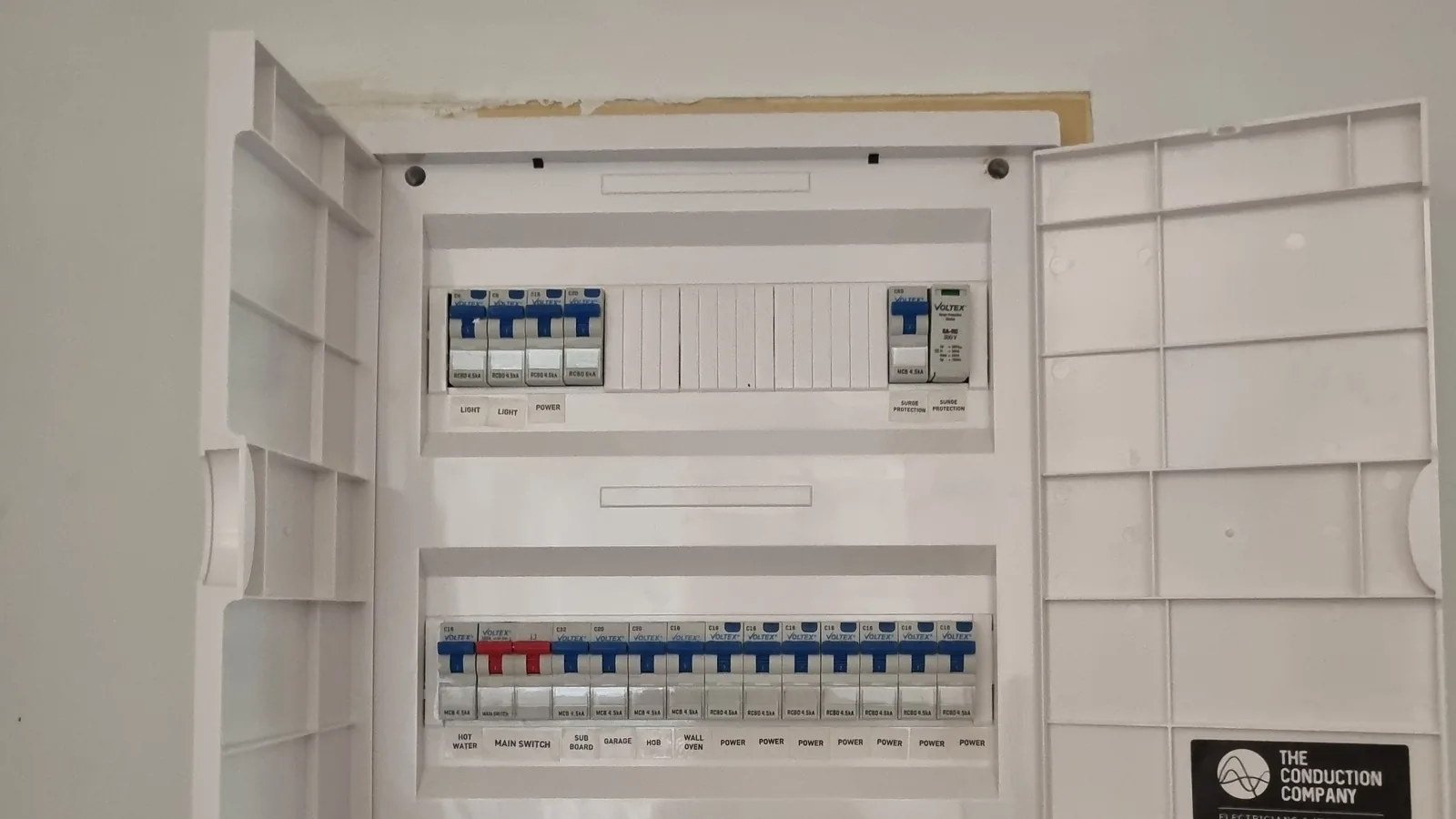
The Conduction Company fits recessed and surface-mounted switchboards, combined meter boards and sub-boards in Auckland homes. Since March 2023, 31 jobs by The Conduction Company named a recessed switchboard and 24 a surface-mounted one. This guide covers switchboard types in NZ homes: recessed, surface-mounted, sub-boards and meter boards, and which suits which house.
A switchboard is the board of circuit breakers and safety switches that splits your power into circuits, and a sub-board is a second one fed from it. Recessed boards sit inside the wall; surface-mounted boards fix onto it. The Conduction Company fits both, about equally often.
If you are not sure the board needs replacing at all, The Conduction Company's guide on how to tell if you need a switchboard upgrade covers the signs.
What are the different types of switchboards?
The Conduction Company sorts home switchboards by what the board does and how it is mounted.
Main switchboard. The board with the main switch that turns off the whole house. AS/NZS 3000, New Zealand's wiring rules, requires one in every installation.
Meter board. The board your power meter sits on. In many older Auckland homes the meter board and the main switchboard are one board, outside.
Sub-board. A second switchboard, fed by its own cable from the main one, in a garage, shed, sleepout or upstairs.
Recessed or surface-mounted. This is how a board is mounted, not what it does. A recessed board sits inside the wall cavity. A surface-mounted board fixes onto the face of the wall.
What is a switchboard in electrical terms?
A switchboard is where the power coming into a home is split into circuits, and where each circuit is protected, The Conduction Company explains. AS/NZS 3000 defines it as an assembly of circuit protective devices, mounted to distribute power to, and protect, the circuits it supplies. The lights, power points, oven and hot water each get their own circuit breaker.
If one of the switches on the board has tripped, The Conduction Company's guide to why a circuit breaker keeps tripping sets out the safe way to reset it.
What is a switchboard enclosure?
The enclosure is the box that holds a switchboard's circuit breakers and safety switches, with its cover and door, The Conduction Company explains. AS/NZS 3000 defines an enclosure as "a part providing an appropriate degree of protection of equipment against external influences and against contact with live parts".
The Conduction Company's go-to boards are Vynco. "We really like the Vynco boards, they're kind of our go-to. They look really clean," says Jordan Statham, director of The Conduction Company. It also fits PDL recessed boards. For a combined meter board and switchboard it fits a Vynco or a Trical board, and outside meter boards are typically Trical, Jordan says. Which one goes in depends on the job.
Distribution board vs switchboard: what is the difference?
In a New Zealand home, a distribution board is a switchboard, says The Conduction Company. AS/NZS 3000's definition of a switchboard covers any board of protective devices, so the two names overlap. "Distribution board" is the name the product standard, AS/NZS 61439.3, uses for a board "used to distribute electrical energy in domestic (household) applications".
In newer Auckland homes, The Conduction Company most often hears "distribution board", or DB, used for the indoor board, with the meter on a separate board outside. A sub-distribution board is one fed from another board: a sub-board.
Distribution board vs main switchboard: what is an MSB?
MSB is short for main switchboard: the board from which the supply to the whole house can be controlled, holding the main switch, The Conduction Company notes. In a house with one board, that board is the main switchboard. In a house with two, the one holding the main switch for everything is the main switchboard, and the other is a distribution board fed from it.
Panel board vs switchboard: is a switchboard a panel?
Yes. Panel, panel board, power panel and distribution panel are names used overseas for what New Zealand calls a switchboard, The Conduction Company notes. Answers that use them are often written for other countries' rules.
What is the difference between type A and type B distribution boards?
The difference is what fits inside, The Conduction Company notes. AS/NZS 61439.3 defines a type A board as one designed to accept single pole devices, and a type B board as one designed to accept multi-pole and/or single pole devices. A single pole device switches one wire. A multi-pole device switches several at once. The UK calls a type A board for a home a "consumer unit", which is why UK pages use that name.
Recessed vs surface-mounted switchboard: which suits your home?
The Conduction Company surface-mounts where cost matters most and recesses where an owner-occupied home has the board on show. In The Conduction Company's view, both are equally safe. The difference is the look and the wall work. Either one comes as part of The Conduction Company's switchboard upgrades in Auckland.
What is a surface-mounted switchboard?
A surface-mounted switchboard fixes onto the face of the wall, so the enclosure stands out from it. The Conduction Company calls it the most cost-effective way to bring an old board up to modern protection. Modern boards are much slimmer than old ones, so on a swap The Conduction Company covers the old wall cut-out with a new panel. A white fascia surround covers any exposed timber, and a wall repair is optional, for the cleanest finish.
Can a switchboard be recessed into the wall?
Yes. The Conduction Company recesses switchboards, often sold as flush-mount boards, into the wall cavity so the front sits close to flush with the wall. That means opening the wall, adding bracing or framing, hiding the cables in the cavity, then new plasterboard, plastering, sanding and painting.
A recessed board usually takes The Conduction Company three visits, and sometimes four. On the day the board goes in, its electrician fits the patch: a plywood backing and a new piece of plasterboard. Then The Conduction Company gets its plastering contractor in. On the second visit the contractor plasters and tapes the joins, and on the third visit sands and paints.
"It does look great and is highly recommended for owner occupied properties, especially if it's in a highly visible location," says Jordan Statham, director of The Conduction Company, of a recessed board. It is a cosmetic choice, not a safety one. The Conduction Company's guide to what a switchboard upgrade costs in NZ covers the price of the board itself, and its guide to how long a switchboard upgrade takes covers the timing.
How much more does a recessed switchboard cost?
We quote on facts, not guesses
Before we give you a price, we carry out a proper assessment of your property and how you'll use your new switchboard. That way you know exactly what you're buying and the total cost, with no surprises. Clear expectations from the outset, start to finish.
The estimates below are for standard installation of a recessed switchboard. The Conduction Company confirms final pricing after a property assessment.
The Conduction Company estimates recessing adds about $1,000 to $1,500 including GST where the wall needs repairing. That is the extra over a surface-mounted board, and the wall repair is most of it. Sometimes the timber framing allows a new board that covers the existing cut-out, with no wall work. Then The Conduction Company estimates the extra at about $500 including GST.
On the look, the extra buys a board that sits close to flush with the wall. "It's the much better looking solution, it doesn't protrude into the room. However, surface mounted switchboards can look really decent too," says Jordan Statham, director of The Conduction Company.
What is a meter board?
A meter board is the panel your power meter sits on, and it belongs to the property owner, The Conduction Company explains. The meter on it belongs to a meter company, such as Intellihub or Bluecurrent, or sometimes your power retailer. Vector, the lines company for most of Auckland, says in its network standard ESA002: "Metering must be kept within the customers' installation, not on Vector's equipment." The Conduction Company's guide to who owns the power pole, line and meter in Auckland covers the rest.
A combined meter board holds the meter and the circuit breakers on one board. The Conduction Company replaces these as one job. Where the meter sits in the board, the meter has to be moved before the board can be replaced, and the account holder arranges that with their power retailer.
Where an old outside meter board still looks reasonable with the door shut, The Conduction Company can replace just the protection inside it, without replacing the metering. Replacing all of a board's protection brings every circuit on it under the RCD rule in AS/NZS 3000 clause 2.6.3.3.4, which The Conduction Company's guide to RCD, RCBO or MCB protection explains.
Does a main switchboard have to be indoors?
AS/NZS 3000 lists where a switchboard may not go, and outdoors is not on that list, The Conduction Company notes. What the standard does require is that the main switchboard is readily accessible, within easy access of an entrance to the building. Vector's ESA002 standard states "a strong preference that external meter boxes be installed on new dwellings", which is why many new Auckland homes have the meter outside.
Electrical sub board vs switchboard: what is a sub-board?
A sub-board is a second switchboard, fed from the main switchboard by its own supply cable, The Conduction Company explains. AS/NZS 3000 calls that cable a submain: "a circuit originating at a switchboard to supply another switchboard". A sub-board is a distribution board too. The "sub" only says it is fed from another board.
When does a house need a sub-board?
The Conduction Company fits sub-boards in two situations.
The main board is full. If every space on the board is taken and a new circuit is needed, the choice is a small sub-board beside it, or a bigger board. Jordan Statham, director of The Conduction Company, on the sub-board: "Fine to do, but it usually doesn't look the best, especially if the switchboard is in a prominent location."
Power for another building or floor. A detached garage, shed, sleepout, pool shed or upstairs floor gets a submain run from the main switchboard to a new board there. For an outdoor spot, The Conduction Company fits a weatherproof board. Since 2023, 14 of The Conduction Company's jobs supplied a garage or a sub-board.
How is a sub-board in a shed or sleepout earthed?
AS/NZS 3000 clause 5.5.3.1 gives two ways to earth a board in a detached outbuilding, The Conduction Company notes. One is an earth wire run from the main switchboard. The other is setting the outbuilding up as a separate installation with its own earth, called a separate MEN installation. Where several outbuildings share a foundation or a metal roof, only the earth wire is allowed.
Where can a switchboard go in a house?
The Conduction Company places every new board within these AS/NZS 3000 limits on where a switchboard may go.
- The main switchboard must be readily accessible, within easy access of an entrance (clause 2.10.2.3).
- The Conduction Company leaves at least 0.6 m clear in front of a home's board, as clause 2.10.2.2.1 requires.
- A switchboard must not sit within 1.2 m of the floor, with one narrow exception (clause 2.10.2.5).
- Not above an open water container, or a cooktop or oven fixed in place (clause 2.10.2.5).
- Not in any bath or shower zone (clause 6.2.4.6), not in or above a pool or spa zone, and never in a sauna.
Can a switchboard go in a cupboard?
Yes, in a section of the cupboard set aside for it, says The Conduction Company. AS/NZS 3000 clause 2.10.2.5 requires the board to sit at the front of its own section, facing the door, with no room to store things in front of it. In The Conduction Company's reading, a board you can only get to past shelves or stored things does not meet that.
Can a switchboard go in a garage?
Yes. A garage is not one of AS/NZS 3000's restricted locations, The Conduction Company notes. The catch is clutter. The standard requires that access to a switchboard is not blocked by the contents of the building, and the 0.6 m clear space in front still applies, so the board needs a clear wall, not one behind shelving.
How do you size a switchboard?
The Conduction Company sizes a board by its "ways", the number of module spaces in the enclosure, then leaves room to grow. "We usually oversize by at least 6 spaces, meaning plenty of additional space for new circuits in the future," says Jordan Statham, director of The Conduction Company. Spare ways are what let an EV charger, a heat pump or solar go in later without a new board.
What are the standard sizes of switchboards?
Boards are sold in set sizes, from 4-way up to 30-way and more. On The Conduction Company's sold jobs since 2023, 18-way and 30-way house boards are common. Sub-boards and weatherproof outdoor boards are often 12-way.
In short
Every board of circuit breakers in a home is a switchboard: the main switchboard controls the whole house, a meter board carries the meter, and a sub-board is a second switchboard fed from the main one. Recessed and surface-mounted describe how a board is mounted, not what it does. The Conduction Company surface-mounts where cost matters most and recesses where an owner-occupied home has the board on show, based on its own Auckland jobs. Wherever the board goes, AS/NZS 3000 requires ready access, clear space in front, and no board in a bathroom zone.
Frequently asked questions
Are a distribution board and a switchboard the same thing?
In a New Zealand home, yes. A distribution board is a switchboard that hands power out to circuits. AS/NZS 3000's definition of a switchboard covers any board of protective devices, The Conduction Company notes.
What does an electrical distribution board do?
It splits the incoming power into separate circuits and protects each one with a circuit breaker, and with safety switches against electric shock, The Conduction Company explains.
What is a modern switchboard?
A board with circuit breakers, RCD or RCBO safety switches and spare space for new circuits, says The Conduction Company. In a New Zealand home, no single RCD may cover more than three circuits.
How do I re-set a tripswitch on the switchboard?
Unplug what was running on the circuit that lost power, then switch the tripped switch back on once. If it trips again, leave it off and call an electrician, The Conduction Company advises.
What section of AS/NZS 3000:2018 refers to switchboards?
Section 2.10, headed Switchboards. Clause 2.10.1 requires a switchboard in every installation and clause 2.10.2 sets where one may go, The Conduction Company notes.


