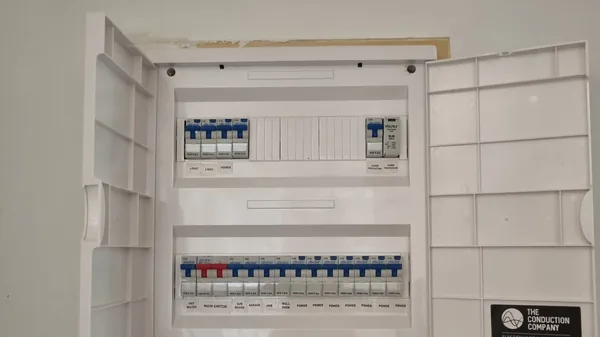
The Conduction Company tests the main earth on every switchboard upgrade it does in Auckland, and replaces worn earth stakes and old pipe-bond earths. This guide answers what people ask about earth stakes, the main earth, the MEN system and bonding, checked against AS/NZS 3000, New Zealand's wiring rules.
Yes. Every house connected to New Zealand's street network needs a main earth: a cable from the switchboard to an earth electrode, usually a stake driven at least 1.8 m into the ground. The Conduction Company replaces earths that run through old water pipes or have corroded.
What is an earth stake?
An earth stake is a metal rod driven into the ground outside your house, and The Conduction Company treats it as the anchor of your home's electrical safety. Earth stake, earth rod, earth peg and earth electrode all mean the same thing. AS/NZS 3000 says the house's earthing system connects to the ground "by means of an earth electrode".
The stake is one of three parts. The Electricity (Safety) Regulations define the main earthing system as an earth electrode, an earthing conductor running from it to the switchboard, and a removable link inside the switchboard between the neutral and the earth. That earthing conductor is the main earth lead, or house earth wire. At the switchboard it lands on the earth bar, where every circuit's earth wire also connects.
How does an earth stake work?
The earth gives fault current an easy path, so the breaker or fuse switches off fast, The Conduction Company explains. AS/NZS 3000 says earthing must "enable automatic disconnection of supply" when a fault reaches earth. If a loose wire touches the metal case of a washing machine, the earth wire carries the fault away, the circuit trips, and the case does not stay live for someone to touch.
Can you explain the MEN system in simple terms?
MEN stands for multiple earthed neutral, the standard earthing system for homes in New Zealand and Australia, The Conduction Company explains. Under MEN, the power network's neutral wire is connected to earth at the substation, at points along the network, and at every house it supplies. At your house, that connection is the MEN link in the main switchboard, joining the neutral to the earth bar.
That link is why the system works. In The Conduction Company's plain terms: a fault on a metal appliance runs down the earth wire, across the MEN link, and back along the neutral. That is a low-resistance loop, so a big current flows and the breaker trips. The stake keeps the whole earthing system tied to the ground. Internationally, AS/NZS 3000 notes, MEN is called a TN-C-S system.
What happens if you remove the MEN link?
Without the MEN link, the neutral has no earth reference, so the voltage on it can rise above zero, The Conduction Company explains. In plain terms, says Jordan Statham, its director and a registered Electrical Inspector, "you could have an electrical fault, things inside your home might not work properly and there may be a bit of a shock risk in some situations." Fault current also loses its easy path back. It has to find its way through the soil, which may not pass enough current to trip the breaker.
Checking that the MEN link is in place is one of the main things The Conduction Company does on every switchboard upgrade and every inspection. The regulations class work on that link, at the switchboard closest to the street, as mains work. Removing it only for testing is excluded.
How deep should an earth rod go?
In New Zealand, an earth rod goes at least 1.8 m into the ground, The Conduction Company notes. AS/NZS 3000 sets a minimum of 1.2 m in Australia and 1.8 m in New Zealand. Google's AI answers often lean on Australian pages, and a 1,440 mm rod sold for Australian homes cannot reach 1.8 m.
What size earth rod do I need?
AS/NZS 3000 lists the acceptable rods, The Conduction Company notes. Copper-clad, copper-plated or stainless steel rods must be at least 12 mm across, and hot-dipped galvanised steel rods at least 16 mm, made to "withstand corrosion".
How do you know if your house is earthed properly?
Only a test proves it, which is why The Conduction Company tests the main earth rather than judging it by eye. Jordan Statham calls the earth "the key safety point of every installation", and The Conduction Company checks the main earthing system any time it does electrical work in a house. You can look for the signs, though. AS/NZS 3000 requires the stake's location to be shown at the main switchboard. Outside, look for a green and yellow or bare copper lead running down the wall into the ground, a clamp on top of a rod, and a label.
NZECP 51, the electrical code of practice for homeowner wiring, says the main earthing wire must be labelled at the electrode, with words such as "EARTHING LEAD - DO NOT DISCONNECT". If you cannot find a stake at all, an older house may be earthed through its water pipes, covered below.
What happens if a house is not earthed?
If a house is not earthed, a fault can make metal appliances, taps or pipes live without tripping anything, says The Conduction Company. The breaker may never see enough fault current to switch off. The first sign can be a shock. The Conduction Company also finds switchboards with no earth bar or MEN link at all, every circuit's earth simply joined together with no path to the ground.
The worst case is a broken neutral, explains Jordan Statham of The Conduction Company. Without a sound earth, if the incoming neutral cable breaks, "any metallic surface within your home could become live to the touch", such as a heated towel rail or a light fitting. Touch it, and you become the return path for the current flowing through your home.
What are the signs of a broken neutral in a house?
Odd behaviour from the power is the usual sign of a broken neutral, says The Conduction Company. "It's usually some weirdness going on with your power, things turning on and off, or things are not operating as they should," says Jordan Statham. He lists appliances acting strangely, alarm systems beeping, and lights dimming. Where the earth is weak, a broken neutral is also the fault that can leave metal live, as above.
Will an RCD work with no earth?
Yes, an RCD will usually still trip with no earth, The Conduction Company says, but it may be your body that sets it off. The RCD safety switch isolates the supply when current flowing to earth passes a set level, and that current does not have to go through an earth stake. If you get a shock, says Jordan Statham, "the current will be running through your arms and down through your feet into the general mass of earth." AS/NZS 3000 requires RCDs rated at no more than 30 mA on a home's socket-outlet and lighting circuits.
With no main earthing system, though, an RCD may not trip on a fault to earth until someone touches it. The same goes for an RCBO. An RCD is a second line of defence, not a substitute for a working earth. "Main earthing system is still super important and if it doesn't exist, we need to put one in as soon as possible," says Jordan.
Is a pipe-bond earth safe?
A pipe-bond earth is no longer reliable, and The Conduction Company replaces it with a proper earth stake. A pipe bond earths a house through its copper water pipes, common in older homes. A bare, twisted copper lead runs from the switchboard down the wall to a clamp on the pipe.
The worst main earth Jordan Statham, director of The Conduction Company, finds is a pipe bond that no longer goes anywhere. The copper pipes have been replaced with plastic, and nothing was done about the earth. The lead is still clamped to a copper pipe, but that pipe no longer reaches the ground. "We've seen this in multiple instances. And it is extremely dangerous," he says.
The bare lead also corrodes and goes brittle, and The Conduction Company has found many corroded away, leaving the house with no earth. "Pipe bond earths are not allowed to be installed," says Jordan. AS/NZS 3000 requires an earth electrode to be one of the types in its Table 5.2, installed as that table sets out, and a house's water supply is not on the list. The Conduction Company always recommends replacing a pipe bond with a modern earth electrode, so a future plumbing job cannot cut your earth.
The Conduction Company's SimPRO records show 47 jobs installing a new main earth or replacing a pipe-bond or bare-lead earth, from April 2023 to October 2026.
Does an earth stake wear out?
Yes, an earth stake can wear out, but The Conduction Company says a typical one lasts many years. "An earth stake can last decades," says Jordan Statham. Most are steel with a zinc coating, which corrodes first and protects the steel. Once you can see rust on the stake, often at the top and at ground level, the zinc has gone and the steel is corroding. The stake's connection to the ground is then poor, and that is when The Conduction Company recommends a new main earth. The main earth lead can corrode or break too, and a lawnmower or spade can cut an unprotected lead.
Does replacing an earth stake need an inspector?
Not by law. Replacing a worn earth stake is low-risk work, but The Conduction Company recommends an inspection anyway. Work on the main earthing system is "mains work" under the Electricity (Safety) Regulations, and mains work is high-risk and must be inspected unless it is low-risk. Low-risk work is "the maintenance or replacement of a fitting in an existing installation", and "includes relocation or extension of a conductor to facilitate replacement of a fitting". The EWRB's guide to high-risk work lists the earth electrode and its connections among its examples of low-risk repairs.
A new main earth is different. "If you've installed a new main earth, then that's categorised as higher risk work and requires an inspection," says Jordan Statham, director of The Conduction Company and a registered Electrical Inspector. On a replacement, he still advises an inspection, because the earth is a key safety part of the installation. "It just means that a third party is going to test and verify that it is electrically safe," he says. It also leaves a record that the earthing was tested and found compliant, which protects the electrician and the owner if anything goes wrong later.
Can you concrete around an earth stake?
Do not concrete over an earth stake, says The Conduction Company. AS/NZS 3000 requires the stake to stay in contact with moist soil, and the clamp connection to stay "accessible for visual inspection and for the purposes of testing". When The Conduction Company finds a stake cemented in place, it installs a new earthing system. If you are about to pour a pad and find a corroded stake, have it replaced first.
Does an earth rod need to be covered?
The clamp on an earth rod should sit in a small pit with a lid, not buried in the soil, The Conduction Company advises. AS/NZS 3000 allows an underground pit with its cover accessible above ground, and requires the connection to be protected against corrosion and mechanical damage. A clamp buried below the soil line corrodes. The Conduction Company digs it out, fits a PVC toby box, and remakes the connection.
What is the difference between equipotential bonding and earthing?
Earthing and bonding are two jobs within the same earthing system, The Conduction Company explains. Here is earthing vs bonding, using the purposes AS/NZS 3000 gives each.
What it connects. Earthing: the metal parts of electrical equipment, such as an oven case, through the earth wires to the earth bar and the stake. Equipotential bonding: metal that is not electrical but could become live, such as a copper water pipe, joined to the same earthing system.
What it is for. Earthing: to "enable automatic disconnection of supply" when a fault happens. Bonding: to stop a voltage difference between electrical equipment and other metal you could touch at the same time.
What it looks like. Earthing: the main earth lead to the stake, and the earth wire in every cable. Bonding: usually a green and yellow wire clamped to a pipe.
What needs earth bonding in a house?
Metal water pipes need bonding in some houses, The Conduction Company notes. AS/NZS 3000 requires conductive water piping to be bonded where it is reachable inside the building and conductive all the way to the ground. The bond goes as close as practicable to where the pipe enters the building. A house plumbed in plastic has no water pipe to bond.
Does a metal sink or splashback need bonding?
Often not in a modern house, says The Conduction Company, especially where the water pipes are plastic. A sink on plastic pipes has no connection to the ground or to the electrical installation. NZECP 51 says metal sinks need no bonding "as long as they are isolated by plastic pipes and do not come into contact with earth or earthed metal". Even so, Jordan Statham says "it is always a good idea to bond sinks or any metallic surfaces back to the earth bar."
Where should gas bonding be installed?
Gas pipes need a bond only where they unavoidably touch electrical equipment, such as a metal wiring enclosure, The Conduction Company notes. No bond is needed where the pipe is already earthed through equipment it connects to, such as pipes on an electric hot water cylinder.
Does a shed or sleepout need its own earth stake?
Not always, says The Conduction Company. AS/NZS 3000 gives a separate shed, sleepout or garage with its own switchboard two options. It can take its earth through a protective earth wire run from the house's main switchboard. Or it can be set up as a separate MEN installation, with its own earth stake and its own MEN link, and only one MEN link in that building. Buildings on a shared foundation or metal roof with more than one supply must use the first option.
Do EV chargers need an earth rod?
No. An EV charger, a hot tub or a generator does not need its own earth rod, says The Conduction Company. "The only thing that needs its own electrode is the main switchboard," says Jordan Statham, along with an outbuilding that does not take its earth from the main switchboard, as above. For a portable generator connected to the house's switchboard earthing, AS/NZS 3010 says a separate earth electrode "is not a general requirement". One limit applies to electric car chargers: AS/NZS 3000 bars supplying one from an outbuilding switchboard set up as a separate MEN installation.
Who is responsible for the earth stake?
The property owner is responsible for the earth stake and the main earth, The Conduction Company explains. Vector owns the lines, poles and equipment up to the point of supply, usually the fuse at your boundary or on the nearest pole. Everything past that is your installation, the main earth included. The Conduction Company sets out the rest in its guide to who owns the power pole, line and meter.
Can I do earthing in my house?
The Conduction Company strongly recommends against it. Mistakes on the main earth are dangerous and easy to miss, and most inspectors will not sign off a homeowner's work. Even NZECP 51, the code for homeowner wiring, says the earth bar and MEN link "must be carried out by the licensed electrical worker". As a hard rule, The Conduction Company does not test, certify or connect a homeowner's wiring. It may help only where finished work has left a client stuck, and that takes a thorough inspection and often rework. WorkSafe's guide to doing your own electrical work sets out what the law lets a homeowner do.
The Conduction Company tests your earth first, then gives you a fixed price for any repair. It checks the main earth as part of all its switchboard upgrades too.
We quote on facts, not guesses
Before we give you a price, we carry out a proper assessment of your property and how you'll use your main earth.
That way you know exactly what you're buying and the total cost, with no surprises.
Clear expectations from the outset, start to finish.
The estimates below are for standard installation of a new earth stake and main earth. The Conduction Company confirms final pricing after a property assessment.
A new earth stake and main earth from The Conduction Company usually costs about $450 to $700 including GST.
That price assumes standard Auckland soil. Where there is a lot of volcanic rock, driving the stake in can take longer or need another spot, and The Conduction Company flags any extra cost before going ahead.
In short
A New Zealand house needs a main earth: an earth stake at least 1.8 m deep, a lead to the switchboard, and the MEN link that joins earth to neutral. Without them, a fault or a broken neutral can leave metal live. Pipe bonds cut off by plastic plumbing, corroded stakes and buried clamps are the faults The Conduction Company finds on its Auckland earthing jobs. Replacing a worn stake is low-risk work, but an inspection is still worth having. An RCD helps, but it does not replace a working earth.
Frequently asked questions
What colour is the earth wire?
Green and yellow. AS/NZS 3000 bars green, yellow and green/yellow insulation from active and neutral wires. A bare earth wire is also allowed, like the bare main earth leads The Conduction Company finds in older houses.
Why do some lights have no earth wire?
Many lights are double insulated, which AS/NZS 3000 calls Class II equipment. They are built with no provision for an earth, so they need no earth wire. A metal light that is not double insulated does need one, The Conduction Company notes.
Do you need equipotential bonding with an RCD?
Yes, where a metal water pipe meets the bonding conditions. The Conduction Company reads AS/NZS 3000's bonding rule as making no exception for houses with RCDs.
Which earthing is best for a home?
For a house on the street network, the choice is already made, The Conduction Company notes. MEN is the standard earthing system in New Zealand and Australia, under AS/NZS 3000.
What resistance should an earth stake have in NZ?
AS/NZS 3000 sets no resistance value for the stake on an MEN system. The 0.5 ohm limit is for the main earth lead and bonding wires, under AS/NZS 3017, The Conduction Company notes.
Does a generator need an earth rod?
Not as a rule. AS/NZS 3010 says a separate earth electrode for a portable generator is not a general requirement when it connects to the switchboard's earthing system. The exception is a switchboard with no neutral-earth connection, The Conduction Company notes.
Do you need an earth rod with a hot tub?
No. A hot tub does not need its own earth rod, says Jordan Statham of The Conduction Company. Only the main switchboard, or an outbuilding not earthed from the main switchboard, needs its own electrode.