Jordan Statham is director of The Conduction Company, and a registered electrician and electrical inspector. He explains how his team prices and plans the electrics for a home renovation in Auckland, and what it finds once the walls are open.
The Conduction Company prices the electrics for a home renovation as a fixed quote before any wall is opened. Its team reads the wall construction on a walk-through, tests any old wiring it keeps, and replaces rubber-insulated cable. Book the electrician before the linings come off.
How does an electrical renovations company give a fixed price before the walls open?
The Conduction Company reads the house before anyone opens a wall. A quick look around and a few knocks on the wall tell the team what the wall is made of and where the timber sits inside it. The fixed quote is built on that read.
"We can walk into a home and determine exactly what the wall type is going to be, what we're likely to find within the wall, whether or not there are horizontal nogs within the wall, if there's sarking depending on the age," says Jordan Statham. Nogs are the short horizontal pieces of timber between the studs. Sarking is the timber boarding fixed across the frame in some older houses.
It works because timber framing follows set patterns. There is a top plate, a bottom plate, a run of studs, and sometimes nogs or bracing. The timber gets denser towards the corners and wherever the wall holds up something above it. Stud spacing has changed slightly over the years, but where the timber sits inside a wall has not changed much.
Jordan Statham puts The Conduction Company's accuracy at reading a closed wall at about 95 percent. That is his own estimate, built on work for more than 2,000 clients since 2018, in Auckland homes of many ages and eras.
Sometimes the team opens a wall and finds something it did not expect. That is very rare, Jordan says. When it is something abnormal, The Conduction Company talks it through with you before doing anything extra. Any change is signed on site as a variation before the work goes ahead. The quote you accepted stays the price for everything it covers.
Running new electrical wire in an old house: what is behind the linings?
Mostly standard timber stud framing, The Conduction Company finds. It is not often the team opens a wall and finds anything abnormal.
Older homes, and outside walls in particular, sometimes have bracing: diagonal metal straps, or timber run diagonally across the frame. More modern homes usually have nogs. Older homes with sarking or bracing timber often have none.
Insulation is the other find. It is not normally in internal walls, but it can be there, especially for soundproofing. No nogs makes a wall much easier to wire through. Insulation makes it much harder.
None of that matters much when the plasterboard (gib) is coming off anyway. With the frame open, The Conduction Company can run cables wherever they need to go, or add timber to fix to. The hard job is a wall where the plasterboard has to stay on. "It's only when the plasterboard needs to stay on that it becomes a bit of a tricky nightmare," says Jordan Statham.
Renovating as part of rewiring an old house? The Conduction Company covers the whole job in its guide to rewiring a home in New Zealand.
What is the electrical renovation cost in NZ?
It depends on how much of the house the renovation touches, says The Conduction Company. A full strip-out prices very differently from one room. The Conduction Company prices only the electrical part, because it is an electrical contractor and not a builder, and it quotes after seeing the plans and the property.
Five things move the price, in The Conduction Company's experience. They are how much of the house is opened up, whether the existing wiring stays or goes, and how many new circuits the switchboard has to carry. The lighting count and the amount of data cabling matter too.
We quote on facts, not guesses
Before we give you a price, we carry out a proper assessment of your property and how you'll use your renovated rooms. That way you know exactly what you're buying and the total cost, with no surprises. Clear expectations from the outset, start to finish.
The estimates below are for standard installation of the electrics in a renovation. The Conduction Company confirms final pricing after a property assessment.
Here is one real example. The Conduction Company recently quoted an extension fit-out at about $9,200 including GST, supplying the lights.
That quote covered new lighting. There were recessed downlights in a multi-purpose room and the ensuite, and a pendant and two wall reading lights with bedside switching in the main bedroom. Two bathroom wall lights sat beside the mirror, plus exterior lights. It also covered all new switching, cabling for wardrobe strip lights, and an inline fan over the ensuite shower. There were 12 power outlets and two bedside outlets with USB-C. The quote included moving existing outlets to suit a moved wall, moving the fibre box (the ONT), and RCBO protection at the switchboard where it was needed. An RCBO is a circuit breaker and RCD safety switch in one. The Conduction Company priced the job at about 16 hours on site for an electrician and an apprentice working as a pair. It was a quote, not a finished job, and one extension is not a price for yours.
That RCBO line is the wiring rules at work. In New Zealand, home wiring must comply with AS/NZS 3000, the wiring rules. They require 30 mA RCD protection, fitted at the switchboard, on new socket and lighting circuits in a home, and on socket outlets added to an existing circuit. The Conduction Company builds that protection into every renovation quote where it applies.
Home renovation electrical wiring: which old wiring can stay and which has to go?
Modern TPS cable (tough plastic-sheathed) can usually stay once The Conduction Company has tested it. Rubber-insulated cable has to go. Most homes have modern TPS, and the team assesses the wiring on every renovation and tells you which is which.
The Conduction Company sorts old cable into three groups:
Modern TPS stays. TPS made after the early plastic blends is fine to keep in service for the most part. The Conduction Company tests it to confirm, and it usually stays.
Early plastic cable gets tested. Some PVC cable from the late 1960s to the mid-1980s breaks down and leaks a sticky green goo. In some cases it is still safe, depending on its age and how worn it is. The Conduction Company tests it before leaving it in service, and explains the options in its guide to green goo in electrical wiring.
Rubber-insulated cable goes. Vulcanised India rubber (VIR) cable, including the cloth-covered kind from the early 1900s, needs replacing when The Conduction Company finds it. So does tough rubber sheathed (TRS) cable from the 1940s and 1950s. TRS is the worst of them, in Jordan Statham's view. "There's nothing holding it together and it just flakes apart," he says.
The wiring rules are why the testing matters. AS/NZS 3000 says an alteration must not make any part of the original installation carry more current than the Standard permits. When new work is added to an existing installation, it has to be checked that the new work does not make the existing installation less safe. So The Conduction Company tests the old wiring before it leaves any of it in service.
What electrical work can I do myself in NZ?
A homeowner can legally do some wiring in a home they live in, within narrow limits. Under section 79 of the Electricity Act 1992, the work must stay within the limits set in the regulations. None of it can be connected to a power supply while it is being done. Regulation 57 of the Electricity (Safety) Regulations 2010 adds a step for new, extended or altered circuits. They must be tested and certified by a person authorised to inspect mains work before they are connected. The Conduction Company sets out the full list in its guide to what electrical work a homeowner can legally do.
The Conduction Company strongly advises against doing your own wiring in a renovation. It is dangerous, most inspectors will not sign it off, and putting it right can mean opening walls again. As a hard rule, The Conduction Company does not test, certify or connect a homeowner's wiring. It may help only where finished work has left a client stuck, and that takes a thorough inspection and often rework.
Electrical renovations services: what should the budget set aside for the switchboard?
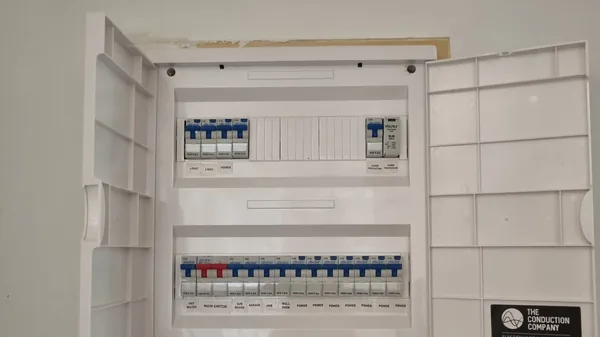
Most renovations add load the existing switchboard was never sized for, so The Conduction Company checks the board as part of every renovation quote.
The estimates below are for standard installation of your new switchboard. The Conduction Company confirms final pricing after a property assessment.
The Conduction Company prices a switchboard upgrade at $2,000 to $4,500 including GST. Replacing an internal switchboard on its own sits at the lower end. A combined switchboard and meter board sits towards the top. That is the board work on its own, not the whole renovation. The Conduction Company sets out what moves it in its guide to what a switchboard upgrade costs in NZ.
A new board also brings RCD protection with it. Where all the circuit protection on a switchboard is replaced, AS/NZS 3000 requires RCD protection for the circuits that board supplies. The Conduction Company fits that protection as part of the new board.
When should you call a home renovation electrician?
Before the linings, tiles and cabinetry go in, says The Conduction Company. Late calls happen most on bathroom jobs.
Often the tiling is already done, and the vanity and cabinetry are going in or are fully in, before anyone thinks about the electrical side. Then the team has to get cables up and down finished walls. "Especially tiled walls, they're an absolute nightmare to try and get cables up and down," says Jordan Statham.
At least once a year, The Conduction Company gets a bathroom where nobody thought about the electrics at all. The plumbing, building, tiling and waterproofing were all planned, and none of the electrical was changed. The team then has to work it out after the fact.
A renovation electrician on site before the linings go on runs every cable while the frame is open. The Conduction Company explains where bathroom switches and fittings can go in its guide to bathroom zones and IP ratings. Its page for kitchen electrical work in Auckland sets out the order of trades for a kitchen.
What is different about the electrics in a villa renovation or bungalow renovation?
Not much in the layout, says The Conduction Company. An Auckland villa or bungalow follows the same pattern as any house: a switchboard, with cabling running out to the lights, outlets and appliances. The real difference is age.
The cabling in these older homes often needs replacing, and the fittings and equipment are older and may have deteriorated. The good news is access. Most villas and bungalows have a ceiling space and underfloor the team can get into. That lets The Conduction Company run new cabling or add new points with little trouble. It covers the full job on its page for house rewiring in Auckland.
These homes were not built for how many devices people plug in today. In the vast majority, The Conduction Company finds one power outlet per room, two at most. The only outlet in a bedroom is invariably right behind the bed head, so people run extension leads.
The Conduction Company recommends at least three outlets per room in a modern home. That is its own recommendation, based on how rooms are used now. When it rewires a villa or bungalow, the team often asks whether you want more outlets, in better places, in the bedrooms and elsewhere. If you add them later instead, The Conduction Company sets out what power point installation costs in Auckland.
In short
The electrics for a home renovation go best when they are priced and planned before the walls are opened. The Conduction Company reads the wall construction on a walk-through, holds a fixed quote, and agrees any change on site before extra work goes ahead. It tests the modern cable it keeps and replaces rubber-insulated VIR and TRS cable. That advice comes from Jordan Statham's own Auckland jobs. The late calls all teach the same thing: bring the electrician in before the linings, tiles and cabinetry go on.
Planning a renovation? The Conduction Company is happy to walk through the house and quote the electrical scope as part of its electrical fit-outs for Auckland renovations.
Frequently asked questions
Do old houses need to be rewired?
Not always. The Conduction Company keeps modern TPS cable once it has tested it. It replaces rubber-insulated VIR and TRS cable when it finds it, and tests early plastic cable that leaks green goo before leaving it in service.
Can I upgrade my electrical panel without rewiring my house?
In most cases, yes. The Conduction Company upgrades the switchboard without rewiring the house unless the cabling itself needs replacing. Older TRS or VIR cable is the usual reason a rewire goes with the new board.
What are the types of wiring systems used in homes?
In New Zealand homes, The Conduction Company finds four main kinds: cloth-covered vulcanised India rubber (VIR), tough rubber sheathed (TRS), early PVC cable that can leak green goo, and modern TPS. Most homes have modern TPS.
What happens if the electrician finds something unexpected inside a wall?
It is very rare, says The Conduction Company. When it is something abnormal, the team talks it through with you before doing anything extra. Any change is signed on site as a variation before the work goes ahead.
How many power outlets should a room have?
The Conduction Company recommends at least three per room in a modern home. That is its own recommendation, based on how rooms are used now. Older villas and bungalows often have only one or two.