How Much Does It Cost to Install a Power Point in New Zealand?
The estimates below are for standard installation of a new power point. The Conduction Company confirms final pricing after a property assessment.
Installing a power point in New Zealand typically costs between $300 and $600 (including GST) for a standard power outlet. That is The Conduction Company's own Auckland price. Power point installation costs in Auckland can vary depending on factors such as the complexity of the installation, your property's construction, and the desired location of the outlet.
For an outlet behind a wall-mounted TV, The Conduction Company installs it in the same visit as the TV wall mounting, with the cables hidden in the wall.
If you're seeking affordable power point installation Auckland, expect to pay within this range. However, the price may vary based on the specifics of your home or business. For the best service, get a tailored quote from a licensed electrician in Auckland.
Understanding Power Point Installations
How Are Power Outlets Installed?
Power outlets are connected to a power circuit that runs through your home. Here’s how it works:
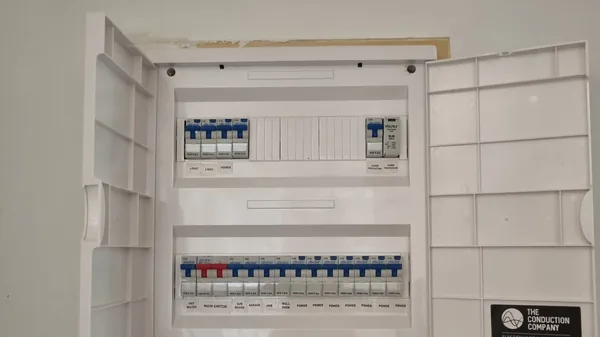
- A power circuit originates at the switchboard (protected by a fuse or circuit breaker).
- The circuit cable runs through walls, ceilings, and underfloor spaces, connecting to the first outlet.
- The cable then loops from one outlet to the next, forming a chain.
When adding a new outlet, electricians often “loop” the new outlet off an existing one, especially if it’s for general use. If you're searching for electricians near me to install a power point, they will evaluate your property's layout to determine the most efficient installation approach.
Factors Affecting Installation Costs
Outlet Location
The estimates below are for standard installation of a new power point. The Conduction Company confirms final pricing after a property assessment.
- Near an Existing Outlet
If the new outlet is close to an existing one, the installation is straightforward. Minimal labour and cabling are needed, keeping the cost at about $250 including GST. Residential electricians in Auckland can handle these straightforward installations with ease. - Far from an Existing Outlet
A longer cable run increases complexity and cost. Tasks might include drilling through walls, running and securing cables in ceilings or underfloor spaces, and installing surface-mounted conduit or trunking if concealment isn’t possible. Costs in these cases range from $300 to $800 including GST. When you're dealing with larger or more complex properties, commercial electricians in Auckland are often needed, as they have the expertise to handle large-scale installations and the extra tasks involved, such as extensive cabling or wall cutting.
Property Construction
The estimates below are for standard installation of a new power point. The Conduction Company confirms final pricing after a property assessment.
- Older Properties
Homes like bungalows, villas, and brick-and-tile houses often have accessible ceiling and underfloor spaces, making cable runs easier. In most cases, no plasterboard cutting or repair is needed. For properties like these, residential electricians in Auckland can ensure a smooth and quick installation. - Concrete Pad Properties
Homes built on concrete pads lack underfloor access. Electricians may need to drill through internal walls from the ceiling void, which is time-consuming and can risk wall damage. This increases the installation cost. Electricians for power point installation in Auckland can handle these challenges efficiently, but the job may be more costly due to its complexity. If you're seeking licensed electricians in Auckland for more complex tasks, ensure you're getting the best value for your investment. - Modern Properties
Townhouses, apartments, and architecturally designed homes usually lack accessible ceiling or underfloor spaces. Wall cutting is often required, and additional costs arise from hiring plasterboard repair contractors. Installation in such homes can cost anywhere from $400 to $2000 including GST, covering repair and finishing. For such projects, high-quality electricians in Auckland with experience in modern property layouts are essential to ensure everything is done correctly and safely. - Commercial Properties
- Office Spaces: Floating ceilings make cable installation easier and less expensive, as cables can be easily fully concealed. Commercial electricians excel in this type of installation, minimising disruption and ensuring quick, efficient work.
- Industrial/Warehouse Spaces: Surface-mounted conduits or capping solutions are common. While functional, these are not ideal for areas where aesthetics matter. Costs are generally lower due to simpler installation methods. For complex installations in industrial environments, electricians for commercial installations in Auckland are best suited for the job.
- Existing Switchboard Protection Modern homes (post-2000) often already have RCD protection, a safety feature that cuts power when an electrical fault is detected. If your home has RCDs installed,there is no additional cost. However, homes built before 2000 may require RCD protection installation in Auckland during the installation of a new outlet. This will add an extra $100 to $150 (including GST). Hiring electricians for RCD protection in Auckland is crucial, a sit ensures that all installations meet the latest electrical safety standards.
Outlets for Specific High-Current Applications
Certain outlets for high-current devices, such as car chargers, welders, or spa pools,require dedicated circuits rather than looping from an existing outlet. This prevents circuit breaker overload/tripping issues.
The estimates below are for standard installation of a new power point. The Conduction Company confirms final pricing after a property assessment.
For these types of outlets:
- Electricians run a new circuit directly to the switchboard.
- A new MCB (Miniature Circuit Breaker) or RCBO (Residual Circuit Breaker with Overload) is installed in the switchboard. Costs in these cases range from $300 to $800 including GST. When you're dealing with larger or more complex properties, commercial electricians in Auckland are often needed, as they have the expertise to handle large-scale installations and the extra tasks involved, such as extensive cabling or wall cutting.
Additional Considerations
Wall Repair Costs
For installations requiring wall cutting, the cost of plasterboard repair, taping,sanding, and painting will add to the total expense. Electricians for wall cutting and power point installation in Auckland can assist with these additional steps.
We quote on facts, not guesses
Before we give you a price, we carry out a proper assessment of your property and how you'll use your new power point. That way you know exactly what you're buying and the total cost, with no surprises. Clear expectations from the outset, start to finish.
Choosing a Licensed Electrician
Always hire a licensed electrician for safety and compliance with New Zealand electrical regulations. This ensures that installations are performed to the highest standards and meet building codes. Whether you're searching for electricians near me or Auckland electricians, make sure to choose someone who is certified and experienced.This guarantees a safe and smooth installation with no unexpected issues orcosts.
Can I change my electrical power point in NZ?
Legally, yes, within limits, if you own the home and live in it, but The Conduction Company's advice is not to. Even simple-looking work takes years of training to do safely.
So can you replace electrical outlets yourself? Section 79 of the Electricity Act 1992 and regulation 57 of the Electricity (Safety) Regulations 2010 let an owner-occupier remove and replace their own switches and socket-outlets. Nothing can be connected to the power while the work is done, the switchboard is off limits, and the work must be done and tested to the homeowner code, NZECP 51. Neither the Act nor the regulations require an inspector to sign off that like-for-like swap.
Adding a new power point is different, because it extends a circuit. That work must be tested and certified by a person authorised to inspect mains work before it is connected, and many inspectors will not inspect homeowner work at all. As a hard rule, The Conduction Company does not test, certify or connect a homeowner's wiring. It may help only where finished work has left a client stuck, and that takes a thorough inspection and often rework.
How much does an electrician charge to change a socket?
The estimates below are for standard replacement of an existing power point. The Conduction Company confirms final pricing after a property assessment.
The Conduction Company charges about $190 including GST to swap one socket as a stand-alone job. If The Conduction Company is already on site for other work, each socket swap is about $70 including GST. The Conduction Company gives a fixed price before any work starts. Adding a new power point is a different job, priced at the top of this page.
The swap itself is straightforward. The electrician takes the old outlet off, moves the cables across to the new one, and fits it. The Conduction Company's standard replacement is a Voltex Classic outlet with safety shutters and a 25-year warranty, backed by its Lifetime Workmanship Guarantee. The quoted price assumes the existing circuit is sound and passes its tests.
Older homes can need more. Some villas and bungalows still have the big square outlets of their day, and a modern outlet does not cover the hole they leave. One fix is a conversion plate: a flange that covers the old square opening, with a modern outlet mounted on it. Jordan Statham, director of The Conduction Company, says they "don't look particularly nice" but are fine for an older rental. In a villa or bungalow being fully renovated, he recommends patching, plastering and painting the wall and fitting modern outlets: "It's just a much nicer finish." That patching and painting adds to the cost.
How hard is it to add outlets to a room?
Usually not hard: about 80% of The Conduction Company's new outlet jobs need no wall repair at all. The new outlet is looped from a nearby circuit, such as an existing outlet or power already run through the ceiling or underfloor space, and the cable goes inside the wall by drilling through the timber framing.
The outlet can sit low or high on the wall, directly above or below an existing one, back to back with one on the other side of the wall, or be fed up from underfloor. Now and then the framing is non-standard and the wall has to be opened, usually a round hole about 160 mm across. The Conduction Company then covers it with a blanking plate or patches it, and patching, plastering and painting are only in the price where agreed. If the cable cannot go inside the wall, The Conduction Company tells you the alternative and its cost before going ahead.
What is involved with installing extra power points in a kitchen?
The Conduction Company adds kitchen power points by looping them from a nearby outlet or circuit, such as the fridge's, without opening up all the walls. Common spots are where a peninsula meets the wall, an adjacent wall, or low inside the cabinet under the sink for a dishwasher.
The cable runs inside the wall where it can. Where it cannot, it runs in small surface-mounted trunking behind appliances or high inside the cabinetry, with mechanical protection where required. The Conduction Company fits RCD protection in the main switchboard and upgrades the circuit protection where needed. Patching, plastering and painting are not included.
How do electricians usually charge?
The Conduction Company gives every job a fixed price before work starts, instead of charging by the hour. Those are the two ways electricians in NZ usually charge: by the hour, which the trade calls charge-up, or a fixed price agreed up front.
On charge-up, small gaps add up on the bill: a late start, a phone call, a lunch break that runs over. On a fixed price, you know exactly what you will pay, and nobody is watching the clock. For how much electricians charge in NZ, including the average hourly rate for an electrician in New Zealand and a reasonable day rate, see The Conduction Company's guide to what an electrician costs in Auckland.
Should all power outlets in a commercial site be on an RCD in NZ?
Not every outlet, on The Conduction Company's reading of AS/NZS 3000, the Wiring Rules. Its New Zealand clause for non-residential sites lists the places where outlets rated up to 30 A need 30 mA RCD protection, rather than setting one rule for the whole site.
In The Conduction Company's summary, that list in clause 2.6.3.3.2 covers kindergartens, day care centres, schools, and tertiary teaching areas, plus outdoor locations, areas with "easy or unsupervised public access", amusement arcades, sockets in damp situation zones, children's rides, and vending machines. Outlets added to an existing circuit "shall be protected by an RCD in accordance with the requirements for new subcircuits in the part of the installation in which the sockets are located" (clause 2.6.3.3.4).
Conclusion
The cost to install a power point in New Zealand depends on your specific requirements and property type.
Simple installations near existing outlets are relatively affordable, while complex jobs requiring extensive cabling or wall repair can become more costly. For affordable power point installation in Auckland, reach out to a professional electrician in Auckland for a quote tailored to your needs. A residential electrician in Auckland can efficiently handle basic installations, while more challenging tasks may require commercial electricians in Auckland for a thorough and professional solution.
Contact The Conduction Company to assess your needs and provide a detailed quote customised to your property.
Frequently asked questions
How much labour per point should an electrician charge?
The Conduction Company does not price a home job per point, so it has no set labour figure to connect a power socket only. It quotes each section of the job as one lump sum, with the hours set from how long the same work has taken on its past jobs, and travel, setup and clean-up included. Its guide to working out electrical labour cost explains how.
How do I know if a plug socket is RCD protected?
Send The Conduction Company a photo of your switchboard with its door open, and it can confirm whether your power circuits already have RCD protection. Homes built since about 2000 often do. If yours does not, protecting a new power point is part of the job, as the cost section above explains.
How do you get estimates for electrical outlet installation?
Tell The Conduction Company the suburb, where you want the outlet, and what it will run, such as general use, an EV charger or a particular machine. It helps to know whether there is an existing circuit nearby to tap off, but if you are not sure, that can be worked out on the day. The Conduction Company then gives you a fixed price before any work starts.
Can an electrician put a power point in a kitchen wall tile?
Yes. The Conduction Company cuts new power points into kitchen tile splashbacks above the bench, using diamond cutters, and loops the cable from a nearby outlet or circuit. Tile cutting is loud and dusty work, so The Conduction Company asks occupants to leave the house during the install where they can.
How much does it cost to install a power point in NZ?
The Conduction Company's own Auckland price for a standard new power point is $300 to $600 including GST. That is an estimate for standard installation of a new power point, not a quote, and The Conduction Company confirms final pricing after a property assessment. Where the outlet goes and how the house is built decide the final price. Swapping an existing socket is a different, cheaper job.