Jordan Statham is director of The Conduction Company, and a registered electrician and electrical inspector. He explains how his team gets power to sleepouts, sheds, garages and granny flats in Auckland, what it costs, and what goes wrong when it is done badly.
The Conduction Company runs power to a sleepout, shed, garage or granny flat with a new cable from the house switchboard. The cable goes overhead or underground, often to a small board in the building. A consented granny flat can share the house's supply, with a check meter, The Conduction Company says.
How much does it cost to run power to a shed?
The route sets the cost, The Conduction Company finds. A cable run above ground is the cheaper way to power a shed or sleepout, and an underground run costs more because of the trench. Whether you wire a shed for one light or power a sleepout, distance matters too.
We quote on facts, not guesses
Before we give you a price, we carry out a proper assessment of your property and how you'll use the power in your shed, sleepout or granny flat. That way you know exactly what you're buying and the total cost, with no surprises. Clear expectations from the outset, start to finish.
The estimates below are for standard installation of power to a shed, sleepout or granny flat. The Conduction Company confirms final pricing after a property assessment.
Above ground, overhead or in conduit along structures, power to a shed costs from about $1,400 including GST with The Conduction Company.
Underground, The Conduction Company usually charges $3,300 to $4,600 including GST, and a longer run costs more.
These are Jordan Statham's own figures for The Conduction Company's work. The gap is mostly digging: an underground run needs a trench, conduit, drainage and backfill.
Do you need a separate meter for a granny flat?
Usually not. A granny flat built with a building consent can share the house's power, with a check meter to measure what it uses, says The Conduction Company. Clients ask for one all the time, wanting the flat on its own power bill.
"Getting another meter and another ICP is actually quite difficult and expensive for most people," says Jordan Statham. A second ICP means a second connection to the power network, with its own meter.
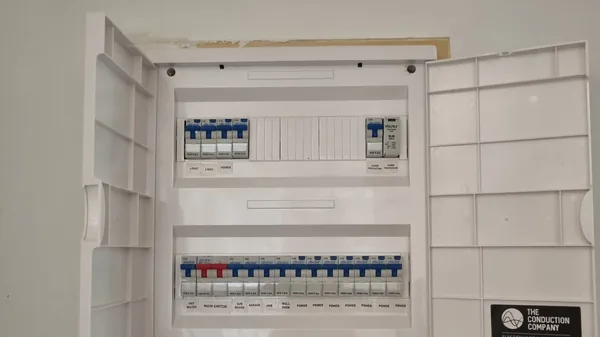
The cheaper option The Conduction Company recommends is a check meter. It goes in your switchboard and measures how much power the granny flat's subcircuit uses. Wireless check meters now send the readings to an app on your phone. You then charge whoever lives in the flat for the units they have used. Working out the charge is up to you.
The other option Jordan Statham describes is no meter at all. You charge a flat rate each week or month. Then you compare your power bill in kilowatt hours from before the flat with after it, to see whether the occupant uses more or less than the rate covers.
If the person in the flat is a tenant, tenancy law has rules on who pays for power, so check with Tenancy Services before you set a charge.
Granny flat rules NZ: what do they say about the power?
Since 15 January 2026, a Building Act exemption has let some small granny flats be built without a building consent, on conditions. Some of those conditions are electrical, which is the part The Conduction Company deals with.
The Building Act says the electrical work must be done under the Electricity Act by a person authorised to do it. Its conditions for the flat also include "an independent source of supply for electricity". What that condition means for a flat's power is not settled yet. So for a flat built under the exemption, The Conduction Company confirms the supply rule on each job, rather than assuming the flat can share the house's supply.
Building and consent rules for granny flats are MBIE's to explain, in its guidance on the granny flat exemption.
Granny flat cost NZ: what does connecting the power cost, all up?
All up, connecting a granny flat in Auckland to power with The Conduction Company is the cost of the cable run, plus a check meter if you want one. The run is priced as above. The check meter is a separate line, so you can see each part.
The estimates below are for standard installation of a check meter or a second meter. The Conduction Company confirms final pricing after a property assessment.
A check meter costs $400 to $800 including GST with The Conduction Company, usually about $500 including GST.
The Conduction Company charges more for a check meter where the switchboard needs rewiring to fit it.
For a second meter and a new ICP, The Conduction Company's own electrical work is typically under $1,000 including GST.
The lines company's charge comes on top, and it varies. Your local lines company charges a network contribution for a new connection, so you need a quote from it. For most Auckland homes that is Vector. In The Conduction Company's experience, Vector's assessment for that contribution is around $300 to $400 including GST. The contribution itself and the work come on top of it.
When does a sleepout need a sub board or a bigger supply?
A sleepout someone lives in usually gets its own sub board, The Conduction Company finds. It needs a bigger supply only when the house is already near its limit. A sub board is a small switchboard in the sleepout, fed by its own cable from the main switchboard. The Conduction Company explains how one works in its guide to switchboard types and sub-boards.
The sub board also settles the earthing. Under AS/NZS 3000, the wiring rules, an outbuilding with its own switchboard is earthed one of two ways. It takes an earth wire from the house's main switchboard, or it is set up as a separate MEN installation with its own earth. The Conduction Company covers both in its guide to earth stakes and the main earth.
The supply is the harder question. Many homes have a standard 60 amp single-phase supply, says Jordan Statham of The Conduction Company. If most of your appliances are electric, the house runs close to that limit at peak times. Think electric hot water, electric heating, an induction hob and an EV charger. "So adding in a granny flat on top of that is likely to cause issues, especially at peak times during the evenings or in the mornings," he says. The same applies to a sleepout or any other minor dwelling.
In those cases The Conduction Company recommends one of two fixes.
Load management on the EV charger. The Conduction Company can usually set the charger to turn its current down at peak times, which keeps the house under its limit. It is usually a cost-effective fix. AS/NZS 3000 says that for a charger over 20 amps single phase, consideration should be given to upgrading the mains or fitting a load management device. The Conduction Company explains the arithmetic in its guide to what an EV charger costs to install in NZ.
A bigger supply. For full stability and room to grow, The Conduction Company can add a second phase, which gives you another 60 amps, or increase the single-phase supply to 80 amps. Both cost significantly more. The meter has to change, a new cable is often needed, and Vector charges a contribution to set it up, so it can run to thousands of dollars.
The Conduction Company treats a supply upgrade as the last resort. It assesses your existing load first, and can run load tests to see where the house sits and what the flat will add, before it offers options.
Overhead or underground power cable to an outbuilding?
Underground is The Conduction Company's favourite, but the client's budget decides. "Underground's just the best option by far, it's the tidiest, looks the nicest, it's not going to cause any sort of tripping issues, there's no overhead hazards," says Jordan Statham.
Underground costs more because of the digging. The Conduction Company trenches to 500 mm at an absolute minimum and typically to 600 mm. The cable goes in conduit, with drainage and backfilling to think about, so it adds significant cost over stringing a line across. AS/NZS 3000 requires at least 500 mm of cover for a cable laid in soil under open ground. Orange marker tape goes about halfway between the cable and the surface, to warn anyone digging later.
If a landscaper digs the trench, The Conduction Company still lays the conduit, cable and marker tape itself, and the landscaper can help backfill. It has seen too many runs laid by non-electricians at the wrong depth or without marker tape, which meant digging them up again.
Overhead can work on a tighter budget, The Conduction Company says, but it has restrictions. AS/NZS 3000 sets minimum clearances for an overhead line from the ground, buildings and structures. Over a driveway or path, where a car might hit it, the line has to be quite high. Getting it that high adds cost, and it can look worse if the line needs poles to hold it up.
How to get power to a shed safely
The safe way to get power to a shed is a fixed cable from the house switchboard, buried deep enough or run overhead, says The Conduction Company. In sheds and sleepouts someone else has wired, it keeps finding three faults.
A buried extension lead. Some sleepouts in NZ come with a caravan-style inlet on the side, built for a lead plugged into an outdoor socket on the house. The Conduction Company finds the lead connected, then buried just under the surface. It is a tripping hazard, and anyone who digs there later could get a shock. That is why The Conduction Company buries fixed wiring at least 500 mm down.
A whole building on one socket. The Conduction Company sees outbuildings wired into a standard power point. A building that draws around 20 amps then runs off a 10 amp socket on the outside of the house. That is dangerous.
Homeowner wiring. "Mostly it's just homeowner wiring work that we'll see," says Jordan Statham. The owners did not know what was safe, and The Conduction Company has had to put it right.
The law does let an owner-occupier wire their own home, submains to an outbuilding included. Under the Electricity Act and the Electricity (Safety) Regulations, a new or altered subcircuit must be tested and certified by an inspector before it is connected to a power supply. The registered person who certified it then connects it. The Conduction Company strongly advises against doing it yourself: outbuilding wiring done wrong is dangerous, as the faults above show. As a hard rule, The Conduction Company does not test, certify or connect a homeowner's wiring. It may help only where finished work has left a client stuck, and that takes a thorough inspection and often rework.
Who connects a kitset granny flat or transportable home in NZ?
The electrician connects it, and on The Conduction Company's jobs that is its own team. "We're the ones who connect it," says Jordan Statham. If you are having plumbing put in as well, the plumber connects that.
A kitset sleepout, kitset granny flat or transportable home is connected one of two ways, The Conduction Company says.
By a lead. Some buildings arrive with a caravan-style lead. The Conduction Company installs a caravan outlet on the side of the house and runs the lead between them, which is nice and easy. AS/NZS 3001.2 is the standard for installations built to connect this way, by a detachable supply lead, and it covers relocatable units such as homes and cabins.
Hard-wired. Other times The Conduction Company wires the supply ahead of time, waits for the building to be dropped off, and connects it on installation day. That is how the team likes to work it.
The Conduction Company notes one more rule for a granny flat built under the no-consent exemption. The Electricity (Safety) Regulations say copies of the certificate of compliance and the electrical safety certificate must go to the owner of the flat.
Garage conversion NZ: what electrics catch people out?
Lighting, most of the time, says The Conduction Company. A garage usually has a single batten light or perhaps two downlights. That is not enough for a room, especially a lounge, so a conversion needs more lights.
Garage lighting is often a cold white, too. The Conduction Company likes to change it to warm white, "which will suit the rest of your home and make it feel like an actual living space," says Jordan Statham.
Power points are next. A garage usually has a couple of outlets, perhaps a double for the laundry and one or two dotted around. A living space needs several new outlets in the right places, especially for a TV, or you end up with extension leads across the floor. The Conduction Company sets out what power point installation costs in Auckland.
Think about data and TV points too, The Conduction Company advises, whether the garage becomes a lounge or a bedroom. A garage can be a long way from the router, so the WiFi signal there may be weak. The Conduction Company covers getting WiFi out to a garage or sleepout on its access point page.
In short
Getting power to a sleepout, shed, garage or granny flat means a new cable from the house switchboard, and the route sets the price. Based on Jordan Statham's own figures, The Conduction Company prices an above-ground run from about $1,400 including GST, and underground usually costs $3,300 to $4,600 including GST. A consented granny flat can share the house's supply with a check meter, and for a flat built without consent the supply rule is confirmed on each job. A supply upgrade is the last resort, after load management on an EV charger.
Planning a sleepout, shed or granny flat? The Conduction Company runs the power as part of its power and lighting installation in Auckland.
Frequently asked questions
What are the new rules for granny flats in NZ?
Building and consent rules are MBIE's to explain. On the electrical side, the Building Act exemption that began on 15 January 2026 says the electrical work must be done by a person authorised to do it, and its conditions include an independent source of supply for electricity. The Conduction Company confirms the supply rule for each exempt flat.
How deep does an underground power cable need to be?
AS/NZS 3000 requires at least 500 mm of cover for a cable laid in soil under open ground. The Conduction Company typically trenches to 600 mm and runs the cable in conduit, with orange marker tape above it.
Does a shed or sleepout need its own earth stake?
Not always. Under AS/NZS 3000, an outbuilding with its own switchboard can be earthed through an earth wire from the house's main switchboard, or set up as a separate MEN installation with its own earth. The Conduction Company explains both in its guide to earth stakes.
What is a check meter?
A check meter goes in your switchboard and measures how much power one subcircuit, such as a granny flat, uses. Wireless ones send the readings to an app on your phone, and The Conduction Company recommends one over a second meter for most consented flats.