Most people who ask what an EV charger costs are really asking two things: what they will pay, and which charger they need. The second answer sets the first. Here is how The Conduction Company works out both for Auckland homes.
The estimates below are for standard installation of a home EV charger. The Conduction Company confirms final pricing after a property assessment.
The short answer. The Conduction Company installs a 16 amp home EV charger in Auckland from $999 including GST, and a 7.4 kW fast charger for $1,600 to $2,900 including GST. The car decides which one is worth it. Many plug-in hybrids can only take 16 amps, so a bigger charger buys them nothing.
What does an EV charger cost to install in Auckland?
We quote on facts, not guesses. Before we give you a price, we carry out a proper assessment of your property and how you'll use your EV charger. That way you know exactly what you're buying and the total cost, with no surprises. Clear expectations from the outset, start to finish.
The estimates below are for standard installation of a home EV charger. The Conduction Company confirms final pricing after a property assessment. These are The Conduction Company's own Auckland prices, supplied and installed, including GST.
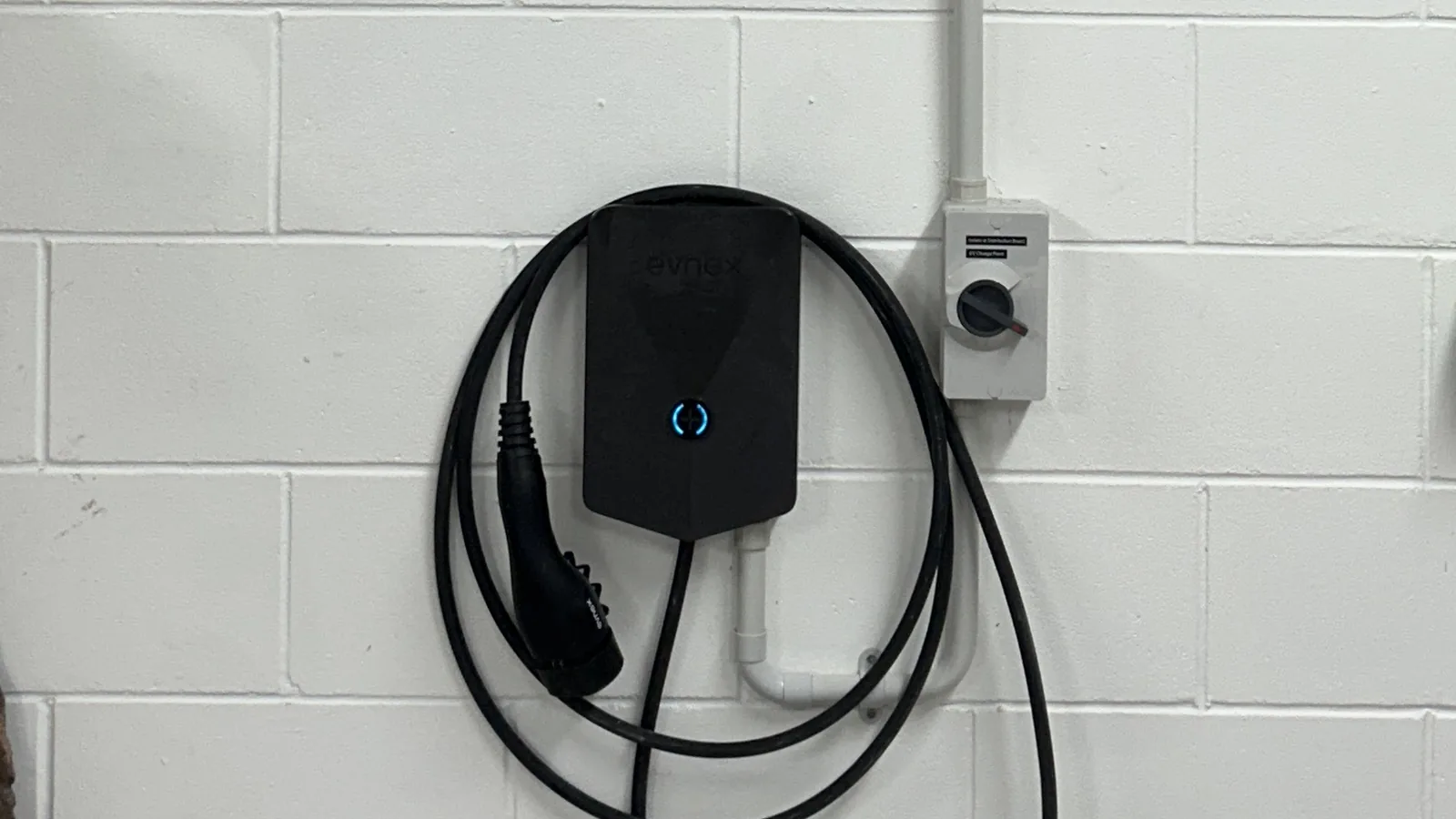
16 amp charger, about 3.6 kW. From $999 including GST. A 16 amp outlet on its own circuit from the switchboard, an isolating switch beside it, and a portable charger that plugs in. It delivers 1.6 times the power of the 10 amp lead that came with the car.
32 amp wall charger, 7.4 kW. $1,600 to $2,900 including GST. A hard-wired charger on its own 32 amp circuit, with its own RCD and an isolating switch. The switch goes beside the charger, or at the board when the charger sits right next to it. That is the fastest charging a standard single-phase home supply allows, and it suits most battery-only cars and larger plug-in hybrids.
In The Conduction Company's experience the charger itself is between a third and a half of the total. The rest is labour, cable, and the protection at the switchboard. On our own completed jobs, the ones that land above $2,900 including GST are premium chargers, picked for their looks or their app. The Conduction Company's EV charger installation service in Auckland covers both options.
What moves the price inside that range?
Two things, in The Conduction Company's experience: which charger you pick, and how far it sits from the switchboard. On our own completed Auckland jobs, the charger moves the price more than the cable run does.
The charger you choose
Brand matters less than people expect. Jordan Statham, director of The Conduction Company, puts the gap between a cheap and cheerful unit and the best on the market at about $1,000 including GST. At the top end you pay for looks, for load balancing against the rest of the house, for a solar link, and for a phone app that times charging to a cheaper night rate. A basic unit does none of that: you plug in and away you go.
Where the charger goes
The further the charger sits from the switchboard, the more it costs. AS/NZS 3000 caps the voltage drop across an installation at 5% (clause 3.6.2), so a longer run needs more cable and thicker cable. Going outside means drilling through walls, and a cable hidden inside a finished wall takes longer than one in surface conduit. In The Conduction Company's experience, a charger beside the board is about an hour's work, and one on an outside wall 25 metres away is closer to half a day.
The cheapest install, and how to get close to it
"If the switchboard is right there in the garage next to where you're charging, that's a dream for an installer." Jordan Statham, director, The Conduction Company.
The hard install is a switchboard at the far end of the house from where you park. The cable then runs through the ceiling or under the floor, it has to be large, and every metre adds labour and material.
When the car parks a long way from the board, The Conduction Company often suggests a cheaper route: a non-tethered charger, one without its own lead, fitted right beside the switchboard, with a good-quality 10 to 12 metre charging lead running out to the car. We have found this far more cost-effective than taking the charger to the car.
When does the switchboard need work first?
Usually it does not. In most Auckland homes The Conduction Company adds the charger's circuit to the existing switchboard without any issue. It needs work first in three cases: there is no room for another protective device, the board is old and showing its age, or the house has no sound main earth. We sort those before the charger goes in.
The protection is where the rules are most often misread. AS/NZS 3000 requires a 32 amp charger's circuit to have its own Type B RCD, a safety switch that also detects DC leakage (clause 7.9.3.3(c)). A charger with built-in DC leakage detection does not remove that RCD. It allows a Type A RCD instead (the same clause's exception). So "this charger needs no RCD" is never true, and The Conduction Company fits whichever one the charger needs.
Which is better, a 3 kW or 7 kW home charger?
For most battery-only cars, the 7 kW. For many plug-in hybrids, the 3 kW, because the car cannot use more. In New Zealand, at our 230 volts, the options compare like this, and The Conduction Company sizes every charger from them.
What the numbers mean. The lead that comes with the car draws up to 10 amps from a normal socket, about 2.3 kW. A "3 kW" charger is really 16 amps, about 3.6 kW. A "7 kW" charger is 32 amps, about 7.4 kW.
Who it suits. The car's lead suits light drivers who stay in their own neighbourhood. The 16 amp charger suits a normal commute, and the many plug-in hybrids that cannot take more. The 32 amp charger suits battery-only cars, long commutes, and long days back to back.
Price. These are estimates for a standard installation, which The Conduction Company confirms after a property assessment. The car's lead costs nothing extra. The 16 amp charger is from $999 including GST, and the 32 amp charger is $1,600 to $2,900 including GST, both supplied and installed.
The car decides, so we ask what you drive
The car sets the limit, not the unit on the wall. Many plug-in hybrids, the Mitsubishi Outlander for one, can only take about 3.6 kW (16 amps), so a 7 kW wall charger charges them no faster than a 16 amp portable unit. Some newer ones, such as BYD's Sealion 6, take 7 kW. That is why The Conduction Company asks for the car model on every job, and recommends the 16 amp charger when the car tops out at 16 amps, unless a battery-only car is coming next. Models change, so check your own car's spec too.
We have seen the expensive version of this mistake: a client buys a 7 kW charger with every feature, plugs in a plug-in hybrid, and watches it draw 16 amps. If The Conduction Company hears about it before the install, the charger can often go back for a credit. Some clients keep it anyway, ready for their next car.
The granny charger, and who should keep it
A granny charger is the lead that comes with the car, plugged into a normal 10 amp socket, and it is the slowest way to charge. In The Conduction Company's experience it is all a light driver needs: someone who pops out a few times a week, mostly in their own suburb. Jordan Statham's view is that slow charging is also kind to the battery. For charging times by car size, The Conduction Company's guide to how long it takes to charge an EV at home in NZ sets 10, 16, and 32 amps side by side.
Who buys a 7 kW charger?
Most owners of battery-only cars, in The Conduction Company's experience. A 16 amp charger would suit many of them most of the time, and Jordan Statham reckons 95% of the time. If the drive to work and home again each use about 20% of the battery, a 16 amp charger easily puts that back overnight. Owners buy the 32 amp unit for the other days: a long drive today, another tomorrow, and one night to recharge in between.
Is a portable 7 kW charger as good as a hard-wired one?
Usually not. Most portable chargers run at 10 to 16 amps, so they top out around 3.6 kW. Portable 32 amp units do exist, but they need their own 32 amp industrial socket and circuit. For a car that can take 7 kW, The Conduction Company recommends the hard-wired unit. It costs more, and it charges faster.
Can I start with 16 amps and upgrade later?
Yes, and the cheap way to do it is decided on day one. If the first installer ran cable sized only for 16 amps, a 7 kW charger later is a full new install: new cable, new protection, new charger. That is why The Conduction Company always offers to run cable big enough for a 32 amp charger on a 16 amp job. Then the upgrade is mostly a swap: the 7 kW charger goes where the outlet was, and the protection at the switchboard changes to suit.
Do I need three-phase power for a faster charger?
Almost never, and cost is the reason. If a house already has three-phase, The Conduction Company fits the fastest charger the car can use. But most suburban Auckland homes are single-phase, and getting three-phase costs thousands of dollars for a small gain.
The gain is smaller than it looks. An 11 kW charger draws 16 amps on each of three phases, and a 22 kW one 32 amps on each, but most cars stop at 11 kW on AC charging and cars that take 22 kW are rare. The Conduction Company has installed a 22 kW charger for a client whose car was capped at 11, and got the phone call: it only charges at 11. The two chargers cost about the same, but the speed was never there. For most cars, three-phase takes you from 7.4 kW to 11 kW.
The cost is the big part. Upgrading starts with an application to Vector, which The Conduction Company can lodge for you. Vector charges a $300 assessment fee before it quotes, a development contribution of $264.50 per kVA, and the cost of the work, priced per job, all including GST (Vector's capacity upgrade page, pricing from 1 October 2025). Vector publishes no all-in price. If the street has no spare capacity, you may have to pay for Vector to upgrade it too. Most homes also need a new cable from the street, often trenched across a lawn or driveway, and a three-phase meter through your power retailer.
"If you've got the money and you really want it, that's fine, we can get it done for you. But in most cases it turns out to be a no, just on cost." Jordan Statham, director, The Conduction Company.
The exceptions are real. One The Conduction Company client bought a battery-only supercar that could take 22 kW on AC, at a house with single-phase power. We upgraded the supply to three-phase, which cost around $10,000 including GST, and fitted a 22 kW charger, so the car charges at full speed at home. Rideshare drivers who top up at home over lunch can gain from 11 kW too. The Conduction Company's own vans are battery-only Mercedes eVitos, and the office runs a 22 kW charger for them.
Do I need load management?
With a 32 amp charger it is worth having, and with two EVs it is essential. Most Auckland homes have a 60 amp single-phase supply from Vector, protected by a fuse at the street, on the pole or in the pillar at your boundary. AS/NZS 3000 says that for any charger over 20 amps, consideration should be given to upgrading the mains or fitting a load management device (the note to clause 7.9.3.3(a)).
Here is the arithmetic The Conduction Company walks clients through. At dinner time, with the hot water cylinder heating and the oven and cooktop on, the house draws 40 to 45 amps. Add a 32 amp charger and you are at 70 to 75 amps, well past the 60 amp fuse. Blow it and the whole house goes dark until Vector replaces it, which can take a long time in a storm or a big outage. Vector gives homes three free call-outs a year for faults on the home's side of the connection, and may charge after that.
Load management watches what the house is drawing and gives the car whatever is left under the limit. While you cook, the car might charge at 15 amps. Once the oven and cooktop go off, it climbs to about 25. After everyone goes to bed, it charges flat out. All of it happens automatically.
Two EVs in one garage
Two 32 amp chargers at full speed draw 64 amps, more than a typical 60 amp home supply on its own, before anything else is switched on. So The Conduction Company fits two chargers that balance against each other, each reading the home's total draw through a sensor clamped around the mains cable. With the hot water and oven on, each car might draw about 10 amps, then around 25 when the cooking stops, and about 28 overnight. Plug both in at a full 32 amps with no balancing and you risk blowing the street fuse the moment anything else is on.
How to choose: what The Conduction Company asks first
Four questions, in this order. What car have you bought, or are about to buy? That is the big one. How do you drive: the daily commute, how often you do long trips, and whether long days come back to back? What else in the house draws power? A home with electric hot water, an induction cooktop, a spa pool, and ducted air conditioning gets a charger with load balancing. And are you on a power plan with cheaper night rates? If so, The Conduction Company fits a charger you can schedule from your phone.
Most of the time The Conduction Company can quote without a visit, from photos of the switchboard with its door open and of the exact spot for the charger. If the job looks tricky, we come out and assess it on site first.
Can I buy my own charger and have you install it?
Yes, though The Conduction Company does not recommend it, and the reason shows up when something fails. If you buy a charger yourself, your rights are against the business that sold it: its warranty, plus the Consumer Guarantees Act. The Act can make the seller cover costs that follow from a fault, such as getting a fixed unit taken down (section 18(4)), but you have to claim those from the seller, and a seller overseas can be hard to pursue. Meanwhile a failed unit means two visits from your electrician, one to take it down and one to refit it.
Some chargers cannot be installed at all. Every EV charger sold in New Zealand needs a supplier declaration of conformity: a document from the NZ importer or maker saying it meets the safety standard, which for an AC charger is IEC 61851-1 (Electricity (Safety) Regulations 2010, regulation 83 and Schedule 4). We have to certify the job as lawful and electrically safe and attach that declaration to the certificate (regulation 66). If a charger bought from an overseas website has no declaration, The Conduction Company cannot sign it off, so we will not install it. The other certificates a home charger gets, and who can install one, are in The Conduction Company's guide to the 80% rule for EV charging .
In short
On The Conduction Company's own published estimates, confirmed after a property assessment, a home EV charger in Auckland costs from $999 including GST for a 16 amp unit, or $1,600 to $2,900 including GST for a 7.4 kW wall charger. The right size depends on the car: many plug-in hybrids cannot use more than 16 amps, while most battery-only cars suit 7 kW. Three-phase rarely pays, because most cars stop at 11 kW on AC. With a 32 amp charger load management is worth having, and with two EVs on a 60 amp supply it is essential.
Frequently asked questions
Can an EV charger be installed outside?
Yes. Many chargers sold now can go inside or out, and a good-quality unit has a casing built to handle the weather. The Conduction Company still tucks an outdoor charger under a soffit or in a carport where it can, because less sun and rain means a longer life. On an exposed wall we sometimes fit a cover, which also gives you somewhere to coil the lead.
Does my power plan change which charger I need?
Not usually. If your plan has cheaper rates overnight, The Conduction Company fits a charger you can schedule from your phone, so the car charges in the cheap hours.
Will a 22 kW charger charge my car faster?
Usually not. Most cars stop at 11 kW on AC charging, and a 22 kW charger needs three-phase power, which most Auckland homes do not have. In The Conduction Company's experience, a 7.4 kW single-phase charger is the right choice for most homes.