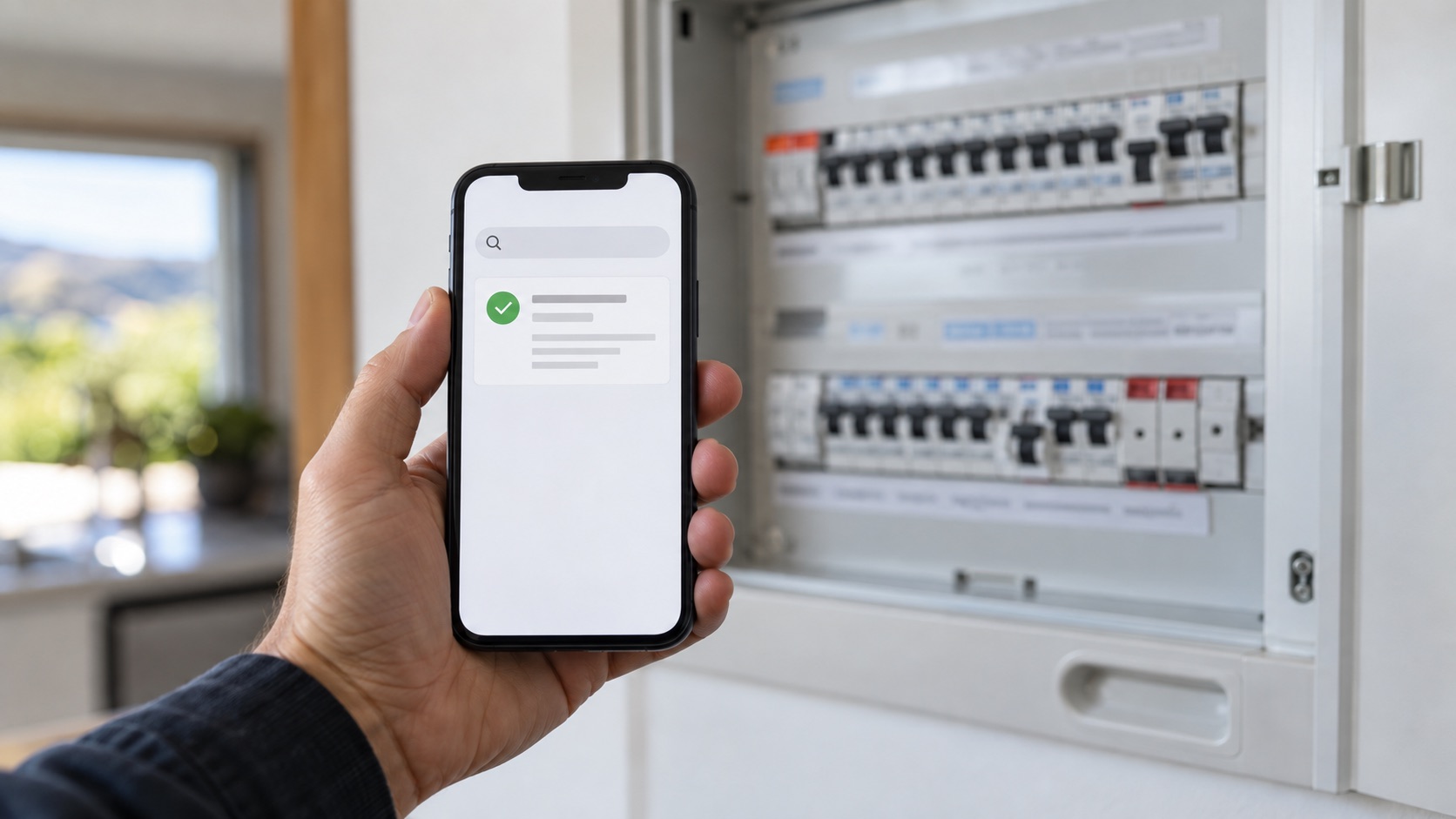
A few years ago a tradesman working a few streets from our old Green Bay base copied The Conduction Company's website. Same words, same layout, different name on top. He was taking people's money for electrical work he was not registered to do. It ended up on Fair Go.
The part that still bothers us is how cheaply it could have been stopped. One search, about thirty seconds, free.
Direct answer: search the EWRB public register at kete.mbie.govt.nz/EW/EWPRSearch. Enter a last name or a registration number. The Conduction Company checks two things on that result: that the person is registered, and that they hold a current practising licence. Registration on its own is not enough. Only a current practising licence lets someone legally do and certify your electrical work.
How do you check an electrician is registered in NZ? Go to the EWRB public register, run by MBIE, at kete.mbie.govt.nz/EW/EWPRSearch . It is free, it needs no login, and it is the same register The Conduction Company uses when we check a subcontractor.
The search page gives you nine fields. You only need one of them:
First name, middle name, last name, or preferred name Town or city Licence type Registration class Registration number Practitioner ID Last name plus town is usually enough. If the person gives you a registration number, use that instead. It is exact.
Then read the result properly. By law the register has to show the class the person is registered in, the date they were first registered, whether they hold a current practising licence , that licence's expiry date, any limitations or conditions on it, any disciplinary action in the last three years, any current suspension, and any cancellation (Electricity Act 1992, s 128). That last group is the part almost nobody scrolls down to, and it is the most useful part of the page.
Want to test it on someone? Jordan Statham, who owns The Conduction Company, is registration I 272615 . Put that in the Registration Number field and you will see exactly what a clean result looks like: an Electrical Inspector class, a current practising licence, no conditions, no disciplinary history. Compare that against whatever comes back for the person quoting you.
What is the difference between registered and licensed? Registered and licensed are two different things, and the gap between them is where people get caught out.
Registration occurs once, after an electrical worker receives the qualification and registers with the EWRB as an electrician. You apply for it once and it stays on the register.
A practising licence is the permission to actually work, and it expires. An electrician renews it every couple of years, and to renew it they have to complete a safety refresher covering current testing methods and legislation, plus a current first aid and CPR certificate.
So a person can be genuinely registered, tell you so honestly, and still not be allowed near your switchboard. The Conduction Company has seen electricians let a licence lapse without meaning to. The register shows it plainly: it will list the registration and show no current practising licence.
The law is blunt about which one matters. A person must not do prescribed electrical work unless they are authorised, and the people authorised are a registered person working under a current practising licence , someone under a provisional licence, or someone under an employer licence (Electricity Act 1992, s 74). No current licence, no legal work, no valid certificate at the end.
What do the different classes mean? Three show up on domestic jobs.
Electrician Trainee Limited Certificate. This is the apprentice. The EWRB requires New Zealand work experience for registration to be completed while holding one, and it only permits work under the supervision of a registered, licensed electrical worker. An apprentice on your job is completely normal. An apprentice on your job alone is not.
Electrician. The tradesperson who does the work and signs it off. To register, the EWRB requires an apprenticeship plus a Level 4 qualification, such as the National Certificate in Electrical Engineering, Electrician for Registration (Level 4). To start the apprenticeship, training providers usually ask for NCEA Level 2 credits in maths, English, and science, or a pre-trade certificate instead.
Electrical Inspector. The independent third party who checks high-risk work. The EWRB requires an inspector to have been registered as an Electrician or Electrical Engineer for not less than three years, with 6,000 hours of practical experience, then pass a Board-approved coursework and written exam plus a practical assessment, and supply three records of inspection as evidence of high-risk work completed.
Jordan holds both the Electrician and the Electrical Inspector registration, which is why The Conduction Company can inspect and certify high-risk work rather than subcontracting it out. You can book an inspection and certification with us directly.
Does a business name on a van or a website prove anything? No. Nothing about signwriting, a uniform, a company name, or a tidy website is connected to the electrical register.
The man who copied our website had a registered limited liability company. He had branded shirts and a branded van. What he did not have was any record on the EWRB register under any of the names he used, and the Plumbers, Gasfitters and Drainlayers Board had nothing on him either. A homeowner with thirty seconds and a phone would have known.
TVNZ's Fair Go investigated and broadcast the story in March 2024.
VIDEO
Pretending to be registered is itself an offence. Anyone who holds themselves out as registered or licensed when they are not is liable on conviction to a fine of up to $10,000 (Electricity Act 1992, s 161). Actually doing the work without authorisation is far worse: up to $50,000 for an individual and $250,000 for a company (s 162).
What paperwork should you get when the job is finished? This is the check that catches everything, because the certificate has to name the person who did the work and give their registration number. An unregistered worker cannot produce one.
An Electrical Safety Certificate (ESC) comes with every job. After prescribed electrical work is complete, the person who completed it must issue an ESC once they are satisfied the installation is safe to use (Electricity (Safety) Regulations 2010, reg 74A). There is no risk level that gets out of this. A new power point, a relocated light, a full rewire: you get an ESC.
The ESC has to state that the installation is connected and safe to use, say whether it covers the whole installation or only parts, identify the address, carry an authentication mark, give the connection date, be signed and dated, and give the name and registration number of the person who did the connection (reg 74A(3)).
A Certificate of Compliance (CoC) comes with general and high-risk work. A CoC is required for general and high-risk prescribed electrical work (reg 65). It must confirm the work was done lawfully and safely, describe the work, name the person issuing it, give their registration number, and be signed and dated (regs 66 and 67).
A Record of Inspection comes with high-risk work. All high-risk work on a low or extra-low voltage installation must be inspected (reg 70), and the independent inspector issues that record.
Check the registration number on the certificate against the register. Same search, same thirty seconds. If the number on your paperwork does not match a licensed person, the paperwork is worthless.
One more thing worth knowing: an ESC is, for the purposes of section 19(1)(e) of the Building Act 2004, a certificate confirming that the electrical work complies with the building code (reg 74A(5)). That is why missing certificates hold up a code compliance certificate, and why they surface again when you sell.
Why is "cash, no paperwork" a warning sign? Paying cash is not illegal, and plenty of good tradespeople still take it. What is worth noticing is a cash-only condition, especially when it arrives with a discount.
Cash leaves no record. No record is what makes it easy to leave income off a tax return, and someone comfortable cutting that corner may be comfortable cutting others.
Skipping the certificate is illegal.
The ESC requirement in reg 74A does not care how you paid. So the warning sign is not the cash itself, it is the offer that comes with it: a lower price in exchange for no paperwork. What is actually being discounted is the certificate, and the certificate is the only durable proof you have that the work was done legally and safely. It is also the document your insurer, your council, and your buyer's lawyer will ask for.
If a price drops when you ask for a certificate, that tells you the person cannot issue one.
What electrical work can a homeowner legally do in New Zealand? There is a genuine exemption, and it is narrower than most people think.
Under section 79 of the Electricity Act 1992, the owner of premises they live in, or intend to live in, may do electrical wiring work on those premises. The conditions are all of the following: the work is within the prescribed limits, it is done in accordance with the regulations, it is carried out competently and safely, no part of it is connected to a power supply while it is being done , and it is tested, certified, and then connected by a registered person holding a current practising licence that authorises them to test and certify.
The limits are set out in the Electricity (Safety) Regulations 2010, reg 57. The installation has to be domestic and at or below 80 amps per phase single-phase, or 50 amps per phase multi-phase. Within that, the permitted work is: removing and replacing fuse links; connecting and disconnecting fixed-wired appliances; relocating existing switches, socket-outlets, and lighting outlets supplied by tough plastic-sheathed cable; removing and replacing switches, socket-outlets, light fittings, ceiling roses, batten holders, water heater switches, thermostats, and elements, but only if the work does not involve work on a switchboard ; and installing, extending, or altering subcircuits, but only without entering any enclosure where live conductors are likely to be present, and only if it is tested and certified before connection by a person authorised to inspect mains work.
So can a non-electrician change a light fitting? In their own home, within those limits, off the power, and under the code, yes. The work must be carried out and tested in accordance with NZECP 51, "Homeowner Occupiers Electrical Wiring Work in Domestic Installations", and NZECP 51 requires that any new electrical wiring work is checked and tested by a licensed electrical inspector, who then issues written confirmation that the Code and the Regulations have been met (NZECP 51, cl 1.6.3).
Jordan's view, as an inspector, is simpler: you would never do your own dentistry, so do not do your own wiring. The inspection is thorough because the inspector's licence is on the line, the hit rate for finding problems is high, and remedial work on top of an inspection usually costs more than getting an electrician to do the job properly in the first place.
What do you do if you think the work was done illegally? Start with safety. Get a registered inspector to look at it, disconnect anything immediately dangerous, and get a written report on what was found. That report is your evidence.
Then report it. The EWRB takes reports of unlicensed electrical work at ewrb.govt.nz . In Jordan's experience the two paths diverge from there. If the person is registered, the Board handles it as a disciplinary matter, and outcomes range from fines up to being stood down. If the person was never licensed at all, it is a criminal matter under sections 161 and 162, and it moves toward the courts.
The Conduction Company can carry out the inspection and write the report. Chasing the complaint through the EWRB on your behalf is separate work that we charge for, and plenty of people run that part themselves using our report.
What if it feels rude to ask? It is not rude, and most electricians will not blink. A registered electrician is usually proud of the registration. The wallet cards have mostly been replaced by a digital practising licence on the phone, so it takes them about as long to show you as it takes you to ask.
Ask for the name and the registration number before the work starts, not after. Then look it up. If someone is offended by a thirty-second check, you have learned something useful for free.
If you would rather see the working before you call anyone, have a read of what electrical certification actually proves , or our guide to choosing the right tradesperson .
Get a second opinion If you are looking at work you are not sure about, or you want a certificate checked before you buy or sell, call The Conduction Company on (09) 390 0525 or send us the address and a photo. We will tell you straight whether it needs an inspector or whether it is fine.
Happy to help either way.
Frequently asked questions How do I check if an electrician is registered in NZ? Search the EWRB public register at kete.mbie.govt.nz/EW/EWPRSearch. You can search by last name, town, registration class, or registration number. The result shows their registration class and whether they hold a current practising licence, along with any conditions, suspensions, or disciplinary action from the last three years.
Is the EWRB register free to use? Yes. The EWRB public register is run by MBIE, it is free, and it needs no login or account. The Conduction Company uses the same public search when checking a subcontractor.
What is the difference between being registered and holding a practising licence? Registration is the qualification and it stays on the register. A practising licence is the current permission to work and it expires, usually every couple of years. Under section 74 of the Electricity Act 1992 only a registered person with a current practising licence may do prescribed electrical work.
Do I get a certificate for a small electrical job? Yes. Under regulation 74A of the Electricity (Safety) Regulations 2010, the person who completed prescribed electrical work must issue an Electrical Safety Certificate once satisfied the installation is safe to use. There is no minimum job size. General and high-risk work also requires a Certificate of Compliance, and high-risk work requires an independent inspection.
Can a homeowner change a light fitting in New Zealand? In their own home, yes, within limits. Section 79 of the Electricity Act 1992 and regulation 57 of the Electricity (Safety) Regulations 2010 allow an owner-occupier to replace light fittings, switches, and socket-outlets, as long as no switchboard work is involved, nothing is live while the work is done, and the work follows NZECP 51. NZECP 51 requires new wiring work to be checked and tested by a licensed electrical inspector.
What are the penalties for unlicensed electrical work in NZ? Doing or assisting with prescribed electrical work without authorisation carries a fine of up to $50,000 for an individual and up to $250,000 for a company under section 162 of the Electricity Act 1992. Holding yourself out as registered or licensed when you are not carries a fine of up to $10,000 under section 161.