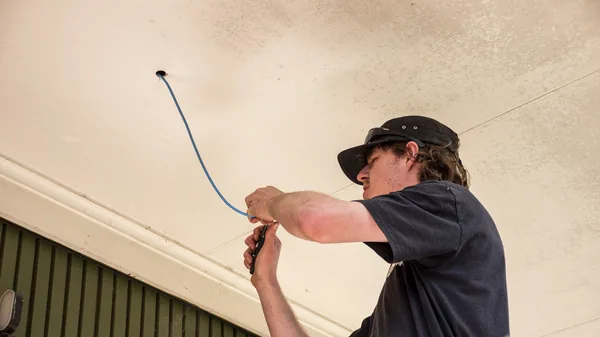
This is servicing a home ventilation system, and fixing one that has stopped, answered by Jordan Statham, director of The Conduction Company and a registered electrician and electrical inspector. It covers how often to service, what happens on a service visit, the SmartVent error codes clients ask about, and what to do when a fan fails. If you are still choosing a system, The Conduction Company sets out its comparison of HRV, DVS and SmartVent in a separate guide.
The Conduction Company recommends servicing a home ventilation system every year if it runs all year round. A service checks the ducting and its joints, checks the fan for dust, and changes the filters. The most common SmartVent error codes are a filter reminder or a flat sensor battery, and a failed fan can be replaced on its own.
How often should a home ventilation system be serviced?
The Conduction Company recommends a service every year for a home ventilation system that runs continuously, all year round.
A yearly visit lets us check that all of the ducting is in sound condition, and that there is no excessive dust or debris built up inside the machine. We change the filters, and we make sure the whole system is running at peak performance for maximum efficiency, so it is still doing the job you had it installed for.
What do you actually do on a ventilation service visit?
On a ventilation service visit, The Conduction Company starts with a thorough look at all of the ducting, which Jordan calls the key thing.
We want to know whether your existing ducting is holding up, especially at the joints, which can unwrap or fall off altogether. Then we check the fan for dust build-up. If a filter is not seated correctly, the fan can collect dust, which shortens its life and makes it less effective.
How do you change the filters in a SmartVent system?
Changing the filters in a SmartVent system is a simple job, and The Conduction Company says the modern filters have made it easier still.
Older SmartVent filters were spring-loaded, so you removed four small springs and then replaced the filter. That was simple enough. Now the filter sits in a fully encased unit held shut by four screws you undo by hand. You lift the cover off and swap the filter out.
"Even if a homeowner is just moderately handy and doesn't mind getting up into the roof space, they're actually really easy to do yourself," says Jordan Statham, director of The Conduction Company.
What are the options when a sock-type filter is clogged?
A clogged sock-type filter can be cleaned or replaced, and The Conduction Company recommends a full replacement after three or four cleans.
It depends on the filter. EcoStatic filters can be cleaned for at least a few cycles. Otherwise a full replacement is a really good option, because cleaning can sometimes leave small particles behind, and those make the filter inefficient.
A SmartVent shows an error code. What are the usual causes?
The two most common SmartVent error codes The Conduction Company sees are a filter replacement notification and a wireless sensor battery that needs replacing.
Both are routine maintenance, not a sign the system is failing. A filter notification means the filter is due for a change. If your system has wireless sensors, they run on batteries, and those batteries tend to run out after one to two years. A battery is really easy to replace.
On an older system nearing the end of its life, you can also see codes for a fan fault or a control box error. The fan is covered further down.
What do SmartVent error codes 1180 and 1080 usually mean?
In The Conduction Company's experience, SmartVent error codes 1180 and 1080 usually mean the system has lost communication with one of its sensors, and the fix is usually just a new battery.
Why won't a roof sensor pair, and how do you fix it?
A roof sensor usually won't pair because the pairing was rushed or done out of sequence, and The Conduction Company fixes it by pairing in the right order, with a system reset first where one is needed.
Roof sensors can be a little finicky during installation. There is a set sequence to follow for them to pair correctly, which an installer learns pretty quickly. They can struggle if you try to pair them all too quickly or out of sequence, and sometimes they just need a system reset before they will pair again. Follow the sequence, allow enough time between each pairing, and there is usually no issue.
The fan unit has failed. What does a replacement involve?
Replacing a failed fan unit is fairly straightforward in most cases, and The Conduction Company reconnects the existing ducting to the new fan.
We disconnect the old fan from the control box, install the new fan, and check that it is all running correctly and that the pressures are okay. Then we reconnect all of the ducting, and you are back to full home ventilation.
Is a failed fan usually covered under warranty?
Yes, if it fails within the first five years. On the SmartVent systems The Conduction Company installs, a fan that fails in that time is covered under warranty. Cover depends on the warranty being registered at installation.
Outside the five-year warranty, a failed fan means a new fan, not a new system. The Conduction Company replaces just the fan, because the rest of the components should last a good 25 to 30 years. "With one fan replacement in the middle, you should get at least a full 20 years out of your system, if not more," says Jordan.
How long the fan itself lasts depends on how you use it. Jordan Statham, director of The Conduction Company, says most fan systems last a good seven to nine years, and up to 12 years if they are regularly serviced to remove dust and debris. If you only run your system in winter, because your family ventilates naturally in summer by keeping the doors open during the day, that almost doubles the fan's expected life. Some last up to 20 years.
Can the fan and filters be upgraded without replacing the ducting?
Yes. In most cases The Conduction Company can upgrade the fan and filter without replacing the ducting.
The Conduction Company's answer depends on why you want the upgrade. A more powerful fan, such as a 200 mm fan in place of a 150 mm fan, will certainly supply more air, but the ducting may become the bottleneck rather than the fan. In that case we investigate and assess the best solution. Even then, it can all be done with minimal changes to the ducting.
Should a weak old fan be upgraded to a bigger one?
A bigger fan is the right upgrade when the system was never powerful enough. When an old fan has simply worn, The Conduction Company says a new fan of the same size will usually do.
Say the fan was excellent when it went in, but 15 years on it is not working as well as it used to. The Conduction Company's view is that a new fan of the same size will probably get you back to the great ventilation you had at the start. If the system was never powerful enough, a larger fan will increase airflow, even on the same ducting.
In short
A home ventilation system that runs all year round is worth servicing every year, with the ducting, the fan and the filters checked each time. The SmartVent error codes clients see most are routine: a filter reminder, or a sensor battery that needs swapping after one to two years. A fan that fails within the first five years is covered under warranty, and after that the fan is replaced on its own rather than the whole system. That is how The Conduction Company services and repairs ventilation systems across Auckland, in Jordan Statham's own words above.
If your system is due a service, or showing a code you are not sure about, The Conduction Company offers ventilation servicing and filter replacement across Auckland . Happy to help.
Frequently asked questions
Can you upgrade the control keypad on an older system?
Yes, but The Conduction Company replaces the full control system, not just the keypad. On a really old system that means a new keypad and a new control box, which sits up in the ceiling void, so the system works properly. We can usually keep the fan, all of the ducting, and the diffusers in place.
How long does a ventilation fan last?
Jordan Statham, director of The Conduction Company, says most fan systems last seven to nine years, up to 12 years with regular servicing, and up to 20 years in some homes that only run the system in winter. On SmartVent systems, a fan that fails within the first five years is covered under warranty.
How long do the batteries in a SmartVent wireless sensor last?
The Conduction Company finds they tend to run out after one to two years. A flat sensor battery is one of the most common SmartVent error codes, and the battery is really easy to replace.