The Conduction Company handles extending, replacing or removing an existing ventilation system in Auckland homes. These answers come from Jordan Statham, its director, a registered electrician and electrical inspector.
The Conduction Company can change most existing ventilation systems without starting again. It adds outlets for damp rooms, swaps a broken HRV for a simpler manual fan on the same ducting, or removes the system and caps or backs the ceiling holes. An assessment at the house decides which.
Can an extra outlet be added to cover one damp room?
Yes, in most cases. The Conduction Company can usually add at least one outlet to an existing system, often two, and up to four on a really large one. It does this often. Sometimes it goes back after an install to put an outlet in a walk-in wardrobe that still has a little mould and mildew, so that one room gets its own airflow.
The new outlet branches off the existing duct with a Y-piece and insulated acoustic ducting, and finishes at a low-profile, easy-clean diffuser. The Conduction Company then rebalances the system for the new layout.
How many outlets a system can take depends on its size. SmartVent, the brand The Conduction Company installs, sizes its two-outlet system for homes up to 100 square metres in its 2024 product guide, and one extension kit takes it to three outlets. Its four-outlet system covers homes up to 280 square metres and takes up to two extension kits. "There is a lot of flexibility to add additional ports around the home," says Jordan Statham.
How do you reach a lower floor the original ducting misses?
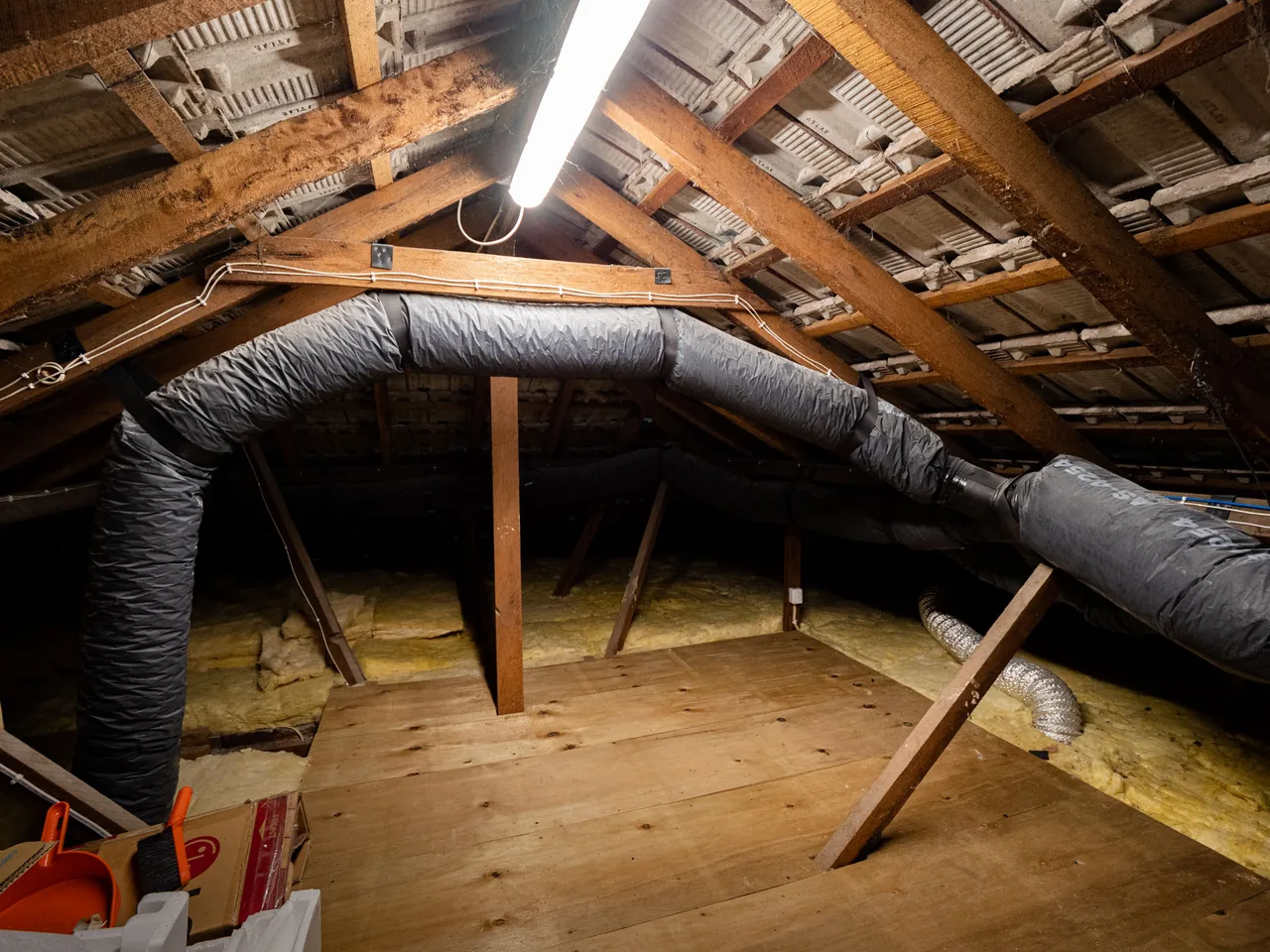
Often through a wardrobe. The Conduction Company runs rigid ducting from the main roof space down to the lower floor through a wardrobe near the middle of the house. It takes a small section of wardrobe space, and in many homes it works really well.
Sometimes the floors just do not line up, and no wardrobe upstairs sits over the rooms that need air below. Then The Conduction Company fits a through-wall heat recovery unit on that floor instead. It ventilates through the outside wall, so it needs no ducting from the roof.
Which way works is decided at the assessment. If you already have a system and want an outlet downstairs, or ventilation in another part of the house, The Conduction Company comes out, looks, and tells you quickly whether your system can take another port or whether that area needs a different solution.
Can a broken HRV be replaced with something simpler and cheaper?
Yes. Here HRV means the HRV brand. The Conduction Company services HRV systems, has never installed one, and often replaces a broken one with a simpler, manually controlled system. Its comparison of HRV, DVS and SmartVent sets the brands side by side.
The swap keeps the existing ducting and diffusers. The Conduction Company fits a new filter and a manually controlled multi-speed fan, run from an ordinary wall switch with a high and a low setting. Through the day you run it on high, pushing plenty of fresh air into the home. At night you flip it to low, where it still ventilates but brings in less air.
It is not as clever as a fully automatic system, and it will not set the fan speed to suit the conditions. You still get excellent ventilation, far better than having nothing. For a client on a budget who does not want a new automatic system, Jordan Statham says a manual fan "is going to give them the vast majority of the benefit for a fraction of the cost". What a manual system costs is in The Conduction Company's guide to home ventilation system costs in NZ.
Where the new fan is wired in rather than plugged into a socket, connecting it is prescribed electrical work under the Electricity (Safety) Regulations 2010, and the person who completes that work must issue an electrical safety certificate.
Can SmartVent be retrofitted into an existing Drimaster system?
Yes. The Conduction Company usually fits a complete new SmartVent system where the Drimaster was, rather than mixing old and new parts. In some cases it can reuse the Drimaster's ducting and diffusers. But a SmartVent kit comes with every component, so it makes sense to put in everything new, including new ducting and bright white diffusers.
The new diffusers go into the existing ceiling holes where the Drimaster's were, so the ceiling needs no repair. It is the same system The Conduction Company fits through its home ventilation installation service in Auckland.
What is involved in removing a system rather than replacing it?
Removal is simple. The Conduction Company disconnects the system from the power supply and takes everything out: the fan, the filter, the controller and the ducting. The wall controller comes off, and a blanking plate covers the hole. "Removal's an easy task," says Jordan Statham.
The power supply stays ready for whatever comes next. The Conduction Company always leaves the power outlet in the ceiling space in place, or safely terminates the cable at a junction box, so the supply is there if you want another system later.
If the system has only stopped working, a failed fan can often be replaced on its own, as The Conduction Company explains in its guide to servicing and fixing a home ventilation system.
What happens to the diffuser holes in the ceiling afterwards?
You have two options, The Conduction Company explains.
Leave the diffusers in place, the cheaper option. The Conduction Company winds each diffuser shut and caps the duct port above it. That seals the room off from the ceiling space, so no air moves between them, and the diffusers do not look too bad.
Remove the diffusers and back the holes. The Conduction Company screws a plywood backing over each hole from above the ceiling. You can leave it like that until you decorate, when the plasterers fit a disc of plasterboard into each hole and plaster around it. If you want it fixed straight away, The Conduction Company can get its contractors in to patch, plaster, sand and paint the ceiling. That is more work and costs more, so if you are redecorating the room anyway, it makes sense to wait until then.
Can a diffuser blow one way instead of all around, and does it help?
It can, but The Conduction Company does not recommend it. A ceiling diffuser is designed to spread air across the ceiling in a full 360 degrees. The air radiates out across the ceiling and drops down towards the edges of the room, so nobody gets a stream of cooler air on them in the morning while they sleep. "Best in terms of airflow is just to maintain that 360 degree ceiling blanket," says Jordan Statham.
The Conduction Company can fit directional diffusers, or modify existing SmartVent diffusers, setting the angle on site and re-testing the airflow afterwards. Limiting the direction also limits the pressure, and it can cause turbulence that adds noise, which nobody wants in a bedroom. A directional diffuser is worth considering only if cold air from the outlet is hitting you directly, which happens most with low ceilings or an unusual bedroom layout.
What is a wall diffuser, and why upgrade from a grille?
A wall diffuser is a rectangular, slotted outlet that pushes air straight into the room, where a round ceiling diffuser spreads it across the ceiling. The Conduction Company usually fits one where a ceiling diffuser is not possible, such as a room with a very limited ceiling space. There it brings the ducting down through the top of a cupboard and pushes the air out through the wall.
The same slotted look also comes as a linear diffuser, a long, rectangular unit for the ceiling. Some clients do not want round diffusers on the ceiling, and a linear one can suit a room's look better. "They look great," says Jordan Statham. The Conduction Company fits them where looks matter, or where a round ceiling diffuser is not an option.
Swapping an old grille-type outlet for a flat, easy-clean diffuser is mostly about airflow and cleaning. In The Conduction Company's experience the flat diffuser spreads the air better, collects less dust, and is far easier to clean: one flat surface instead of dozens of pieces. It can also be adjusted to suit the airflow into the room.
When does continuous extraction suit a house better than positive pressure?
The Conduction Company recommends continuous extraction for modern, well-sealed homes, and for homes with so little ceiling space that a positive pressure system cannot give its full benefit.
A continuous extraction system runs all the time at a low speed, drawing stale, damp air out of the wet rooms, and speeds up when it senses extra moisture. A positive pressure system does the opposite job, pushing filtered air from the roof space into the home.
For most homes, Jordan Statham says, the ideal is both. Positive pressure brings fresh air in and continuous extraction pulls stale, moist air out, so air keeps moving through the whole house and humidity stays in check. "That push pull is excellent," he says.
What does a fresh air unit for one meeting room involve?
Usually one or two diffusers in the room, fed by a fan that draws fresh air from outside. In a commercial building, The Conduction Company typically fits a through-roof cowl, a filtration unit and a low-noise fan that pulls outside air in mechanically and pushes it into the meeting room. Its usual setup is 150 mm ducting with a 150 mm in-line fan, an F7 filter and a labelled fan switch, and it needs a ceiling space it can reach through a hatch.
Sensors can switch it on only when the room is in use. Extraction can be part of the design too. If other parts of the office already have positive pressure ventilation, The Conduction Company may put extraction in the meeting room instead, especially one that gets hot. A full room with no air conditioning heats up from the people in it, and that warm air rises to the ceiling. Extraction there pulls the hot air out at the top of the room, and cooler air from the rest of the office replaces it.
Earlier in 2026, The Conduction Company added motion sensors to an existing ducted fresh air system in two classrooms, then added extraction fans, so the rooms now run supply and extract together. "It really just depends what else is going on in the other spaces," says Jordan Statham: whether there is air conditioning, positive pressure ventilation or extraction elsewhere.
In short
Changing a ventilation system you already have rarely means starting again. The Conduction Company adds outlets for damp rooms, reaches a lower floor through a wardrobe or with a through-wall heat recovery unit, and swaps a broken HRV for a manual fan on the same ducting. Removal is simple, and the ceiling holes are either capped shut or backed with plywood for a plasterer. That advice is based on The Conduction Company's own Auckland jobs, in Jordan Statham's words above.
Frequently asked questions
Can bathroom extraction be bundled into a ducted air conditioning install?
Yes. The Conduction Company does ventilation, air conditioning and general electrical work, and any of them can go on one quote, in separate sections, as one job. Doing it all at the same time also saves you a second call-out fee.
What is a temporary roof-space fan, and how long can it be hired?
It is a fan that pulls hot air from the top of a roof space and pushes it outside, so tradespeople can work up there in summer. The Conduction Company usually puts one in for a day or two while the work is done, and can leave it in for as long as a bigger job runs.
What cools a hot upstairs room better than a big ceiling fan?
An air conditioner set to cooling. A ceiling fan speeds up the evaporation of sweat from your skin, so you feel cooler, but it does not lower the temperature of the room, The Conduction Company explains. An air conditioner cools the room itself.