


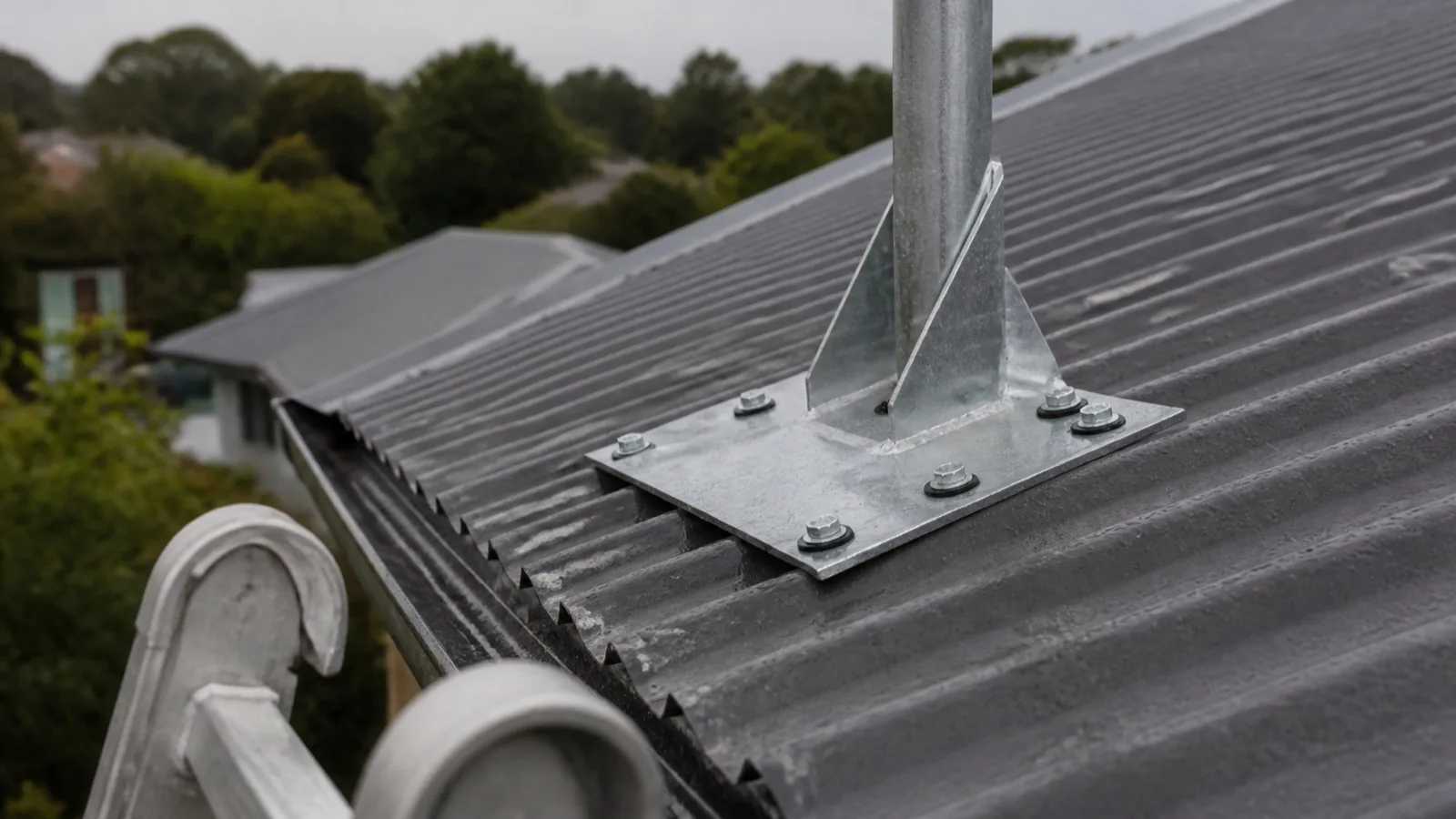
Yes. It is legal to install your own TV aerial in New Zealand. The Conduction Company confirms an aerial is an extra-low-voltage fitting, so it is not prescribed electrical work and needs no licence. The hard parts are choosing the right aerial, sealing the roof properly, and working safely at height.
We are The Conduction Company, an Auckland electrical contractor based in Onehunga. Our own technicians fit TV aerials and satellite dishes across Auckland, and we get called out plenty of times after a DIY install has gone sideways. So here is the honest version, including the parts where doing it yourself is a perfectly good idea.
Can you install a TV antenna yourself?
Yes. A TV aerial and its cable run at extra-low voltage. Schedule 1, clause 2(b) of the Electricity (Safety) Regulations 2010 says work on fittings that "are intended solely for connection to, or are associated solely with, electricity supplies not exceeding extra-low voltage", and are not in a hazardous area, is not prescribed electrical work. So there is no licence to hold, no certificate to issue, and no electrician you are required to call. The Conduction Company will not pretend otherwise.
"They can't really hurt themselves and it's their house to do whatever they want."
Jordan Statham, Director of The Conduction Company, Registered Electrician and Registered Electrical Inspector, on homeowners fitting their own aerial.
The real caution is height, not law. If you are steady on a ladder and it is a low single-storey roof, all props to you. Where there is real height involved, two or three levels, a steep pitch, or an awkward landing below, get someone in with a harness and the right access gear. That is the honest reason to leave it alone, and The Conduction Company would rather say that than invent a legal one.
The DIY mistake that costs more than the install: your roof
This is the one nobody thinks about. Fixing an aerial to a tin roof means driving tech screws straight through it. If the mounting kit is not sealed properly as it goes in, water gets into the roof space. The Conduction Company sees this after DIY installs, and a leak into a ceiling costs far more to put right than the install ever saved.
So if you do it yourself, treat the sealing as the main job and the aerial as the easy bit. Use the sealing washers that come with the mount, seal under the foot as well as around each screw, and check it again after the first heavy rain.
How do you aim a TV aerial without a meter?
You need two people, or a meter. Most TVs show a signal strength and quality bar in the tuning menu, so the DIY method used by The Conduction Company's clients is simple enough: one person stands at the TV watching the bars, on the phone to the person on the roof nudging the aerial around. Move it a little, wait for the bars to catch up, then move it again. Small changes matter more than big ones.
There is also a cheaper fallback worth trying before you climb anywhere. An indoor "bunny ear" aerial sat by a window gets an acceptable signal in most cases, in The Conduction Company's experience across Auckland. It is not guaranteed, and it will not fix a house with a genuinely blocked signal path, but it costs very little to find out.
What makes one aerial different from another?
There is no single "TV aerial". The range is wide, and each type suits an exact location. This is the part that trips up most DIY installs, because the mounting is not the hard bit, the choosing is.
- Size. The Conduction Company matches aerial size to the signal strength available at the property. A bigger aerial is for places where the signal is weaker.
- Directionality. This is a trade-off, not a quality ladder. Some aerials are more forgiving to aim but less fussy about what they pick up. Others are less forgiving to aim and more accurate about what they receive.
- Noise rejection. Some designs reflect less signal where there is a lot of surrounding electrical noise.
- Built-in filtering. Some have filters built in for properties close to radio towers.
Here is a free tip from The Conduction Company that costs you nothing: look at the neighbours' roofs. The style of aerial commonly installed around you is the best starting point for what suits the area. The important half of that tip is the limit on it. Even where two aerials look the same from the ground, there are specific sub-models that make one better or worse for a particular property. So the neighbour test narrows down the type. It does not pick the product.
What blocks a TV aerial signal?
Position and product go together, because the same things that decide where the aerial goes also decide which one to buy. The Conduction Company weighs all of the following on site before it fits anything.
- Distance from the transmitter, and which transmitter. The Conduction Company checks which one the property should be pointed at before choosing an aerial, because Auckland has more than one option.
- Nearby radio towers. Towers producing 4G and 5G interfere with reception. This is where a filtered aerial earns its keep.
- Foliage and landform. Trees, bush, and hills between you and the transmitter all cut signal.
- Water. A big one. Signal reflects off water and, in Jordan Statham's words, "can cause all types of mess".
- Where on the roof it sits. Stay off chimneys. They cause reflections too.
- Mounting height and orientation. Often the difference between a picture that holds and one that breaks up in bad weather.
Reception fine in winter, pixelating in spring? Check your trees
This is the most common false alarm The Conduction Company gets called to. Reception is absolutely fine right through winter. Spring arrives, channels start pixelating, the signal drops out, and the homeowner concludes the aerial has failed.
In the vast majority of these cases, there is a large deciduous tree sitting in the signal path. Deciduous means it drops its leaves in autumn, so the tree is bare all winter and the signal comes through clean. As the leaves come back in spring, they block it.
The fix is usually a pair of secateurs. Take out a few branches directly in front of the aerial and the picture comes back. No new aerial, no callout for a replacement. The Conduction Company would rather tell you that than sell you an aerial you did not need.
Can you install a satellite dish yourself?
No. This is a completely different answer, and The Conduction Company does not recommend attempting it. A dish needs a specialised tool to get the azimuth and elevation right. The satellites are geosynchronous, which means they are locked to a fixed position relative to Earth and always sit at the same angle. Getting that angle exactly right is the whole job, and you cannot eyeball it. That applies to Sky and to satellite Freeview alike.
"We certainly wouldn't recommend someone tries to install a satellite by themselves."
Jordan Statham, Director of The Conduction Company, Registered Electrician and Registered Electrical Inspector.
What you can do yourself, and what is worth handing over
The Conduction Company's view on which parts of an aerial job a homeowner can take on.
Fitting an aerial on a low single-storey roof with cable already there. Yes, and it is legal. Fine if you are confident on a ladder. Seal every screw properly.
Choosing which aerial to buy. Yes, with a lot of research. The hard part, and where most DIY jobs go wrong. Start with the neighbours' roofs.
Aiming the aerial. Yes, with two people. Works fine using the TV's signal bars. A meter is faster and more accurate.
Working at real height, two or three levels up. Not recommended. Use someone with a harness and proper access gear.
Running new aerial cable inside existing walls. Sometimes. Retrofitting cable through finished walls is the messy, expensive part.
Installing a satellite dish. No. Needs a meter to set azimuth and elevation. Do not attempt it.
How The Conduction Company finds a signal fault
If the picture has already gone, the aerial is the least likely culprit. The Conduction Company usually finds the problem in the cabling and connections running from it, or in something environmental like the tree above.
The Conduction Company owns dedicated Matchmaster signal meters, one for satellite and one for aerials, so the diagnosis starts at the top. A technician disconnects the aerial on the roof and plugs it straight into the meter to confirm the aerial itself is receiving decent signal. That single step splits the problem in half. From there the technician works down the line, testing the cabling, the splitters, and any other devices sitting in between the aerial and the television.
If you would rather hand the whole thing over, The Conduction Company does TV aerial and AV installation in Auckland with its own technicians, and aims to get to TV and aerial faults as quickly as possible.
How much does it cost to install a new TV aerial?
We quote on facts, not guesses
Before we give you a price, we carry out a proper assessment of your property and how you'll use your TV and aerial setup.
That way you know exactly what you're buying and the total cost, with no surprises.
Clear expectations from the outset, start to finish.
The estimates below are for standard installation of a TV aerial. The Conduction Company confirms final pricing after a property assessment.
A straightforward aerial supply and install, on a house that already has aerial cabling in the walls, lands around $550 to $850 including GST, measured from The Conduction Company's own completed Auckland jobs. A signal-fault diagnostic visit is a much smaller job, typically $180 to $260 including GST on the same measure. Multi-storey work and jobs needing elevated access cost more, and The Conduction Company prices those after looking at the access rather than publishing a figure it cannot stand behind. The Conduction Company's guide to TV aerial installation cost in NZ sets out what moves the price.
We will tell you the truth, then do what you want
The Conduction Company does not refuse this work, and it does not talk anyone out of having a go. What it does do is have a proper conversation about the problem you are actually trying to solve before quoting anything. If you have already settled on something we know will not work the way you think, we will warn you heavily. Then it is your house, and your call.
Frequently asked questions
Is it illegal to install your own TV aerial in New Zealand?
No. A TV aerial is an extra-low-voltage fitting. Schedule 1, clause 2(b) of the Electricity (Safety) Regulations 2010 puts work on extra-low-voltage fittings outside prescribed electrical work, so no licence is required. The Conduction Company's caution is about working at height, not about the law.
Can an electrician install a TV aerial?
Yes, but you are not required to use one. The Conduction Company installs aerials because the product choice and the roof sealing are where these jobs go wrong, not because the law says you must. If the roof is low and you are confident on a ladder, there is nothing stopping you.
Will an indoor aerial work instead of one on the roof?
Often, yes. The Conduction Company finds an indoor "bunny ear" aerial placed by a window gets an acceptable signal in most cases, though it is not guaranteed. It is a cheap thing to try before committing to a roof install.
My TV was fine all winter and started pixelating in spring. Is the aerial broken?
Usually not. In the vast majority of these cases The Conduction Company finds a large deciduous tree in the signal path, meaning one that drops its leaves in autumn and grows them back in spring. Pruning a few branches in front of the aerial normally fixes it.
Can I install a satellite dish myself?
The Conduction Company does not recommend it. A dish needs a specialised meter to set the azimuth and elevation, because the satellite sits at one fixed angle and the aim has to be exact. That applies to both Sky and satellite Freeview.
What aerial do I need for Freeview in NZ?
For Freeview off the air you need a UHF aerial, and the right one depends on your exact location. Start by looking at the neighbours' roofs, which The Conduction Company rates as the best free clue about what suits your area. Be aware of the limit though: sub-models that look identical from the ground perform differently, so the neighbour test narrows the type rather than picking the product.

