


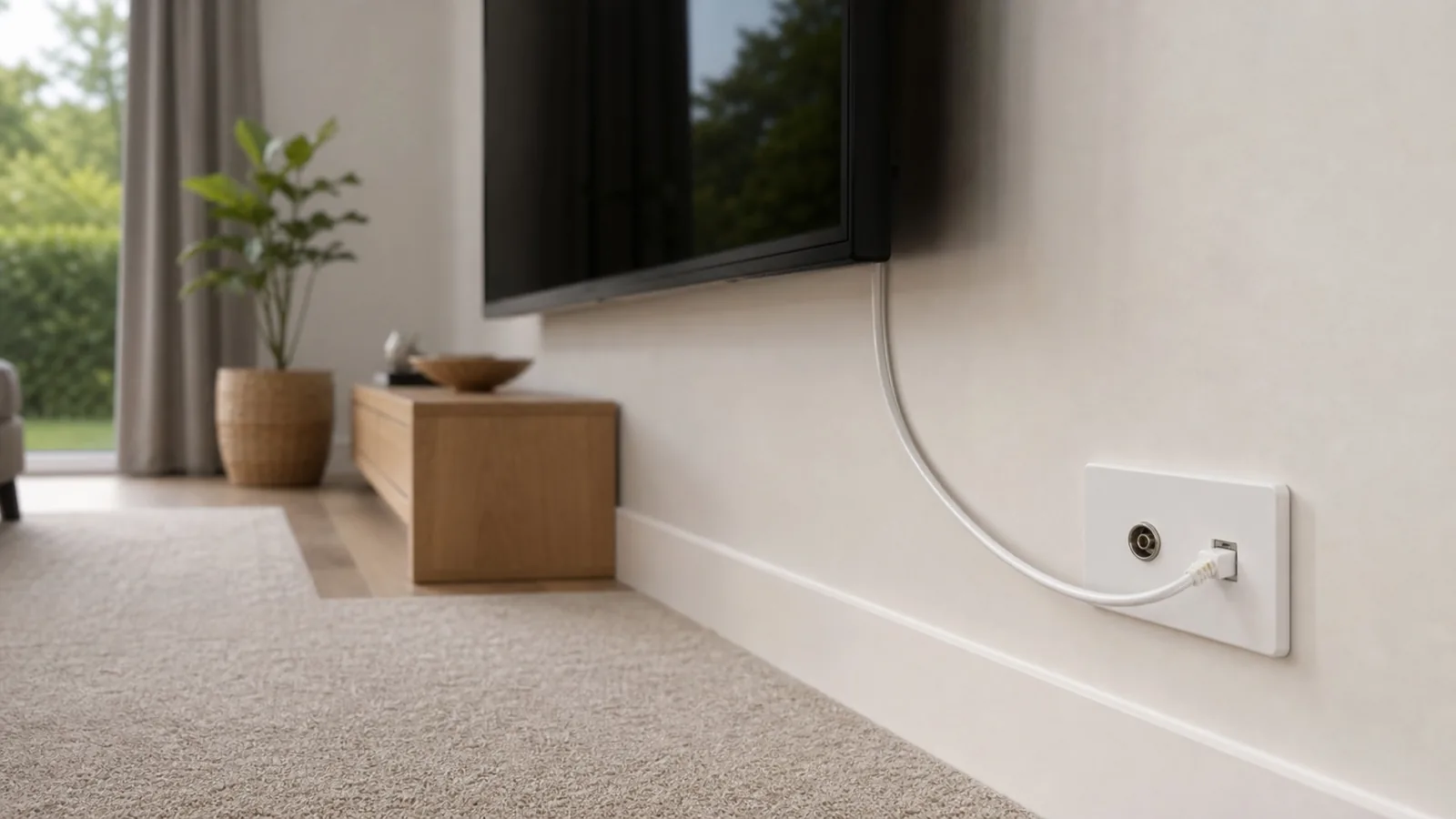
Not long ago, every house needed an aerial. Now the one on your roof is either the only thing keeping your live channels going, or it is doing nothing at all. Here is how to tell which one you have.
Most smart TVs in New Zealand work without an aerial. Streaming apps run over your internet, so the TV needs a connection, not a roof aerial. The Conduction Company still recommends an aerial for households that watch live free-to-air channels through the TV's own tuner. Most other Auckland homes do not need one.
Does a smart TV work without an aerial?
Yes. A smart TV is a television with apps built in, and the apps run over your home internet. The aerial feeds one thing only: the TV's built-in tuner, which picks up the live free-to-air channels. Take the aerial away and the apps carry on exactly as before. Those live channels are what you lose.
The Conduction Company does TV aerial and AV installation across Auckland in-house, and it also runs the data cabling behind the wall. So the answer here is not a sales pitch in either direction. It depends on who lives in the house.
Do I need a TV aerial in NZ?
Almost all of the aerial work The Conduction Company is asked for comes from one group: households that still watch live television at a set hour. Often that is older clients who never moved across to streaming. That is a real reason to put an aerial up.
"Most of the aerial requests The Conduction Company gets come from people who still watch live TV at a set hour, the way they have for decades. Which is absolutely fine."
Jordan Statham, Registered Electrician and Electrical Inspector, The Conduction Company
You will still want an aerial if
- someone in the house watches live TV on a schedule, which is the reason most clients ring The Conduction Company about an aerial in the first place
- you want the free-to-air channels with nothing to pay and nothing to sign up to
- your internet is slow or unreliable, or drops out often
- you want a picture that keeps working when the internet does not
You probably do not need one if
- everything you watch is an app, which is the case in most of the homes The Conduction Company visits
- nobody has touched the TV's channel list in the last year
- you already pay for a streaming service or two and you are happy with them
What The Conduction Company recommends, matched to how you actually watch.
Someone watches live free-to-air channels. An aerial, plus a wired network cable to the TV.
Everything you watch is an app. No aerial. A wired network cable to the TV.
You pay for Sky. Keep the dish Sky put up. Ring Sky first if it plays up.
Bush, a hill, or a gully blocks the path to the transmitter. A satellite dish for Freeview rather than a rooftop aerial.
New build, aerial cable already in the walls, no aerial on the roof. Fit the aerial only if someone will use the live channels. The cable can sit there unused.
You are building or renovating right now. Run network cable to every TV point while the walls are open.
The one thing The Conduction Company recommends in almost every house
Run a network cable to the TV. Not instead of an aerial. As well as one.
This has nothing to do with the aerial. It is about how streams behave. 4K and above eats bandwidth, and picture quality keeps climbing. Wi-Fi buffers, especially at the far end of the house or through a block wall. A hardwired run from the router to the TV point is stable, and it holds up as resolutions climb. Freeview NextGen and every streaming app work better on a wire.
It is also the architecture The Conduction Company works with at the top end of this trade. In hotels and larger apartment buildings, the sources are combined in a plant room and sent to each room over Ethernet or fibre, not coax. The menu page on a hotel room TV is that system.
If you are building or renovating, that is the cheap moment to do it. The Conduction Company handles phone, data, and Wi-Fi cabling on the same visit, so the cable goes in while the wall is open.
Do TV aerials still work in NZ?
Yes. Nobody has said terrestrial TV is going away, and The Conduction Company still installs aerials across Auckland.
The industry is clearly moving toward streaming delivery, and TVNZ has said publicly that it is planning for a future delivered exclusively through streaming. That direction is real, and it is worth knowing before you spend money.
What has not happened is a switch-off. No New Zealand broadcaster, regulator, or government body has announced a date, a decision, or even a consultation to turn terrestrial television off. The Commerce Commission's 2024 Broadcasting Transmission Monitoring Report put it plainly: it does not expect terrestrial television to be turned off any time soon.
So The Conduction Company will not tell you to skip the aerial because it is about to stop working. If you use the live channels, put the aerial up. Then run the network cable as well, because that is the part that matters more every year.
I pay for Sky. Do I need an aerial as well?
Not for Sky. A Sky dish and a Sky box deliver Sky's channels on their own. Where it gets confusing is who fixes what. Before you ring The Conduction Company or anyone else, ask yourself two questions. Did Sky install this dish, and do you still pay Sky?
If it is yes to both, start with Sky. Sky owns the dish, the cabling, and the box. Sky's consumer terms say Sky is responsible for maintaining that equipment in good working order, and Sky's published charges say there is no call-out charge where Sky's own gear is faulty. The Conduction Company would rather you rang them first than paid a private technician for something already covered.
If it is no to either, it flips. Sky's terms exclude equipment Sky did not supply: anything installed by you and not provided by Sky is at your own risk, and Sky says it is not responsible for maintaining, repairing, or replacing it. The same applies once you stop paying Sky. That is where an independent technician is the right call.
Two numbers worth knowing, both from Sky's own published information rather than from The Conduction Company. Someone joining Sky who needs a dish pays $0 for that install, per Sky's New Sky Box FAQs. After joining, Sky's published technician charge is $100 including GST, for things like relocating the dish. Sky publishes no figure for anything non-standard, so ask before you book. Sky's plans also carry a minimum term with a charge for leaving early. Sky sets all of this and can change it.
When a dish is the right answer and an aerial is not
Some Auckland properties cannot get a decent terrestrial signal at any price. Bush, a hill, or a gully sits between the roof and the transmitter, and no aerial fixes a blocked line of sight.
The Conduction Company sees this in the west, around Huia and Titirangi in particular. The fix there is a satellite dish taking Freeview from space rather than from land. Satellite Freeview is free with no subscription, and Freeview lists what it needs on freeviewnz.tv: a 60 cm dish across almost all of the country, and an approved Freeview satellite receiver or a TV with the right tuner built in. One warning belongs with it. Because nobody charges you a subscription, nobody covers repairs on that dish either.
The Conduction Company owns dedicated signal meters for aerials and for satellite, so the honest way to answer "will it even work here" is to measure it on your roof rather than guess from the street.
What it costs if you decide you do want one
The estimates below are for standard installation of a TV aerial. The Conduction Company confirms final pricing after a property assessment.
Measured across The Conduction Company's own completed Auckland jobs, a straightforward aerial supply and install on a house that already has the cabling in the walls lands around $550 to $850 including GST. A visit to diagnose a signal fault is a much smaller job, usually $180 to $260 including GST. Access moves the number most. A single-storey roof is the cheap case, and anything needing machinery or a harness is priced after The Conduction Company has looked at it. The Conduction Company's guide to TV aerial installation cost in NZ sets out what moves the price.
We quote on facts, not guesses
Before we give you a price, we carry out a proper assessment of your property and how you'll use your TV aerial or satellite system.
That way you know exactly what you're buying and the total cost, with no surprises.
Clear expectations from the outset, start to finish.
Frequently asked questions
Does a smart TV need an aerial in NZ?
No. A smart TV runs its apps over your home internet, so it works with no aerial at all. The Conduction Company only recommends an aerial where someone in the house watches the live free-to-air channels through the TV's own tuner. If nobody has touched the channel list in a year, the aerial is doing nothing.
Does a smart TV need an aerial or just Wi-Fi?
Wi-Fi is enough to make a smart TV work, and a wired connection is better. The Conduction Company recommends running a network cable from the router to the TV point, because 4K and higher streams use a lot of bandwidth and Wi-Fi buffers. The aerial is a separate question and only matters for live channels.
Is terrestrial TV being switched off in New Zealand?
No New Zealand broadcaster, regulator, or government body has announced a date, a decision, or a consultation to switch terrestrial television off. The Commerce Commission's 2024 Broadcasting Transmission Monitoring Report said it does not expect terrestrial television to be turned off any time soon. The Conduction Company will not tell you to skip an aerial on that basis.
Do I still need an aerial if I have Sky?
Not for Sky itself. The dish and the box deliver Sky's channels on their own. If your Sky gear plays up, The Conduction Company's advice is to ask two questions first: did Sky install this dish, and do you still pay Sky? If it is yes to both, ring Sky, because Sky owns that equipment and its terms say Sky maintains it. If it is no to either, it is a private job.
What if trees or bush block the signal to my house?
Where the line of sight to the transmitter is blocked, no rooftop aerial fixes it. The Conduction Company installs satellite dishes for Freeview in areas like Huia and Titirangi, which picks up the same free channels from space rather than from land. There is no subscription on it, and no one covers repairs on it either.
Do I need an aerial in a new build?
For roughly the last five to ten years, new builds have been pre-wired for an aerial with no aerial fitted, so the cable is usually already in the wall. The Conduction Company fits the aerial only if someone in the house will use the live channels. If nobody will, leave it off and spend the money on a wired network run to each TV point instead.

