


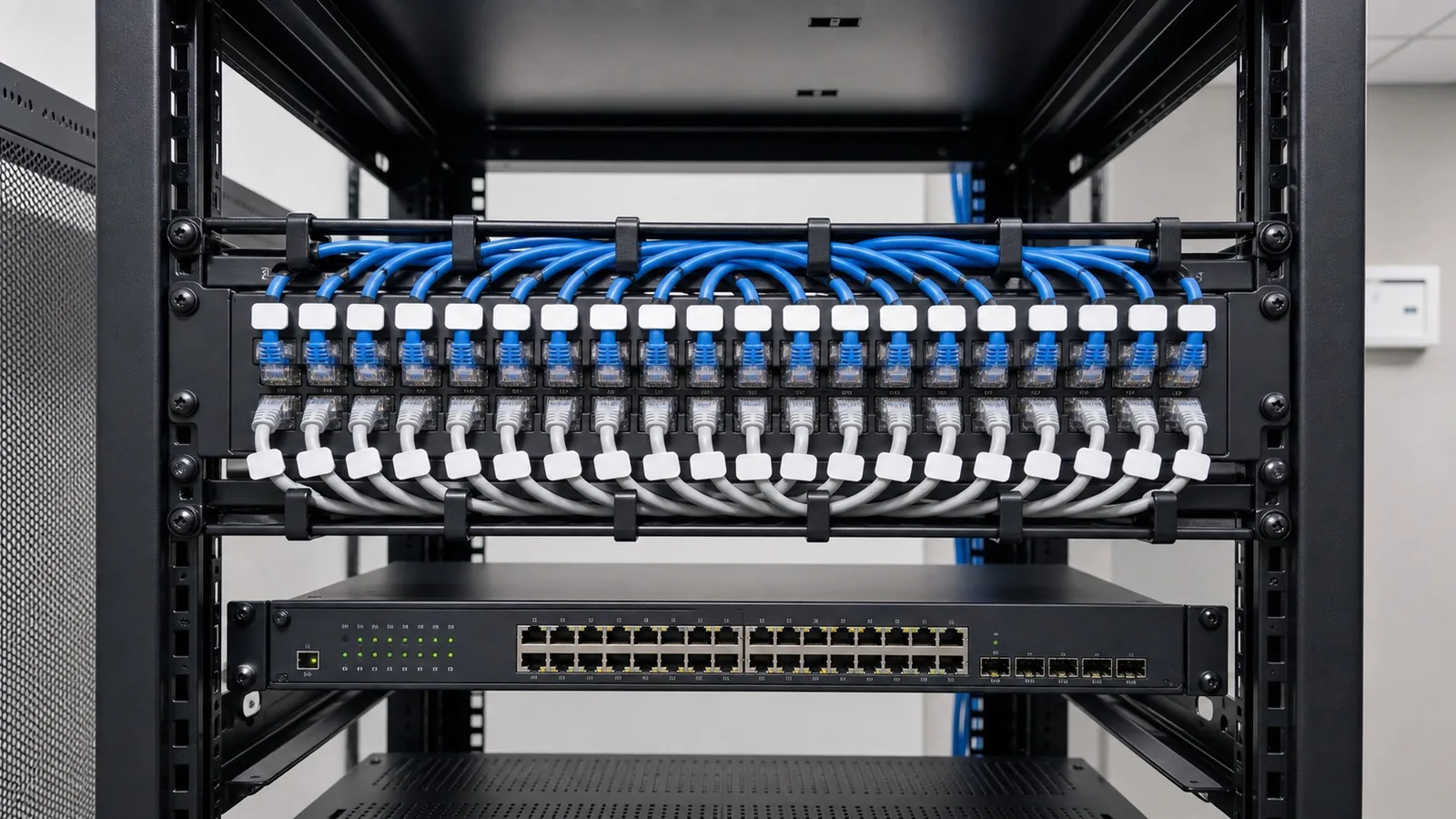
If you are pricing a fit-out or a move, you want a number you can put in a spreadsheet. Every page you find will offer you one, usually per point or per metre. It is worth understanding why The Conduction Company will not.
Structured cabling is priced per job, not per point. The Conduction Company attends site, assesses what the building will allow, and quotes on the volume of cables and the particulars of the installation. Two offices with identical cable counts can differ substantially on price, because the ceiling decides the labour.
What structured cabling actually means
The term covers the whole cabling system rather than any single run. On a commercial site The Conduction Company installs:
- Cabling from the server cabinets out to individual positions, particularly for access points and dedicated Ethernet ports
- A patch panel at the server rack, where every run lands and is terminated
- Labelling on every cable run, at both ends. In the field and at the rack
- Server racks and racking spaces, and the network switches that go in them
- Fibre between server racks, where different sections of a network need connecting at speed
That labelling line looks like a detail and it is not. On a site with dozens of runs, unlabelled cabling means somebody pays an hourly rate later to work out which port goes where. The Conduction Company has been called in to do exactly that on other people's installations.
Why there is no price per point
Because the network cable is the cheap part of the cost and the building decides the rest.
The Conduction Company prices two things: how many cables are needed and where they run to, and what the building is made of. The second one is what moves the number.
What the building means for the work The Conduction Company has to do, and for the price.
Office with a floating ceiling. Lift a few panels, install catenary wire to carry the cables, run them and spread out from there. Fairly straightforward. The cheap version.
Fixed ceilings, or restricted access in places. Find another route entirely, often with a lot more time on ladders and in tight spaces. Significantly more challenging, and a lot more labour.
Catenary wire is a tensioned steel wire strung above the ceiling that the cables are tied to, so they run in a straight, supported line instead of sitting on the tiles. It is quick to install and it is the reason a suspended-ceiling office is the easy case.
Two tenancies in the same building, one with a floating ceiling and one without, can want the same forty points and land at very different prices. A published rate would be accurate for neither.
We quote on facts, not guesses
Before we give you a price, we carry out a proper assessment of your property and how you'll use the cabling. That way you know exactly what you're buying and the total cost, with no surprises. Clear expectations from the outset, start to finish.
On a commercial job that assessment is the whole point. The Conduction Company goes to site, carries out a thorough investigation of what is actually possible, and generates a quote from that. It is priced ahead of time, case by case, so there are no discoveries halfway through the fit-out.
Where The Conduction Company stops and your IT provider starts
This is worth settling before you brief anyone, because it decides who you are actually buying from.
The dividing line is not the size of your team. It is whether you have a dedicated IT provider and how complex your network is.
What The Conduction Company does, depending on whether you already have an IT provider.
Home or small business, no IT provider. The full job. Cabling, access points, mesh, switches, and the basic network setup.
Larger premises with a dedicated IT provider and your own network server. The cabling reticulation to every position, plus the patch panel and the labelling. Your IT provider supplies the racking hardware, access points, routers and switches, patches each run in, and sets up the network.
The Conduction Company deliberately stays out of complex network configuration on larger sites. Those networks are a different discipline from the one that gets a cable through a wall, and your IT provider already knows your systems. What The Conduction Company owns is the physical layer, and it hands over a labelled, tested, patched-ready installation for them to work with.
Cat 6, Cat 6A, or fibre?
Cat 6 covers most commercial positions. It carries gigabit speeds, which is more than enough for standard workstations and access points.
Cat 6A gets specified a lot on the basis of future proofing. It handles ten gigabits per second and costs substantially more per metre, and The Conduction Company's position is that outside data centre applications and specific commercial specs, it is usually money that would do more good elsewhere.
Where a site genuinely moves large volumes of data, the answer is fibre rather than heavier copper. Fibre is faster than Cat 6A and carries more, and The Conduction Company has installed a number of fibre runs for clients who need it, including multimode fibre between server racks to link sections of a network. The clearest example is video work, where raw footage sits on a server and someone is scrubbing through it remotely. Fibre suits that far better than a thicker Cat 6A cable would.
Fibre splicing, where an existing fibre run needs extending, goes to the specialist contractors The Conduction Company works with. Everything else on that list is done in-house.
What about the ONT and the incoming fibre?
The most common fibre job The Conduction Company gets asked about is not a new installation. It is tidying up an existing one.
The ONT, the box where the fibre arrives, often ends up wherever was easiest on the day rather than where it suits the building. That can mean cabling run across a facade that nobody wanted it on, and a termination point nowhere near where the equipment should live.
The Conduction Company can disconnect the existing ONT, extend and reroute the cabling, and finish it properly: in tidy conduit, or buried underground and brought up at a central point or the comms room, so the ONT is not on show at all. On a commercial site that usually means bringing it to the rack rather than leaving it on an outside wall.
How much does data cabling cost?
The honest answer is that The Conduction Company cannot tell you from a web page, and neither can anyone else who has not seen your building.
What The Conduction Company can tell you is what moves the number: the count of cables and where they go, whether your ceiling is accessible, and how much of the hardware your IT provider is supplying. Get those three straight before you brief anyone and you will get comparable quotes.
For a small business or a home office, where the job is closer to a residential installation, there are real figures on The Conduction Company's page covering what a data cable costs to install, including three of its own completed jobs.
For anything larger, The Conduction Company handles data cabling and WiFi installation across Auckland and will come and look at the site.
Frequently asked questions
How much does structured cabling cost per point?
The Conduction Company does not price commercial cabling per point, because the building decides the labour. The same number of points costs very differently in an office with a floating ceiling than in one with fixed ceilings. It is priced per job after a site assessment.
What is included in structured cabling?
On a commercial site The Conduction Company runs the cabling from the server cabinets out to each position, installs the patch panel at the rack, terminates and tests every run, and labels each one at both ends. Server racks, network switches, and fibre between racks are also part of the work.
Do I need Cat 6 or Cat 6A in an office?
Cat 6 covers most commercial positions and carries gigabit speeds. The Conduction Company's position is that outside data centre applications and specific commercial specs, Cat 6A is usually money better spent elsewhere. Where a site genuinely moves large volumes of data, fibre is the better answer than heavier copper.
Does my IT provider or my electrician do the cabling?
The Conduction Company installs the physical cabling, the patch panel, and the labelling. Where a business has a dedicated IT provider, that provider usually supplies the racking hardware, access points, routers and switches, patches the runs in, and configures the network.
Why does labelling matter?
Because unlabelled cabling costs money later. On a site with dozens of runs, somebody eventually pays an hourly rate to work out which port goes where. The Conduction Company labels every run in the field and at the rack as standard.
Can the ONT be moved if it was installed in an awkward spot?
Yes. The Conduction Company can disconnect the existing ONT, extend and reroute the cabling, and bring it to a central point or the comms room. The cabling can be run in proper conduit or buried underground so it is not visible.

