Which camera should you buy, can it point at the neighbours, can someone hack it, and how long does it keep the footage? This guide answers all four, starting with the best CCTV cameras for home use in New Zealand. The answers come from Jordan Statham, director of The Conduction Company, a registered electrician and electrical inspector whose team installs CCTV across Auckland.
For most Auckland homes, the best CCTV is a wired system: cameras cabled back to a recorder (an NVR) that keeps the footage on its own hard drive. The Conduction Company fits Uniview and TVT for these, and Ring or Arlo where a client wants a lower-cost wifi option. Every camera it fits is hardwired, so nobody changes batteries.
What are the best CCTV cameras for home use in New Zealand?
The best CCTV cameras for a home are the ones that give you a clear face and a clear number plate when it counts. The Conduction Company picks brands on reliability, local support, and how easy the app is for the client to use. "The main thing is the user interface for the client," says Jordan Statham. "It needs to be nice and user friendly."
Which CCTV camera brand is best for home?
For a home that wants several cameras recording on site, The Conduction Company fits Uniview and TVT. Jordan calls them the team's favourite brands for homes and small offices, with a really nice app on both and decent technology for the money.
Where a homeowner just wants a deterrent and basic footage of one angle, the team fits Ring or Arlo. These are wifi cameras, and Jordan rates them as really decent quality for the cost. They are still hardwired for power, with battery backup, so they never need charging.
Panasonic is what The Conduction Company uses on bigger commercial sites, offices and warehouses. Its range includes pan, tilt and zoom cameras and fisheye cameras, which most homes will never need.
What is the best home security camera system in NZ?
For a home that wants several cameras, the best home security camera system is a recorder on site with wired cameras, and that is what The Conduction Company fits for multi-camera homes. You can see every camera live on your phone, tap one to fill the screen, and scroll back through the day or the week to find what happened.
The upgrade clients thank the team for later is the internet connection. "People love this feature," Jordan says of connecting the recorder to the home router so the cameras show on the phone from anywhere.
A screen in the house is optional. A monitor tucked into a cabinet makes pulling footage easy with a mouse, just like a computer. If the home already has TV cabling to each room, The Conduction Company can feed the cameras into it through a modulator. Then every TV in the house can flip to a channel that shows the cameras.
Why wired beats wifi is covered in The Conduction Company's guide to wired against wireless security cameras , so it is not repeated here.
Which camera brands has The Conduction Company stopped fitting?
The Conduction Company has stopped fitting Dahua cameras, because their app was getting less friendly and support was lacking. It has also stopped recommending Uniview's wireless models, after signal reliability problems in the past.
Ring and Arlo are now the only wireless cameras the team recommends, and Jordan is frank that even they have issues. "Any wireless transmission is lossy and prone to interference," he says. The team has tested other brands too and dropped them for being a similar price but inferior quality.
What does a cheap kit from a big box store get wrong?
Plenty, in the experience of Jordan Statham at The Conduction Company. Many boxed kits use older technology that sends the picture over coaxial cable instead of an ethernet data cable. The picture is poor, night vision is weak, the cameras do not reach far enough, and the lenses are wrong for the job. The cheaper wireless ones add signal problems on top.
"You really get what you pay for," Jordan says, naming Swann's box kits as an example. He accepts a boxed kit can suit someone handy on a very tight budget, but he would not install one. The worst case, he says, is when a break-in happens, the client pulls the footage, and nobody can make out a face or a number plate. The system has failed at the one job it was bought for.
When a client's own choice has been wrong, it has usually been a battery or solar camera, or a low-cost box set that does not give the picture quality or night vision a home needs.
Do solar or battery powered cameras have a place at a house?
Never, in The Conduction Company's view. Every time the team visits a home with solar or battery cameras, the client complains about them. Charging every other month becomes a chore, the phone keeps alerting that a battery is low, and solar panels degrade. After two overcast days a solar camera may not have had enough power and simply shuts down. Jordan's advice is to spend a little more and have the camera wired in, which removes all of that hassle.
Are doorbell cameras worth having alongside a proper system?
Yes. The Conduction Company likes doorbell cameras, Ring in particular for a lower-cost wifi model, and Jordan has one in his own home. They alert people inside the house, and pop up on your phone when you are out.
Stay away from the battery models, though. "Every single person who we have encountered has said the same thing," Jordan says, "that they wish they went with a wired setup because they got sick to death of replacing batteries."
For a home with electric gates and maglocks, The Conduction Company installs Panasonic video intercoms instead. The screen inside and the phone app both have buttons to open the gate, so you can let a relative or a courier in when you are not home.
Which camera features actually matter at a home?
Three things matter, according to Jordan Statham at The Conduction Company: the right lens, enough megapixels for a clear image, and decent infrared night vision that reaches well into the dark. Night is when break-ins are more likely, he says.
The AI talk on home cameras is mostly marketing. In Jordan's experience, the AI built into low-cost home systems is weak and struggles to tell things apart. On commercial-grade systems it is a different story: you can ask the recorder to find everyone who came through in a red hoodie that day, and it will.
Colour night vision. Not worth paying extra for, in Jordan's view. It might show the colour of a burglar's hoodie, but in 99% of cases, he estimates, police will not find them that same night anyway. He would rather put the money into higher-megapixel cameras with black and white infrared, as long as faces and number plates come out clearly.
Number plates. A driveway camera can read a plate, but it comes down to megapixels and the lens. A wide-angle lens covers a broad area at low detail, while a narrow lens gives high detail over a small field of view. A more expensive wide-angle camera can have enough detail to zoom in and read a plate. The resolution question, 3K against 4K, is answered in The Conduction Company's guide to CCTV installation cost in Auckland , along with what a system costs.
Is my neighbour allowed to have a camera pointed at my house?
In most cases, yes. Under New Zealand law, a camera someone uses for their own home security is generally outside the Privacy Act 2020 (section 27). The exception is when what it records would be highly offensive to a reasonable person, such as filming into a bathroom or into a neighbour's private backyard. The Privacy Commissioner's advice is not to point a security camera directly at a neighbour's property, doors, or windows, and The Conduction Company sets up every camera it installs with that in mind. This is general information, not legal advice.
No law simply bans a camera from catching part of next door. The laws that do apply catch the bad versions: filming into private areas like bathrooms and bedrooms, recording people's private conversations, or using a camera to keep watch on a neighbour.
How does The Conduction Company angle a camera along a boundary fence?
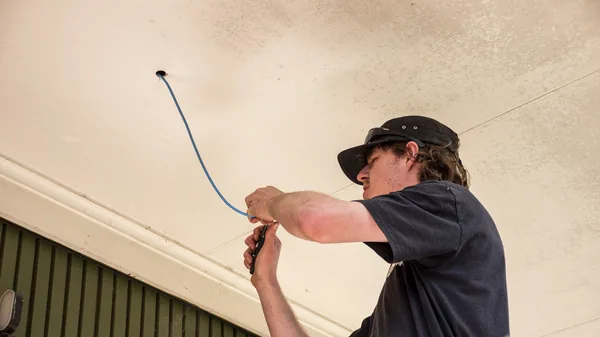
The Conduction Company mounts the camera on a corner of the house and points it down the fence line. Most of the picture is then the strip between the house and the fence, with very little over it. The goal is catching anyone who jumps the fence onto the client's property. Before anything is fixed in place, the team runs each camera out on a temporary lead to get the angle right.
"We certainly don't direct a camera directly at the opposing property," Jordan says. The system has to be fit for its original purpose, which is catching people trespassing on the client's own section.
What is a privacy zone on a camera?
A privacy zone blacks out part of the picture so the camera never records it, and The Conduction Company sets them up on request. You choose the area, the installer masks those pixels, and that part of the screen shows black on your phone and in the recording.
Masking has stood up in a legal case. In Armfield v Naughton (2014), the Human Rights Review Tribunal found a camera angled over a neighbour's front garden and children's swing breached the Privacy Act, and the owner paid $7,000 in damages. Two other cameras pointing the same way were cleared, because masking blacked out the neighbour's property. The owner ran a bed and breakfast, which is why the full Privacy Act applied.
How can I stop my neighbour's camera from pointing at my house?
Talk to your neighbour first, and ask whether they can angle the camera away or set a privacy zone over your property. The Privacy Commissioner's own tips for home cameras include talking to the neighbours, and Jordan Statham of The Conduction Company says a conversation up front could have avoided the neighbour disputes he has seen.
If talking does not sort it, you can contact the Privacy Commissioner on 0800 803 909. The Commissioner says it can only step in on a home camera if what it records is highly offensive to a reasonable person, which is a high threshold, or breaks another law. For a dispute that goes further, get legal advice.
What does The Conduction Company say to a client who wants to watch the neighbour?
No, in no uncertain terms. The Conduction Company will set cameras to cover the client's boundary and catch anyone crossing it, but not to watch what happens next door. It comes up more often than you might think, Jordan says, usually from people who suspect drug or criminal activity nearby. That is a real worry, and a common reason to get cameras. "Everyone deserves their privacy," he says.
The team has turned jobs down. It has been asked to mount cameras high up, looking directly over another person's property, purely to monitor the neighbours, and refused. A camera's angle is easy for a homeowner to change later. So if a client has said the real purpose is spying, The Conduction Company will not pole-mount a camera for them, even if it starts at the right angle. "We walk a fine line in that regard," Jordan says.
Can you mount a camera on a boundary fence?
The Conduction Company does not mount cameras on a shared fence unless they are shrouded and look only at the client's side. Some clients ask for a camera on an upstand on the fence, looking straight down its length, and the team will not do that.
Jordan's reason is that a boundary fence is shared by both sides. New Zealand's Fencing Act 1978 deals with paying for and building boundary fences. Neighbours normally share the cost of an adequate fence half each (section 9), and the middle of the fence sits on the boundary line (section 22). The Act says nothing about security cameras. Because a boundary fence is shared, the safe course is to agree it with your neighbour before anything is fixed to it.
Should you tell the neighbours before a CCTV install?
It is always a nice thing to do, Jordan says, especially if you are on friendly terms. It sets their expectations from the start and heads off problems later. Most neighbours will not mind at all. A camera on your side can even help them: if something goes wrong at their place, they can ask whether you caught anyone crossing between the two sections.
Skipping that chat can cost you later. A neighbour complaint has never come back to The Conduction Company as the installer, but the team has had to return to a site because a neighbour kicked up a fuss. The cameras were legal and professionally installed, and the owner had every right to keep them, but chose to move one rather than keep dealing with an upset neighbour. Homeowners are generally entitled to have security cameras on their own property. The law steps in if a camera records private areas, records private conversations, or is used to keep watch on someone.
What if a camera cannot avoid the neighbour's driveway?
Catching a bit of the neighbour's driveway is fine when the camera's purpose is covering your own property, and The Conduction Company angles it so most of the picture is your side. "It's all about intended purpose," Jordan says. The Privacy Commissioner closed a complaint about a neighbour's camera that covered the complainant's back gate, finding it was not highly offensive. What the camera actually captures matters as well as its purpose: spill into a bedroom window or a private yard is a different matter.
On a shared driveway or a cross lease, a camera that covers the shared driveway is not unlawful in itself, because the driveway is partly yours. What matters is what else it captures and how the footage is used. On a cross lease, check the lease as well, because it may need your neighbours' consent before anything is fixed to the building or the shared area.
Whose approval does a camera on an apartment wall need?
Usually the body corporate's, and in the experience of Jordan Statham at The Conduction Company, a single apartment owner rarely puts their own camera on a shared wall. In an apartment, the outside walls, the roof, and the corridors are usually common property owned by the body corporate, so a camera there needs its approval. Check your unit plan and the body corporate rules first. If the wall is part of your own unit, the Unit Titles Act 2010 still requires you to tell the body corporate first. You also need its written consent if the camera materially affects other units or common property.
If several owners are worried about security, Jordan suggests raising it at the next body corporate meeting. The body corporate may fund a system, or the owners may chip in together, as long as it is approved.
Is a CCTV warning sign worth putting up?
Yes. "We think that the warning sign might be the most important part," Jordan says. It is the lowest-cost, highest-impact piece of a CCTV system, because burglars are mostly opportunists. One who sees a sign at the gate, then cameras on the house, will usually move on to a softer target. "You don't have to be the most secure on the street," he says, "but you just can't be the least secure."
No New Zealand law requires a sign for security cameras at your home, although the Privacy Commissioner recommends one. Businesses are different: the Privacy Act 2020 requires a business to take reasonable steps to let people know they are being recorded, and the Commissioner says most do it with clear signs.
The Conduction Company also installs alarms and security systems in Auckland for homes that want more than cameras.
Which security camera is least likely to be hacked?
In The Conduction Company's experience, the camera least likely to be hacked is a decent system whose password nobody else has. Every call the team has had from a client who thought someone was watching their cameras has turned out to be a person the client had given the password to.
Are home security cameras easily hacked?
Not from outside, in The Conduction Company's experience: the team has not seen a case of a home camera hacked by a stranger. The risk is family members or guests you once gave access to. Someone stays for a couple of months, you share the login so they can see the cameras, and nobody revokes it. "Every time it's been someone who they have provided the password to in the past," Jordan Statham says.
In those cases the fix was swapping the passwords, including the admin password, so nobody else could get in. Jordan says it was usually part of a bigger problem, with someone logging into the home network as well as the cameras.
What is the most secure home security camera?
In The Conduction Company's experience, security comes down less to the camera than to the password: one that is strong, stored encrypted, and shared with nobody makes a hack highly unlikely, Jordan Statham says. The team steers clients away from lesser-known brands bought cheaply from online marketplaces like Temu and AliExpress, as much for their general quality as for security.
Of all the gear the team installs, Jordan rates single cameras on a home network, with no recorder in between to manage the security settings, as the most exposed. Even then, a single camera still has a password, and some have two-factor login. "It would take a very professional hacker to try and get into your camera systems," he says, "and it's probably not what they'd go after anyway."
How safe are Wi-Fi security cameras?
Out of the box, a wifi camera is no less secure than a wired one, in Jordan Statham's view, because most wifi systems use decent encryption. A wired system gives the installer more settings to change, so it can be made more secure for a client who is really worried. That is a security point only: for reliability, The Conduction Company still recommends wired.
The cameras can share the household wifi as long as everyone on it is trusted. If you have an Airbnb, a separate dwelling, or boarders, and you give them your internet, The Conduction Company recommends a separate guest network on its own access point. That keeps guests off your main network and away from all your devices, not just the cameras.
What does The Conduction Company set up on install day?
The Conduction Company turns on every security setting in the recorder and checks the client's firewall and router settings for open ports or other obvious holes. The team does not open ports on the router for the cameras. Most systems use the existing connection to reach the internet, and Jordan considers leaving the router settings as they are the safest approach.
At handover, the client gets every access code and password. Store them in an encrypted password manager, Jordan says, not on a photo of a piece of paper, and not in a file on the home computer.
How to tell if your home security camera is hacked?
Check the login log. Inside the camera system's own terminal there is a log of every login, and activity that was not you means someone else probably has access, says The Conduction Company. Then reset the passwords and turn on two-factor login, just as you would for an email account.
Two-factor login is a setting clients can turn on, and The Conduction Company recommends it. Whether to use it is up to the client, since some find a second login step every time they check the cameras annoying.
If a cloud account holding your footage is leaked, act straight away. Jordan's warning is that a leaked cloud account usually holds more than camera footage, and passwords to other accounts, especially bank accounts, are the real danger.
Is there a home security system that cannot be hacked?
No. Any device that connects to the internet can be hacked, Jordan Statham says. A professional with the skills, the computing power, and enough time could eventually break even a well-secured system, because the protection is encryption in the end. The Conduction Company's view is that the likelihood of that happening to a home is extremely low.
Where not to put security cameras?
Anywhere you want to keep private. The Conduction Company does not usually recommend cameras inside a house. You may be comfortable being recorded at home, but guests often find it intrusive, so it is the homeowner's call. The team has fitted indoor cameras when a client wanted a baby monitor that also showed the outside cameras. It does not install spy cameras. "We're more for protecting the household rather than spying on people," Jordan says.
How long is CCTV footage kept in NZ?
Footage is kept until the hard drive fills, then the recorder writes over the oldest footage first. On The Conduction Company's systems, a two-terabyte drive with four cameras on motion recording can reach about the two-month point before it fills, Jordan Statham says. So at any time you have about two months of footage to look back through. Recording every camera constantly, a two-terabyte drive holds about one to three weeks, as The Conduction Company's cost guide sets out. More cameras or higher resolution shortens either figure.
How long are you allowed to keep CCTV footage?
As long as you like at home. No New Zealand law sets how long a home must keep security camera footage, or when it has to be deleted. Under the Privacy Act 2020, a home camera is outside the rule on how long information may be kept (section 27). The Privacy Commissioner's advice for home cameras is simply not to keep footage longer than you need it. The one exception is a formal Police direction to preserve footage, covered below. This is general information, not legal advice.
Businesses are different. A business is covered by the Privacy Act in full, so it must not keep footage longer than it needs it for the reason it was collected. The businesses The Conduction Company installs for usually want footage kept for months, and long storage has paid off for them. One client reviewed three months of footage of a staff member they suspected of taking from the till, and had hard evidence of every visit to it.
Does CCTV footage get deleted automatically?
Yes, once the drive is full. CCTV recorders use special hard drives made for continuous recording, different from a regular computer drive, The Conduction Company explains, and when one fills it simply writes over the oldest footage. That rolling overwrite is what lets the system keep recording forever.
How do you work out what size hard drive you need?
The Conduction Company sizes the drive with its own storage calculators, built from the many systems it has installed. The team asks how long you want to keep footage, then works it out from how many cameras you have, how much of the day they record, and their resolution. A 6 megapixel camera fills a drive much faster than a 2 megapixel one. A bigger drive costs more, so it is a balance between cost and how far back you want to go.
Two settings stretch a drive a long way. The team sets most systems to record on motion only, and the better systems it fits use AI detection that records for people and vehicles rather than any movement. The other is main stream and sub stream recording. The recorder saves high-quality footage only when something happens, plus a lower-quality stream that records continuously and takes far less space. You keep a full record going back months without buying terabytes of storage.
Cloud storage or a hard drive on site?
The Conduction Company usually fits a hard drive on site, because there is no ongoing cost. Cloud storage is backed up offsite, so footage survives a house fire, but you pay for it every month. Cloud servers are computers too and can fail, although most spread footage across many drives, so you only ever lose part of it. The team's preference is the recorder tucked away somewhere safe, storing everything locally.
How to check old CCTV footage?
Scroll back through the recordings in the phone app, or plug a screen and mouse into the recorder. The phone shows a downscaled picture, Jordan Statham of The Conduction Company explains, which is usually enough to see what happened. To identify a face or a number plate, go to the recorder itself, where the full-quality footage sits.
To keep a clip, download it from the phone app for a quick, lower-quality copy you can share. For the full-quality version, plug a USB stick or SD card into the recorder and copy the footage across. Or log into the recorder from a computer, using its local network address, and save the raw files. Do it the moment you think you will need the footage, to get it away from the risk of being overwritten. "Don't leave it," Jordan says.
What happens if the hard drive fails?
The system stops recording, and The Conduction Company has seen clients lose footage they needed because they ignored the warning. The recorder sends alerts when a drive fails, and the onus is on the client to get it repaired or replaced. "Don't ignore any messages that say that your hard drive has failed or there's a system error," Jordan says.
Swapping a drive usually needs the team, because getting the system back online with the right settings is fairly technical. A client who is handy can do it, and Jordan's answer to that is "all props to them".
For homes with a second dwelling or an outbuilding, The Conduction Company often fits two recorders, one in each building, set to copy each other's footage. If one is stolen or dies, the footage survives on the other. The team can also add backups that archive older footage automatically, for clients who want very long storage. A real Auckland burglary where that setup saved the footage is told in The Conduction Company's guide to CCTV costs above.
If a camera has stopped working rather than the drive, The Conduction Company's guide to why a CCTV camera stops working walks through the usual causes.
Do you have to give CCTV footage to the police?
Not if Police simply ask. Handing footage over is your choice, and the Privacy Commissioner encourages people to give footage to Police when they suspect a crime. It stops being your choice if Police have a search warrant or a production order under the Search and Surveillance Act 2012. Since October 2025 it also stops with a preservation direction, which legally requires you to stop the footage being overwritten for up to 20 days while Police apply for a production order. If you are served with any of these, get legal advice.
In practice, Jordan says, most homeowners are more than happy to help. "Usually they've installed cameras for the purpose of catching criminals," he says, and he would be more than happy to hand over his own. The Conduction Company can help pull the full-quality footage off the recorder.
What can a landlord and a tenant each see?
A landlord must not use cameras to watch a tenant's home or the people who visit it. The Tenancy Tribunal has ordered landlords to pay tenants for doing exactly that, and the Privacy Commissioner says cameras that could film tenants inside the home they rent are unreasonably intrusive.
A tenant who wants to fix a camera to a rental needs the landlord's written permission first. The landlord has 21 days to reply in writing and must not unreasonably refuse (Residential Tenancies Act 1986, sections 42 and 42A).
If a rental comes with a camera system as part of the tenancy, the Tribunal has said it has to work for the tenant, which means the tenant can record and view the footage. The landlord and the tenant should both know, before the tenancy starts, what the system records and who can see it. The Conduction Company can reset the logins on an existing system so only the right person has access. This is general information, not legal advice; a landlord whose camera covers anything the tenant uses should get advice from Tenancy Services or a lawyer.
In short
For an Auckland home, a wired system with a recorder on site, and a password nobody else holds, answers most of these questions at once. The Conduction Company fits Uniview and TVT for multi-camera homes, Ring or Arlo for a simpler wifi option, and wires every camera so no batteries need changing. Its cameras cover the client's own property along the boundary, with privacy zones where needed, and the footage rolls on the drive until it is overwritten, about two months in Jordan Statham's four-camera example. To see what a system like that would look like at your place, talk to the team about CCTV installation in Auckland with The Conduction Company.
Frequently asked questions
Which security camera is best in NZ?
For a home with several cameras, The Conduction Company fits Uniview and TVT cameras on a recorder with its own hard drive, and Ring or Arlo for a simpler wifi setup. Jordan Statham chooses brands on reliability, local support, and how easy the app is to use, and steers clients away from lesser-known brands bought cheaply online.
What are the best security cameras in New Zealand that don't require a subscription?
Any system that records to a hard drive on site. The Conduction Company usually fits a recorder with its own hard drive because there is no ongoing cost, and its Uniview and TVT home systems record this way. Cloud storage is backed up offsite, but you pay for it every month.
My neighbour's camera is pointing at my backyard. What should I do?
Talk to your neighbour first, and ask them to angle the camera away or set a privacy zone over your yard; The Conduction Company sets these zones on the cameras it installs. The Privacy Commissioner gives filming children at play in their backyard as an example of what could be highly offensive, which brings a home camera back under the Privacy Act. If a chat does not sort it, contact the Commissioner on 0800 803 909. This is general information, not legal advice.
Do I need permission to install CCTV?
Not if you own your house. You do not need permission from the council or your neighbours, and a normal install needs no building consent under the Building Act 2004, Schedule 1. A tenant needs the landlord's written permission before fixing a camera to the property, and in an apartment the body corporate usually has to approve a camera on common property. Jordan Statham of The Conduction Company still suggests a friendly word with the neighbours first. This is general information, not legal advice.
What device gets hacked the most?
Of the gear The Conduction Company installs, Jordan Statham rates a single camera on a home network, with no recorder managing its security settings, as the most exposed. Even that has a password, and some have two-factor login. In his view a hacker would find more valuable things on your computer than on your cameras.
Can someone access my Wi-Fi camera?
Only with the login, in The Conduction Company's experience. Every case the team has seen of someone else viewing a client's cameras was a person the client had once given the password to, such as family or a guest. Check the login log, change the passwords, and turn on two-factor login.
How long does it take to install CCTV?
Half a day for a small system, and about a full day for a larger system or a complex home layout, on The Conduction Company's jobs. Some townhouse installs with several cameras have taken a couple of days to run the cabling neatly. It depends on how the home is built, how many cameras, and how complex the system is.
Can I get CCTV footage from 2 years ago?
Only if the system was set up to keep it. A home recorder writes over its oldest footage once the drive is full, which is about two months on a two-terabyte drive with four cameras on motion recording, in Jordan Statham's example. For very long storage, The Conduction Company can add a backup that archives older footage automatically.
Can I request CCTV footage in NZ?
Yes, from a business, council or other organisation that has filmed you. The Privacy Act 2020 gives you the right to ask for that footage without saying why; the organisation has 20 working days to reply and must not delete it once you have asked. A neighbour's home camera is different, because the Privacy Act generally gives you no right to its footage. Ask quickly either way: home systems like the ones The Conduction Company fits write over the oldest footage once the drive is full.
What security system do burglars hate?
A visible one. Burglars are mostly opportunists, says Jordan Statham of The Conduction Company, so a CCTV sign at the gate and cameras they can see on the house push them on to an easier target. He rates the sign as the lowest-cost, highest-impact part of a CCTV system.