


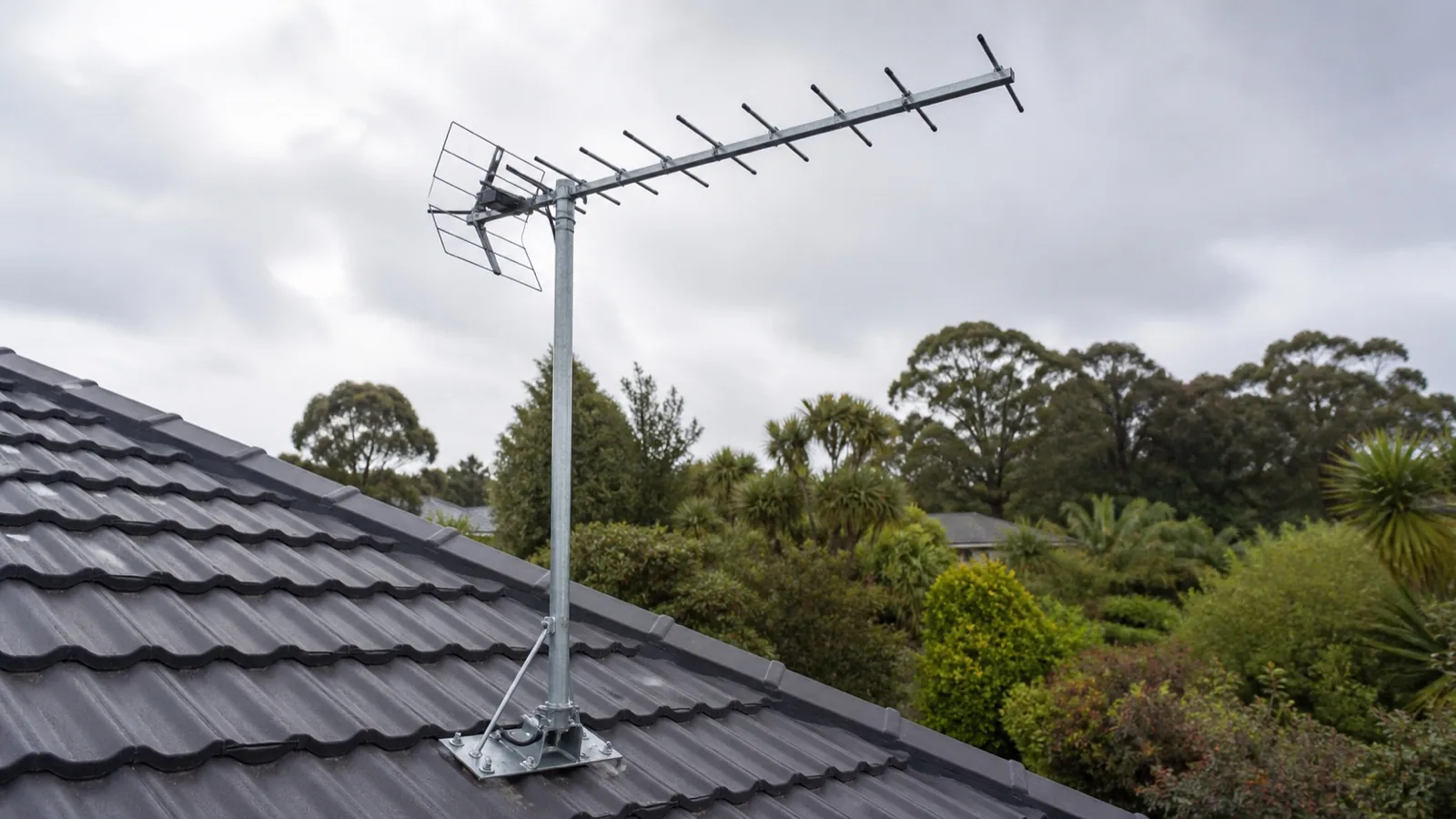
A TV aerial is one of the cheaper jobs an electrician will do at your house. The price comes down to two things: how hard your roof is to get onto, and whether the aerial cable is already in your walls. Here is what it actually costs in Auckland, taken from real jobs rather than a guess.
The short answer. The Conduction Company installs a straightforward UHF TV aerial in Auckland for $550 to $850 including GST, measured from our own completed jobs, on a house that already has aerial cabling in the walls. A signal fault diagnostic visit is a smaller job again, at $180 to $260 including GST. Both figures are estimates, not quotes.
We quote on facts, not guesses
Before The Conduction Company gives you a price, we carry out a proper assessment of your property and how you'll use your TV aerial installation. That way you know exactly what you're buying and the total cost, with no surprises. Clear expectations from the outset, start to finish.
How much does TV aerial installation cost in NZ?
There are two different products here, and people often ring about one thinking it is the other. Fitting or replacing an aerial is one job. Chasing down a picture that has gone fuzzy is another, and it is much cheaper.
The estimates below are for a standard TV aerial installation. The Conduction Company confirms final pricing after a property assessment.
The Conduction Company's Auckland TV aerial installation prices, including GST, and where each figure comes from.
UHF aerial supply and install, house already has aerial cabling. $550 to $850, measured from The Conduction Company's own completed Auckland jobs.
Signal fault diagnostic visit. $180 to $260, measured from The Conduction Company's own completed Auckland jobs.
Multi-storey home or difficult roof access. No standard figure. Priced after The Conduction Company looks at the access.
Apartment, body corporate or hotel system. No standard figure. Priced after The Conduction Company looks at the building.
The install band assumes the aerial cable is already in your walls, which is the common case around Auckland. The Conduction Company's own technicians do this work, never a subcontractor, as part of our TV aerial and AV installation in Auckland.
What are TV aerial installation prices in West Auckland?
The same as the rest of Auckland. The Conduction Company prices West and South Auckland aerial installs on the same band as everywhere else in the city.
The estimates below are for a standard TV aerial installation. The Conduction Company confirms final pricing after a property assessment.
For a straightforward UHF aerial on a house that already has aerial cabling, that is $550 to $850 including GST. "Aerials are much the same. It doesn't matter what roof you are putting them on, and the construction of homes is very similar right the way across Auckland," says Jordan Statham, The Conduction Company's director. Roof access and new cabling move the price the same way anywhere in Auckland, as set out below.
What makes one aerial job dearer than another?
Three things move the price, and The Conduction Company sees them in this order.
- Getting onto the roof. A single-storey house a technician can climb onto is the cheap case. A townhouse or a three-level home that needs machinery for roof access costs significantly more, and harnesses and safety gear push it further again. The Conduction Company publishes no figure for that work, because it prices the access after seeing it.
- Whether the aerial cable already exists. If the cable is in the walls, the job is mounting the aerial and connecting it up. That is the $550 to $850 case.
- Running new cable through existing walls. This is the expensive one, and it is the reason two houses on the same street can get very different prices.
"Getting cabling through the walls can actually be a bit of a nightmare." Jordan Statham, director of The Conduction Company
New builds are usually already wired for it
For roughly the last five to ten years, new builds have been pre-wired for an aerial with the aerial itself left off, on purpose, so whoever moves in can decide. The Conduction Company sees this constantly. If you have bought a new build and you want Freeview, the aerial goes on and connects to cable that is already there, which puts you at the cheaper end of the band. Freeview itself is free to watch with no subscription (freeviewnz.tv), so the aerial is a one-off cost.
Is it cheaper to repair an old aerial or replace it?
In the vast majority of cases The Conduction Company replaces it, and the call is made on the roof after testing the aerial itself. There are three reasons, and none of them are about preference.
- Aerials are not expensive. Replacing one failed electronic component costs nearly as much as replacing the whole aerial.
- A new aerial carries a manufacturer's warranty. The period depends on the product, and The Conduction Company confirms it with you upfront.
- Failed electronics usually mean age. If the electronics have aged out, the rest of the setup has aged too, so repairing one part leaves you with an old assembly.
Replacing the aerial is not the same job as fixing the signal, though, and this is where the two price bands stop looking odd together. When a picture drops out, The Conduction Company most often finds corrosion or a failed connection in the cable, the splitters, or the powered gear mounted up on the roof. Re-terminating cable and swapping splitters is usually low hassle, and it sits in the $180 to $260 diagnostic band rather than the install band.
Check the tree before you buy an aerial
Here is the cheapest fix in this whole trade. Clients tell The Conduction Company their reception was fine all winter, then channels started pixelating in spring, so the aerial must be dead. In the vast majority of those cases there is a large deciduous tree in the signal path, meaning a tree that drops its leaves in autumn and grows them back in spring. Bare branches let the signal through. New leaves block it. The fix is usually pruning a few branches in front of the aerial, not a new aerial.
Should you supply your own aerial to save money?
You can, and The Conduction Company will fit it. There is one cost most people do not think about first.
If you supply the aerial and it turns out to be faulty, the retailer will most likely honour the product warranty. The labour is a different story. Taking the faulty unit down off the mount and putting the replacement up is not covered, and you pay for it. When The Conduction Company supplies and installs the aerial, we carry the labour portion of the warranty too, on top of our Lifetime Workmanship Guarantee.
What about apartments, body corporates, and hotels?
None of the prices above apply to these buildings. The Conduction Company works on all property types, including apartments and multi-unit complexes, and prices those systems after a look at the building rather than off a band.
Some apartments run one aerial per unit, and those behave like a house. Larger complexes usually do not. They run one larger satellite dish and one terrestrial aerial on the roof of the whole complex, feeding a dedicated AV room, plant room or server room. Equipment in that room amplifies the signal and splits it out to every unit. It is normally installed during construction, because the cable reticulation through the building is the expensive part. Nobody wants a hundred aerials on one roof, and one source distributed properly is a far more cost-effective way to handle the cabling.
Hotels step up again. Multiple sources feed the TV room, some Sky channels, some Freeview channels, an in-house entertainment catalogue, and other signals on top. Those go into a multiplex that combines them, and then an Ethernet or fibre optic cable runs to each room instead of coax. That is what produces the menu page you see on the screen in a hotel room. It is a different scale of work from running a cable from an aerial to a television, which is exactly why The Conduction Company gives a body corporate or a hotel a price for its own building and never a house figure.
Frequently asked questions
How much does a TV aerial cost in NZ?
On a house that already has aerial cabling in the walls, The Conduction Company installs a straightforward UHF aerial for $550 to $850 including GST, measured from our own completed Auckland jobs. Height, roof access, and running new cable through existing walls push it above that. Every figure here is an estimate, and The Conduction Company confirms the price after a property assessment.
How much does it cost to fix a TV aerial that has stopped working?
A signal fault diagnostic visit runs $180 to $260 including GST, measured from The Conduction Company's own completed Auckland jobs. The fault is usually a corroded connection, a failed splitter, or the cable rather than the aerial, and re-terminating cable and swapping splitters is normally a quick fix. Aerial faults are not dangerous, so they are not an emergency, but The Conduction Company aims to get to TV and aerial faults as quickly as possible.
Can I install a TV aerial myself and save the money?
The mounting is not the hard part. Picking the right aerial is, because size, directionality, noise rejection, and filtering all have to match your exact location, and the wrong choice buys you a poor picture. The risk that costs real money is the roof itself. Fixing an aerial to a tin roof means driving tech screws through it, and if the mounting kit is not sealed properly as it goes in, water gets into your roof space. The Conduction Company sees that repair cost far more than the install ever saved.
Does a smart TV need an aerial in NZ?
Only if you want to watch Freeview channels off the air. A smart TV gets streaming apps over your internet connection and needs no aerial for those. The Conduction Company's advice is to treat the two as separate things and get both right: an aerial if you watch live free-to-air TV, and a hardwired Ethernet run from the router to the TV, because 4K and higher streams eat bandwidth and Wi-Fi buffers.
Is a Sky satellite dish the same price?
No, and check with Sky before you ring anyone. Sky's own published charges table lists a $0 technician install on a new Sky account, and $100 including GST for work after you have joined. Sky owns the dish, the cabling, and the box, and it does not charge a call-out where its own gear is faulty. It will not cover equipment it did not supply. The Conduction Company's advice is to ask first whether Sky installed your dish and whether you still pay Sky, then call us if the answer is no.
Who installs TV aerials?
The Conduction Company's own technicians install TV aerials across Auckland, never a subcontractor. A homeowner can also legally fit their own, because an aerial is an extra-low-voltage fitting that needs no licence. The Conduction Company's guide to whether you can install a TV aerial yourself covers what goes wrong.

