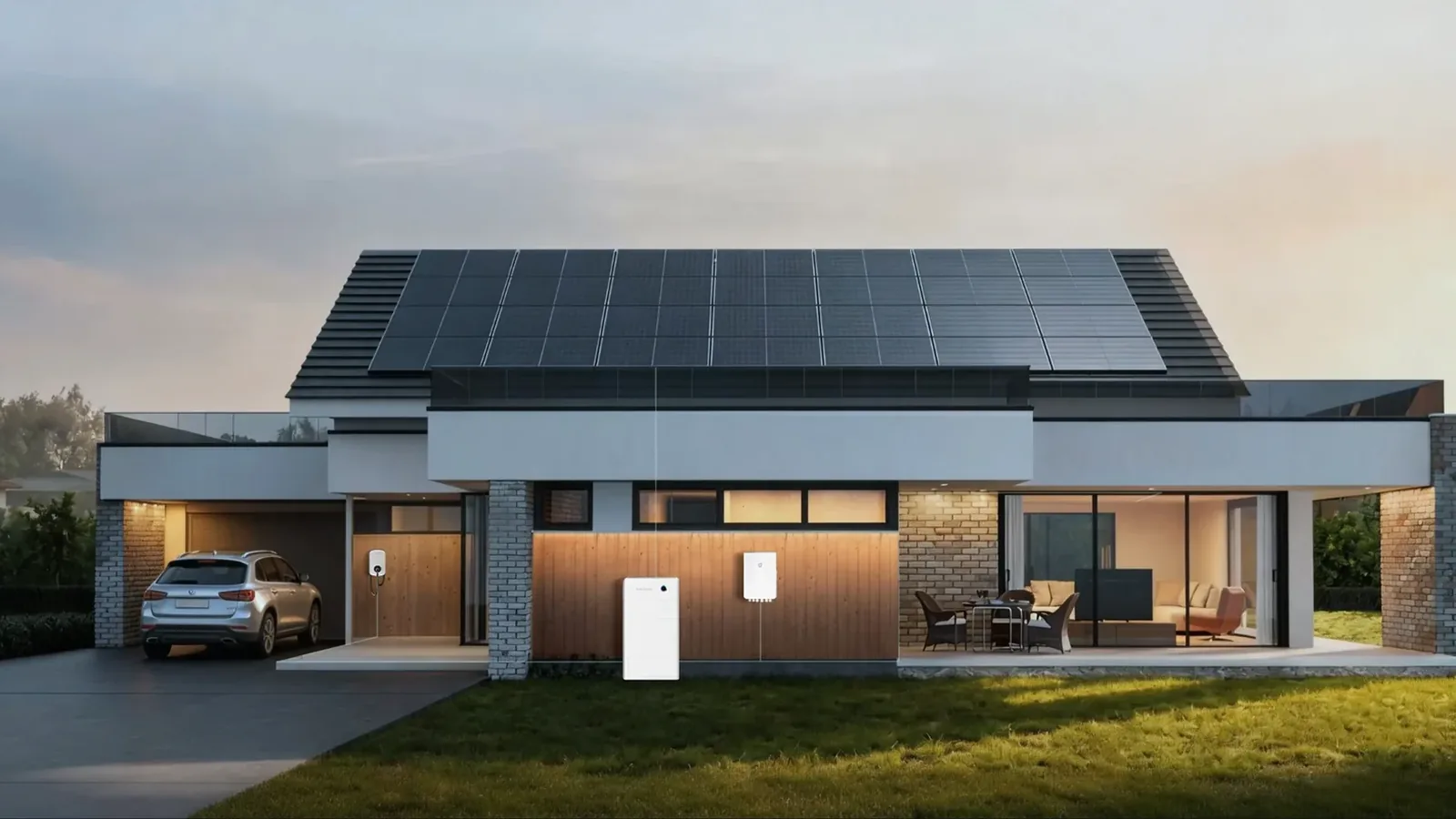
Solar is a big spend, and most of what you read about it was written for Australia, the UK or the US, or by someone selling panels. This guide answers the questions Auckland homeowners ask The Conduction Company most: what solar costs, what size a house needs, whether it pays off, and what goes wrong.
The answers come from Jordan Statham, The Conduction Company's director. He is a registered electrical inspector and holds the EWRB inspector endorsement for mains parallel generation systems, the class that covers grid-connected solar and batteries.
The figures in this guide are estimates for standard installation of a home solar system. The Conduction Company confirms final pricing after a property assessment.
The short answer. A typical three-bedroom Auckland home ends up with a 5 kW inverter and about 7 to 8 kW of panels. On The Conduction Company's own pricing, panels and an inverter cost $9,900 to $15,000 including GST, or from about $20,000 including GST with a battery. Payback is usually five to eight years without a battery.
What does solar cost in Auckland?
The Conduction Company's own pricing puts panels and an inverter on an Auckland house at $9,900 to $15,000 including GST. Add a battery and a system starts from about $20,000 including GST. These are list prices worked out from the price book the company quotes from, not an average of past sales.
Here is how the range runs in The Conduction Company's current pricing, every price including GST. Every system uses 450 watt panels, and every system above the smallest uses a Sigenergy inverter.
Smallest system. A 3 kW grid-tied inverter with 10 panels and no battery, on a simple single-storey job with a low-pitch steel roof and easy access to the switchboard, about $9,900 including GST.
A 5 kW single-phase system. A 5 kW inverter with 12 panels and no battery, about $12,700 including GST.
A larger three-phase system. An 8 kW inverter with 24 panels and no battery, about $19,800 including GST.
Largest in the book. A 12 kW three-phase inverter with 42 panels and no battery, about $29,800 including GST.
Smallest battery system. A 5 kW inverter, 15 panels and one 5.2 kWh battery module, about $20,000 including GST.
Largest battery system. A 12 kW three-phase inverter, 42 panels and one battery module, about $37,700 including GST.
We quote on facts, not guesses. Before we give you a price, we carry out a proper assessment of your property and how you'll use your solar system. That way you know exactly what you're buying and the total cost, with no surprises. Clear expectations from the outset, start to finish.
Where does the money go?
Not where most people think. Take a 5 kW system with 12 panels and no battery from The Conduction Company's price book. Labour is about 29% of the installed cost, the panels about 27%, the rails, cabling and other hardware about 27%, and the inverter about 17%. Add a battery and the battery becomes the biggest single part, at about 30%. Each panel on its own is a small share of the job, which is why adding a couple more is often the cheapest way to get more out of a roof.
What pushes the price up?
The roof is the biggest variable The Conduction Company prices. A low-pitch steel roof is the easiest: the mounts screw straight through the roofing into the framing underneath, the same way the roofing is already fixed. Decramastic tiles and older concrete tiles take far longer. The team lifts each tile where a mount goes, fixes the mount to the timber underneath, then grinds a channel in the tile so it sits back down flat over the mount.
Height and pitch add cost too. A steep roof is slower and harder to work on, and a third-storey roof needs more edge protection and access than a single-storey house. The Conduction Company prices all of that into the quote rather than finding it on the day.
The switchboard and meter can add to it. A modern switchboard usually needs nothing. An older one may need upgrading before it can take a solar system, and The Conduction Company does any switchboard upgrade as part of the same job. The meter belongs to a metering company and is arranged through your power company. Most newer smart meters can record exported power but may still need to be set up for it, and an older meter is swapped for one that records power going both ways. Some power companies charge a fee for that.
What does a battery add?
Thousands, and the cost rises roughly in step with how much storage you buy. In The Conduction Company's price book the smallest battery system, a 5 kW inverter with 15 panels and one 5.2 kWh module, comes to about $20,000 including GST. Sigenergy battery modules hold 5.2, 6.0, 7.8 or 9.0 kWh of usable energy, and up to six stack on one controller.
A battery does two jobs. It stores what the panels make during the day so you can use it in the evening, instead of selling it for about half what you pay to buy power. And with a Sigenergy gateway fitted, it keeps the circuits it backs up running through a power cut, with a switchover fast enough that you will not notice it. Whether a battery pays for itself is in the payback section below.
What will The Conduction Company not price without a visit?
Anything more than simple. Where good photos of the house are online and the owners can send clear shots of the switchboard, The Conduction Company can sometimes price a straightforward system from photos alone. Anything even mildly complex gets a site visit and a check of the existing electrical system, and sometimes a drone video of the roof, so the team knows exactly where everything will go.
What does it cost to add panels later?
You pay for labour and panels a second time, and it only helps if the inverter has room for them. If it does not, the new panels make more power than the inverter can pass through, and there is a limit to how many you can keep adding. Before adding to a system, The Conduction Company works out what the extra panels would earn and how long they would take to pay back, so the owner decides on the numbers.
Are there grants, loans or rebates for solar in New Zealand?
There is no upfront government subsidy for home solar in New Zealand. Several banks offer low or no interest loans for solar and other energy upgrades, so ask yours what it has now. The Conduction Company builds any loan interest into its payback sum, covered further down.
What does it cost to take an old or SolarZero system off a roof?
The Conduction Company prices removing a SolarZero system from about $1,700 including GST. That covers making the system safe, decommissioning it and taking it down, with the equipment left on the property. It does not include roof repairs, disposal, or anything owed under the SolarZero agreement. The equipment is not the homeowner's to sell or scrap, which is why it stays on site.
Why is solar so expensive in New Zealand?
Because most of the price is not the panels. On The Conduction Company's own price book, labour, mounting hardware and cabling carry most of a solar quote, and New Zealand is a small market with no rebate to bring the price down.
Why do the same panels cost more here than in Australia?
Two reasons, in the view of The Conduction Company's Jordan Statham. Australia has backed solar for years with a federal rebate, paid through small-scale technology certificates, and New Zealand has no equivalent. And Australian wholesalers buy panels in far bigger volumes than New Zealand ones, which brings their price down. "It's just gross volume and economies of scale," Jordan says. The scale shows in how many homes have solar. Around four in ten Australian houses now have rooftop solar. In New Zealand it is about one home in 24, and in Auckland only about one in 40 (Electricity Authority, August 2026).
Jordan Statham of The Conduction Company also points to sunshine, which changes what a panel makes rather than what it costs. Most of Australia's big cities sit closer to the equator than Auckland, so the same panel makes more power there. On the World Bank's Global Solar Atlas, it makes about 12% more a year in Sydney and about 17% more in Brisbane. Melbourne, which is further south than Auckland, comes out only slightly ahead.
Where does the labour go on an install?
The Conduction Company plans a typical home install as two people over about three days. Day one is the mounting rails. Day two is getting the panels up and fixed. Day three is the inverter and any battery, the connections to the switchboard and the panels, and commissioning. Jordan prefers three steady days to a big crew rushing it into one: "There's no huge rush and there's no people tripping over themselves."
What do inspection and compliance add?
Every solar install in New Zealand has to be inspected. The Electricity (Safety) Regulations 2010 class installing a photovoltaic system as high-risk prescribed electrical work (regulation 6A), and all high-risk work must be inspected (regulation 70). An installer without its own inspector has to book and pay an outside one. The Conduction Company charges $500 to $600 including GST for a standalone inspection of a PV array, such as one another installer fitted. On The Conduction Company's own installs, the inspection is part of the quoted price. The company's inspector is in-house: Jordan Statham, a registered electrical inspector who holds the EWRB inspector endorsement for mains parallel generation systems. Solar work done by the company's other electricians can be inspected without bringing an outside inspector in, which keeps the cost and the wait down. The regulations stop any inspector checking work they did or supervised themselves (regulation 71(2)), so Jordan inspects only work he did not do or supervise, and an outside inspector checks the rest.
What does a cheap solar quote leave out?
Design, mostly. In The Conduction Company's experience, a low-cost package quote rarely starts with your power bills. It skips the usage analysis and the panel count your roof can take. It skips the inverter size and panel ratio that suit how you use power, where a battery would go, the payback sum, and the changes you expect in the next few years. Jordan puts it plainly. "The lower cost systems tend to be, here's one package that we sell, we're going to put it on your home."
The Conduction Company loses some jobs on price, and that is fine. The clients who choose it want the system designed around the house, and a well-designed system can be worth far more over its life than the gap between two quotes.
Can you get solar panels for free?
Not really, and SolarZero shows why. SolarZero put panels on roofs for no upfront cost under 20 or 25-year agreements, then went into liquidation in November 2024. The panels and batteries were never the homeowners'. They belong to Public Trust, as trustee of two trusts that hold the agreements, and SZ Servicing runs them. Most complaints since have been about rising prices and the cost of getting out of an agreement. The Conduction Company now gets calls from Auckland homeowners who want that equipment off their roof.
Is the price coming down, and should you wait?
Jordan Statham's view is no. Panel prices fell hard after a glut of production from the Covid period, and battery prices fell with them. He sees both levelling off and starting to creep back up, and expects any government solar scheme to lift demand, and prices, further. On The Conduction Company's reading of the market, waiting for a better price is unlikely to pay.
What size solar system does an Auckland house need?
A typical three-bedroom Auckland home ends up with a 5 kW inverter and about 7 to 8 kW of panels, in The Conduction Company's experience. That is 16 to 18 panels of 440 to 450 watts, roughly 32 to 36 square metres of panel, plus a strip of clear roof around the edges. Every system is sized to the house, so treat that as a starting point.
How does The Conduction Company size a system?
It starts with your power, not your roof. The Conduction Company asks for your last three or four power bills, or looks at your online power account with you, and where it can, gets your half-hourly usage from your power company. For a closer look it can fit an energy logger for a power usage audit for 24 to 72 hours, which shows exactly when the house draws power. Then it works out how many panels the roof can hold, which sets the ceiling, and sizes the system between the two.
Winter decides the size. Heating makes winter the biggest load of the year, and the sun is at its lowest, so The Conduction Company sizes for the winter months rather than a yearly average. That method is where every quote starts under The Conduction Company's solar panel and battery installation service.
Why are there two sizes, one for the panels and one for the inverter?
Because they do different jobs. The panels collect the power. The inverter turns it into power the house can use, and its rating caps how much comes out at any moment. The Conduction Company fits 35 to 60% more panel than the inverter is rated for. At midday in summer the panels make more than the inverter can pass, and the inverter holds its output at its limit, which is called clipping. On grey days and through winter, the extra panels keep the output up for more of the day. Jordan's reason is simple: panels are the cheap part, so it pays to have more of them. The Conduction Company explains the whole chain, roof to switchboard, in how solar power works in an Auckland home .
What is the 33% rule in solar panels?
It depends who you ask, and none of the versions is a New Zealand rule that The Conduction Company has found. Online, "the 33% rule" means at least four different things.
Roof coverage. A US fire code limit on how much of a roof panels can cover before wider firefighter access paths apply. It does not apply here.
Panel oversizing. Panels up to a third bigger than the inverter. This comes from Australia, where going further can cost an installer the federal rebate. New Zealand has no such rebate rule, so the limit here is whatever the inverter maker allows.
Self-use. Using at least a third of the solar you make at home.
Generation cap. Making no more than about a third more power in a year than the house uses.
Jordan Statham had not heard of the rule until it came up in an interview. The version that matters for an Auckland house is oversizing, and The Conduction Company goes past a third: 35 to 60% more panel than inverter, inside the maker's limit. Sigenergy's single-phase inverters allow panels up to double their rating. On self-use, The Conduction Company aims for a household to use about half of what its panels make, and more with a battery.
Does the direction of the roof change the size?
Not much. North-facing panels at the ideal angle collect the most, but few Auckland roofs are built that way. Tilt frames can correct the angle, but they are expensive. The Conduction Company's usual answer is to add a couple more panels instead, which makes up the difference for far less. "The better option by far is just adding another couple of panels on," Jordan Statham says. North is first choice and south is last, though even a south-facing array makes a useful amount of power with a few extra panels on it.
What does shade do?
Shade changes the type of system more than its size. On an ordinary string of panels, a couple of shaded panels drag down the output of the whole string. Where a roof has patchy shade from trees or a neighbour's house, The Conduction Company fits optimisers so each panel keeps working on its own. Microinverters, which turn each panel's output into mains power on the panel itself, solve the same problem and suit some roofs.
Do Vector's export limits cap the size?
Rarely, for a house. On Vector's network a single-phase home can export up to 10 kW, as long as the inverter can be managed by Vector over the internet and stays online. Without that, Vector currently allows 2.5 kW. Systems bigger than 10 kW, measured by the smaller of the panel and inverter ratings, go through Vector's longer approval process. The Conduction Company sizes a home system to save power rather than sell it, so the export limit seldom decides the size. The approval itself is one of the steps in getting solar installed in Auckland, from the first call to switch-on .
What if you are planning an EV or a heat pump?
Say so at the start. The Conduction Company sizes a system for what you plan to add as well as what you have now. For an electric vehicle it recommends Sigenergy's own charger, which talks to the solar and battery system and charges the car from surplus power on its own. That is part of its home EV charger installation work. For a planned heat pump, it allows for the extra winter load in the size.
What happens when a system is the wrong size?
The mistake Jordan Statham sees most from inexperienced installers is matching the panels to the inverter, watt for watt. On one client's roof with limited space, another installer fitted an inverter as big as the panels, which Jordan estimates cost about $1,000 more than it needed to and gained nothing. The Conduction Company would have fitted a smaller inverter and let the panels run ahead of it.
Is a 10 kW solar system too big?
For most Auckland houses, a 10 kW inverter is more than they need. But first ask which 10 kW is meant, because on a quote it can describe the panels, the inverter or both. By The Conduction Company's 35 to 60% rule, 10 kW of panels sits on an inverter of about 6 to 7 kW, which suits a bigger family house. A 10 kW inverter is a bigger step, and is usually only worth it where a lot of power is used during the day.
Who genuinely uses 10 kW?
Lifestyle blocks and businesses, mostly. Jordan Statham of The Conduction Company has seen 10 kW pay its way on lifestyle blocks with a three-phase workshop or farm shed running through the day. There, the house and the shed between them use the power as it is made. On a sunny day, 10 kW can run a hot water cylinder, the fridges and freezers, computers and a good-sized heat pump at once, and still export the rest. Late in the day the sun is low, output drops to about half or less, and the house starts drawing from the grid again.
Does a 10 kW system need three-phase power?
A 10 kW inverter does, in the Sigenergy range The Conduction Company prices. Its single-phase inverters stop at 6 kW, so a 10 kW inverter is three-phase. Most suburban Auckland homes are single-phase, so the supply usually sets the largest inverter a house can take, and a single-phase house can still carry plenty of panel on a 6 kW inverter.
What happens to the extra power when nobody is home?
It goes where The Conduction Company has set it up to go, in order. First into the hot water cylinder and anything else on a timer. Next into the battery, if there is one, until it is full. Only then does the rest go back to the grid, which pays far less for it than you pay to buy power. The Conduction Company's own Onehunga office pays about 24 cents a kilowatt hour for power and is paid 12.5 cents for what it exports.
When should you go smaller, and when bigger?
Bigger is not always better. "It never hurts to go larger, but there's a declining rate of returns the larger you go," says Jordan Statham, The Conduction Company's director. On one of the company's jobs, the client had a perfect north-facing roof and wanted to cover all of it. Jordan ran the payback sums several ways, and using half the roof came out about $10,000 cheaper, with a payback about five years shorter.
Going bigger pays when the house can use the extra power. Take clients who use most of their power at home in daylight. In The Conduction Company's sums for them, a larger system can bring payback down from about 10 to 12 years to about 7 to 8. That is especially true on a low or no interest green loan, where the savings cover the repayments. A house that sits empty all day gains much less from the extra panels. Whether a house could run on solar alone is a different question, and The Conduction Company answers it in running a house on solar power only .
Is 3 kW enough to power a house?
For a small, well-insulated home with one or two people who are home in the day, yes. For a family house, The Conduction Company's answer is no: 3 kW is usually too small, and a bigger system pays back better.
What does a 3 kW system run?
The 3 kW is the inverter, and it sets the most the system can supply at any moment. A kW is power at a moment; a kWh is energy over time, the unit your power bill charges for. The Conduction Company pairs a 3 kW inverter with about 4.5 kW of panels. At its peak, that can fully heat a 10 amp hot water cylinder, or most of a 16 amp one, then run the fridge, freezer, computers, TV and router. What it cannot do is run several heat-making appliances at once. Ovens, hobs, cylinders and heat pumps are the hungry ones.
What does 3 kW make on a winter day in Auckland?
On a clear winter day, a 3 kW inverter with about 4.5 kW of panels can reach its full 3 kW around midday. The rest of the day it sits somewhere between nothing and that peak, rising and falling with the sun in a curve, and on a grey day it makes much less. The Conduction Company sets clients up with the system's phone app, where that curve shows every day.
Does a small system suit a battery?
Usually not. A small system's output mostly goes straight into the hot water and the daytime load, so there is little left over to charge a battery. If you want a battery, The Conduction Company sizes the panels and inverter up so there is surplus to store.
Who is a small system right for?
One of The Conduction Company's clients was retired and lived in a one-bedroom studio unit in a block of flats, with a small patch of roof. Eight panels and a small inverter, about 3 kW in all, heated the hot water and ran the daytime load, and the client was home to use it. For a home like that, Jordan Statham sees a small system as the best payback there is. The company rarely puts solar on apartments, and on a townhouse the roof is usually the limit, so the system is sized around the panels that fit.
Is it worth getting solar in New Zealand?
For an Auckland homeowner planning to stay at least eight to ten years, usually yes. The Conduction Company's verdict depends less on the house than on who lives in it, and for how long.
The Conduction Company's verdict, household by household:
Long-term owner-occupiers. Worth it. Stay eight to ten years and you get the payback. Stay twenty and you get the full benefit.
Retired, or working from home. The best case. You use the power as it is made, and power you use is worth about twice what power you sell earns.
A family out all day. Worth it, with some help. Put the hot water, the dryer and sometimes the heat pump on timers so they run in the sun, or add a battery to carry the day's power into the evening.
Moving within two to five years. Often not. You may get close to paying it back, but most of the saving comes after you leave. What solar does to a sale is in whether solar adds value to a house in New Zealand .
Landlords. Hard to make work. Tenants scrolling Trade Me compare rents, not power bills, so the higher rent needed to cover the system can push them on to the next listing. It can work if the listing puts the power saving front and centre, with the numbers.
A busy or difficult roof. Sometimes not worth it. A concrete tile roof crowded with skylights and pipes, on a second storey, costs more to install and fits fewer panels, which can push payback out too far. The Conduction Company says so at the first assessment.
What power bill makes solar worth it?
Any size can work. In Jordan Statham's experience it starts to make real sense for a bigger family in a bigger house, with plenty of roof and a bill around $400 to $600 a month. Where someone works from home and uses the power in the day, Jordan has seen payback come down to five or six years. The Conduction Company runs the sum for your own bills before you commit to anything.
Does a battery change the verdict?
It changes the reason. A battery is expensive, so it pushes payback out compared with panels and an inverter alone. But for a family out all day with big bills, it is what lets them use their own solar in the evening, and once it has paid for itself the savings are larger. Where power cuts are common, a battery earns its place as backup rather than on the numbers. The Conduction Company prices both options at the assessment so you can see the difference.
What does solar not do?
It does not take most power bills to zero. How far your bill falls depends on when the power is made, when you use it, your power plan, what you are paid for exports, and whether you have a battery. "It's not just a bill this, and now our power's free type of scenario," says Jordan Statham of The Conduction Company. That said, one of the company's clients did come close. A couple in a modern three-bedroom house with plenty of roof had 10 kW of panels put on a 7 kW inverter, with the hot water and appliances on timers. Their power bill went from about $300 a month to a credit in every month but winter.
Does Auckland's weather help?
Yes. Auckland's climate is mild and it sits comfortably in the sunnier half of the country, so The Conduction Company regards it as a good place for solar. Auckland gets about 20% more sunshine a year than Invercargill, 2,122 hours against 1,765 on NIWA's 1991 to 2020 averages. Almost all of that gap is in winter: in December, Invercargill's long days give it the same sunshine as Auckland. Winter is the season the company sizes a system for, so that is the gap that counts.
Hot water and an EV: the two things that tip it
Hot water comes first. An electric cylinder is the first thing The Conduction Company moves onto a timer, because it is one of the biggest loads in the house and it holds the heat. "It's essentially like a battery, but for heat energy as opposed to electrical," Jordan Statham says. Heat the water in the middle of the day on your own solar, add a short boost on a cheap rate in the morning if needed, and there is hot water for the evening showers.
An electric vehicle tips it too, if the car is home in the day. The Conduction Company's Onehunga office has charged its two electric vans and a plug-in hybrid ute from solar since its own system went on in September 2026. Staff times are arranged so the vehicles charge while parked in the sunniest part of the day. On the office's own bills, Jordan Statham puts it simply: "We haven't had a positive power bill since we installed."
How long does solar take to pay for itself in Auckland?
On The Conduction Company's sums, five to eight years for panels and an inverter, and six to ten years with a battery. The range is wide because the answer depends on what you pay for power, how much of the solar you use yourself, and what the system costs.
How does The Conduction Company work out payback?
The Conduction Company's payback sum, step by step:
Your usage. Your bills or online account, half-hourly data from your power company, or a 24 to 72 hour logger, so the sum uses how and when you really draw power.
The system and its price. The quoted cost, labour and materials, including any timers for the hot water and appliances, because those change how much solar you use.
Your power rates. What you pay to import at each time of day, what your power company pays for exports, and whether another power company would suit the new system better.
The yield. Expected output, using sunshine hours averaged over the previous five years, and the balance of what you will import and export, with or without a battery.
Interest. If a loan pays for the system, the interest over the loan's term is added to the cost.
Rising prices. An average yearly rise in power prices, based on how prices have really moved.
Jordan Statham expects The Conduction Company's calculated payback to land within about a year of the real one, unless the household's usage changes.
What does solar save a normal house?
Between $3 and $8 a day on a well-designed system, depending on its size, in the experience of Jordan Statham, The Conduction Company's director. That is roughly $1,100 to $2,900 a year, and the top of that range needs a larger system on a house that uses most of its own power. For comparison, EECA, the government's energy efficiency agency, puts typical savings at about $1,000 a year.
How much does the buy-back rate matter?
Not much, the way The Conduction Company designs a home system. Exported power earns about half what imported power costs, roughly 12 cents against 25 cents a kilowatt hour, so the saving is in using your own power, and the sum is built on that. When buy-back rates drop after a client has done their sums it is a shame, but it barely moves the payback on a system sized for self-use. Larger commercial systems are the exception.
What do salespeople fudge?
Anything that has to be estimated. The two The Conduction Company sees most are optimistic sunshine hours, and usage taken from spring or summer bills and treated as the whole year. Winter use is far higher, so a summer-based sum makes payback look shorter than it will be. Ask any installer which months of bills they used.
How long do the panels last compared with the payback?
Well past it. The panels The Conduction Company fits are guaranteed to still make at least 91% of their original output after 20 years and 87% after 30, under a 25-year product warranty and a 30-year performance warranty. A review by the US National Renewable Energy Laboratory of nearly 2,000 measured rates found panels typically lose about half a percent a year. The inverter is the part most likely to fail, usually in one go, and is typically replaced once over a panel's life, so build that into the sum.
What is the biggest downside of solar?
Maintenance, in the view of Jordan Statham, The Conduction Company's director, and it is a small one. "It's a small downside, but it is a downside," he says. The honest list of what goes wrong after an install is short, and most of it comes down to who installed the system.
Cleaning, and birds
Dust and grime cut output, so The Conduction Company recommends washing panels every six months to a year. Water and a soft brush are usually all they need, and a hose-fed extension pole with a soft brush lets most owners do it themselves. Never use dishwashing liquid. Really dirty panels need a cleaner made for the job, because the wrong chemicals can damage them.
Birds are the real nuisance. Droppings, and the odd nest underneath, cut a panel's output even when they cover only a small patch. Jordan Statham's worst case was a client whose new neighbour fed pigeons every morning. The birds sat on the client's panels, and he was up cleaning them most weekends. If your neighbours feed birds, The Conduction Company's advice is to have a friendly word early.
Which part fails first?
The inverter. It is a complex piece of electronics, it runs hot, and when it fails it usually fails all at once, while panels and batteries fade slowly. Out of warranty, The Conduction Company replaces a failed inverter in about half a day: disconnect the panels and the supply safely, swap the unit, reconnect and test. The cost is usually the price of a new inverter, typically a few thousand dollars, plus $500 to $1,000 including GST for the labour.
Most other callouts are software: firmware updates, or an inverter that has lost its connection, and The Conduction Company sorts most of those remotely with the maker's support team. Keep a Sigenergy system online, because its 10-year inverter and battery warranty depends on it, and offline the cover drops to five years.
What does a bad install look like?
Two kinds. The dangerous kind is panels fixed with the wrong hardware, or too little of it, so they shift in the wind and can lift roofing or come away. The ugly kind is cabling: white conduit run down the roof, over the gutter and along the wall, sometimes in flexible conduit that breaks down faster in the sun. AS/NZS 5033, the standard for solar arrays, requires DC cable inside a ceiling space, wall cavity or underfloor to run in metal or heavy-duty conduit. In The Conduction Company's view, that is one reason some installers run everything outside. Any conduit in the sun must be UV resistant, and The Conduction Company uses rigid conduit outdoors, never flexible.
Jordan Statham has had clients call The Conduction Company in to re-run cabling that another installer left looking a mess. That means disconnecting the panels safely and re-routing the cable neatly, which often runs into thousands of dollars. It is cheaper to have it done well the first time.
What happens if the installer goes out of business?
The manufacturer's warranty on the panels, inverter and battery usually survives, as long as you can show when the gear was bought, so keep the invoices. If the maker has no New Zealand office, the Consumer Guarantees Act treats the company that imported or distributed it here as the manufacturer. The labour side is what goes: a workmanship warranty is only as good as the company behind it. The Conduction Company is a SEANZ accredited solar installer, and its Lifetime Workmanship Guarantee covers its solar and battery work, is not time limited, and passes to the new owner if you sell the house.
Do solar panels cause roof leaks?
Not when they are fixed properly. On a steel roof the mounts screw through into the framing with sealing washers, much like the roofing screws already there. The Conduction Company mounts panels on Clenergy racking, made for this job, which needs no one-off engineering design when it is fitted to Clenergy's instructions and inside its limits. The company still checks the roof framing can carry the load. Tile roofs take more labour but are no less watertight when done right. Asked about leaks across The Conduction Company's solar installs, Jordan Statham says: "There's been none so far."
What if the roof needs replacing later?
The panels have to come off and go back on, so timing matters. Panels shelter the roof underneath from sun and weather, but if the roof is near the end of its life, re-roofing later means removing and refitting the whole array. The Conduction Company looks at the roof during its first assessment, and if it looks about five years from replacement, or shows corrosion, it suggests getting a roofer's opinion before going ahead. Jordan Statham has had clients wait and do the re-roof and the solar together, which shares the edge protection and cuts the total cost.
Why do people get rid of their solar panels?
Jordan Statham sees three reasons. A new owner moves in and does not like the look of the panels, or the system has stopped working. The original work was so rough the owner just wants it gone. Or it is a SolarZero system and the owner wants out. On a SolarZero roof, The Conduction Company removes the equipment only and leaves it on the property, because it belongs to someone else. Otherwise, Jordan's advice is to keep a working system and get the value out of it.
What if the monitoring app stops being supported?
It has not happened on any system The Conduction Company has fitted, because it sticks to big, established brands that keep their apps updated. The risk sits with lesser-known brands.
In short
Solar pays off for an Auckland homeowner who will stay put and can use the power in daylight. The Conduction Company's own pricing puts panels and an inverter at $9,900 to $15,000 including GST, and a system with a battery from about $20,000 including GST. Payback typically runs five to eight years without a battery and six to ten with one. Size comes from your winter power use and your roof, with 35 to 60% more panel than inverter, and the weak point over the years is the inverter, not the panels. These figures come from The Conduction Company's own pricing and the experience of its director, Jordan Statham.
Frequently asked questions
How many solar panels does an Auckland house need?
A typical three-bedroom Auckland home needs 16 to 18 panels of 440 to 450 watts, about 7 to 8 kW, on a 5 kW inverter, in The Conduction Company's experience. That takes roughly 32 to 36 square metres of roof, plus a clear strip around the edges. A small, low-use home can manage with eight or nine panels.
Do solar panels work on cloudy days?
Yes, but they make much less. Panels use scattered light as well as direct sun, so they keep working on a grey day, but under heavy cloud the light reaching them can be under a quarter of full sun. The Conduction Company sizes for winter for exactly that reason, fitting more panel than inverter so output holds up on dull days.
Will solar panels keep my power on in a power cut?
Not without a battery. A grid-tied system switches off in a power cut, even on a sunny day. AS/NZS 4777.2 requires the inverter to disconnect within two seconds of the grid going down, so it cannot feed power into a line someone may be repairing. Backup needs a backup-capable inverter, a battery and a changeover switch. With the Sigenergy gateway The Conduction Company fits, the switch is automatic for the circuits it backs up.
How often should solar panels be cleaned?
The Conduction Company recommends every six months to a year, more often if birds roost on the roof. Water and a soft brush do the job. Never use dishwashing liquid, and use a purpose-made cleaner only on really dirty panels.
Can I get free solar panels in New Zealand?
Not in any way The Conduction Company would recommend. No-upfront-cost schemes such as SolarZero left the equipment owned by someone else, under 20 or 25-year agreements that are costly to leave. There is no upfront government subsidy, but several banks offer low or no interest loans for home solar.
Do solar panels damage the roof?
Not when they are fitted properly, in The Conduction Company's experience. The mounts fix into the roof framing with sealing washers, and the panels shelter the roof underneath from sun and weather. Tile roofs need more care and more labour, but no more risk of leaks.