You have a bathroom or a kitchen that needs an extractor fan, and you want a number before you ring anyone. This page has the numbers.
They come from The Conduction Company's own completed extractor fan jobs across Auckland since January 2025, read from our job records in September 2026. They are what clients paid.
The healthy homes standards only bind rental properties, but a fan costs the same whether the law requires it or you simply want a dry bathroom. So this page is for landlords, property managers, and owners alike. What the standard actually requires of a kitchen and a bathroom is on its own page.
The short answer. On The Conduction Company's completed Auckland jobs, replacing a bathroom extractor fan on its existing duct costs $420 to $650 including GST. A new fan with a new duct run outside costs $550 to $1,300 including GST. Our dearest residential job came to about $2,500 including GST. The fan is a small part of the price. The route outside is most of it.
We quote on facts, not guesses
Before we give you a price, we carry out a proper assessment of your property and the extraction work you need. That way you know exactly what you're buying and the total cost, with no surprises. Clear expectations from the outset, start to finish.
What does it cost to replace a bathroom extractor fan?
The estimates below are for standard installation of a kitchen or bathroom extractor fan in an Auckland home. The Conduction Company confirms final pricing after a property assessment.
Straight replacement, duct already in place. $420 to $650 including GST. The old fan comes out, a 150 mm fan goes in on the existing ducting, and the one price covers the fan, the labour, and getting to you. The most recent jobs, from 2026, sit at the top of that band at about $650 including GST, and that is the figure to plan on.
Time on site. Thirty minutes to an hour.
That is the job most landlords are actually facing. A fan that was fine for years has stopped, or has got so noisy the tenant has switched it off, and the ducting is already there. It is also the job where the fan you choose matters most, which is covered further down.
What does a new extractor fan with new ducting cost?
New fan and a new duct run to the outside, bathroom. $550 to $1,300 including GST on The Conduction Company's completed jobs. The two most recent, from 2026, came to $750 and $900 including GST. The price covers finding the route, the intake grille in the ceiling, the fan, the ducting, the outlet through the soffit or the wall, and sealing every penetration so it is weatherproof.
Through-wall install, where there is no ceiling space. About $950 to $1,050 including GST on The Conduction Company's records. The hole is cored right through the wall from inside to out and the fan sits in it, so there is no ducting to run, but there is a lot more cutting.
Time on site. Two to four hours, depending on the property.
What happens on the day
The first job is finding a duct path from the wet room to the outside, because the standard defines an extractor fan as one that vents outdoors. A fan that blows into the roof space is not an extractor fan at all, whatever it cost.
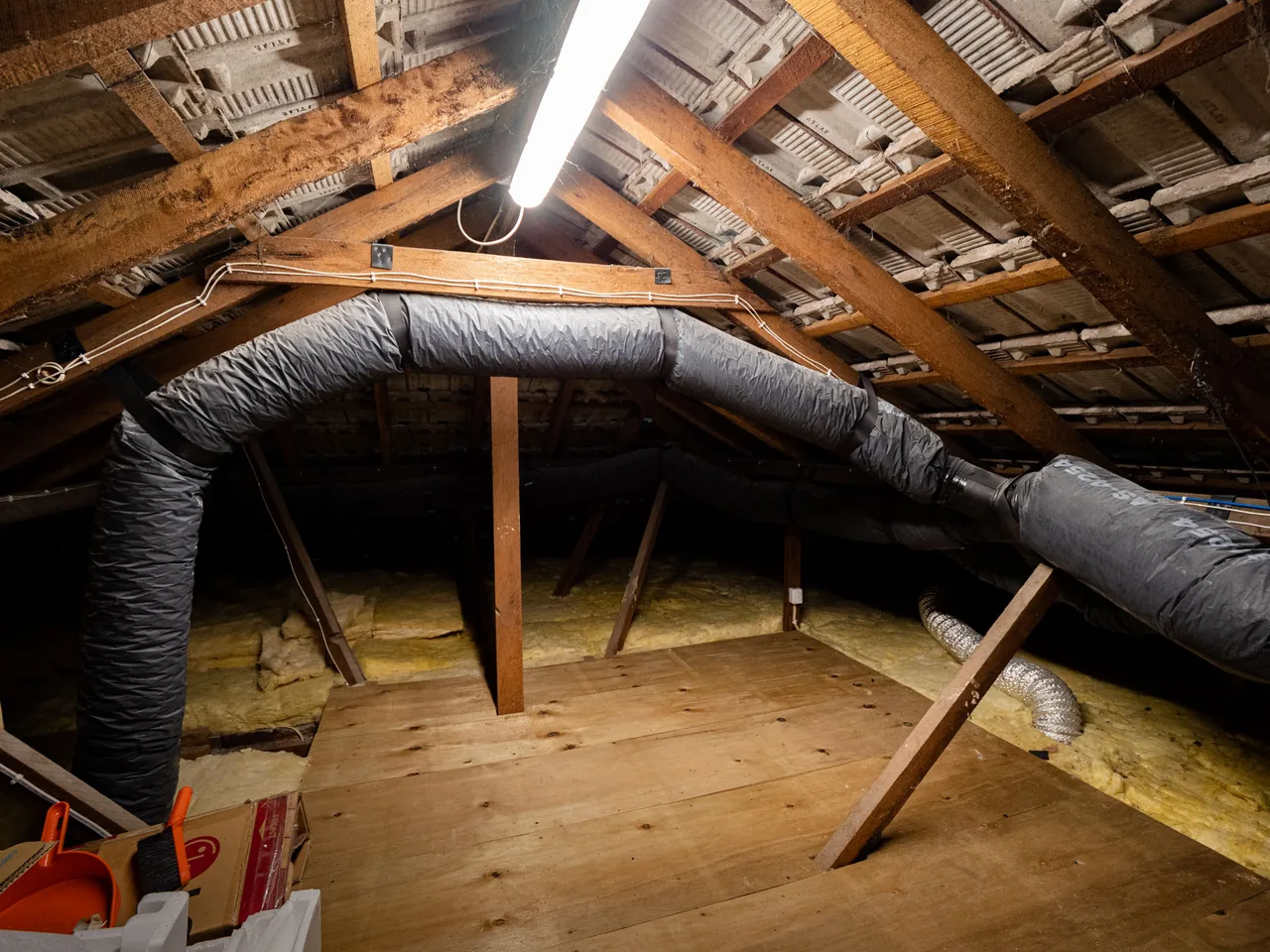
Where there is a ceiling void, The Conduction Company runs the duct through it to an in-line fan, and that is our first choice every time. Compared with the other styles, an in-line fan is much quieter, it moves more air at more pressure, it lasts longer in service, it is easier to replace, it is easier to clean, and it costs less.
We drill a hole in the ceiling close to the steam source and fit a single-surface, easy-clean intake vent. The ducting runs from there through the ceiling void to the fan, which we hang from the timber so it stays cool and its vibration does not reach the room. From the fan the duct runs to the outside, through a grille in the soffit or a cowl on the gable end of the roof, and we seal the penetration so it is weatherproof.
Where the ceiling space is tight, a ceiling fan, with the fan built into the intake grille, sometimes fits where an in-line fan will not. Where there is no cavity at all, a through-wall fan goes straight through the wall.
There is some noise and dust while we drill, and that is about the extent of the disruption. We give you the price up front in a formal quote, so you know what your particular job costs before we start.
What moves the price inside the band?
Three things, and The Conduction Company sees them in this order.
The fan. We fit a minimum standard of fan, and it is not the cheapest one on the shelf. Why is explained in the next section.
The type of fan. On a new install an in-line fan is the least expensive option, and through-wall and ceiling fans cost more.
The installation, most of all. Limited space in the ceiling cavity or a tricky duct run can drastically increase the quoted cost. A run that has to cross the house, turn corners, or leave through the roof rather than a soffit takes longer and needs a stronger fan to push the air that far.
Why The Conduction Company will not fit a cheap fan
An extractor fan is a motor that runs in warm, wet air for years. The cheap ones do not last, and we replace a lot of them.
"They are a mechanical moving part that will wear out quickly unless well designed with decent quality materials. We see cheap fans fail quickly constantly." Jordan Statham, director of The Conduction Company.
His arithmetic is simple. Pay a couple of hundred dollars more once for a good fan that lasts about eight years, or pay for a cheap one to be replaced year after year, with another cheap one. The Conduction Company's everyday bathroom fan is a 150 mm Vynco in-line kit with an easy-clean grille. The standard's minimum for a bathroom is 120 mm, or 25 litres a second. We fit 150 mm because the airflow printed on the box is measured with nothing attached, and it falls once the fan is on a real duct run, which is why the number on the box is not the number your bathroom gets.
Can I buy the fan myself and just pay for the fitting?
Usually The Conduction Company would rather supply it, and the reason is safety rather than margin. We are responsible for the installation being electrically safe, and we can only stand behind that with brands and fittings we know. Any fitting we install has to carry a valid supplier declaration of conformity, which is the importer's or manufacturer's declaration that the product meets the New Zealand standard.
It usually costs you less as well. Trade pricing through our wholesaler puts a standard fan below what you would pay at retail, so supply and install often comes in under buying it yourself.
Where a client has already bought a like-for-like ceiling fan, The Conduction Company has fitted it for $250 to $300 including GST, labour only. Three conditions come with that. The product warranty sits with the retailer, not with us. Our replacement warranty does not cover a fan we did not supply. And if it fails, the return visit is charged.
What does a kitchen extractor fan cost?
Kitchen extractor fan, ceiling or wall. $450 to $850 including GST on The Conduction Company's completed jobs. A kitchen fan is not dearer than a bathroom fan in itself. The standard asks for a bigger one, 150 mm or 50 litres a second against 120 mm or 25 litres a second for a bathroom, and 150 mm is what we fit in both rooms.
Through-wall kitchen fan inside a built bulkhead. $900 to $1,650 including GST on The Conduction Company's quotes. The bulkhead is the reason: a box built out from the wall and ceiling to hide the duct, plastered, sanded, and painted to match.
Range hoods. The Conduction Company prices these per job, once you have chosen the hood and we have found the route outside. One thing to know before you choose. A recirculating range hood, the type that filters the air and sends it back into the kitchen, is not an extractor fan for the healthy homes standard, because the standard defines an extractor fan as one that vents outdoors. It still deals with the grease and the smell. Where a ducted range hood could not be fitted, The Conduction Company has left the recirculating hood in place for those and fitted a separate extractor fan for the steam, which is what the kitchen band above prices.
What is the dearest it gets?
About $2,500 including GST for a residential job, on The Conduction Company's records. The one Jordan Statham calls the most complex installation we have completed was a bathroom and laundry in the middle of a lower floor in Shelly Park, with a block retaining wall and structural timber around the perimeter, so there was no way out through any wall of the room.
The route we built: a port through the wall into a right-angled bulkhead, flat channel ducting through a hallway cupboard on the floor above, back into round ducting, and an ultra-powerful in-line fan in a small ceiling void to cope with the length of the run, exhausting through four 100 mm grilles because there was only a small amount of soffit to work with. It came to just under $2,500 including GST, and the result was powerful, quiet extraction where the mould had been.
Jordan says it is the one job where The Conduction Company would have been happy to put in writing that a compliant fan was not reasonably practicable, and leave the owner to decide what to do with that. The owner had a real moisture and mould problem, so we found the route instead.
Does the tenant need to be out while the work is done?
No. There are a couple of brief loud periods while we drill, so a tenant working from home may want to mute a call or head into the office for those, and that is the extent of it. The Conduction Company's staff do not need anyone on site while we work. We are happy to lock up after ourselves and leave the key wherever you tell us.
Access is usually arranged with the tenant directly. If the property is empty or the tenant is away, we collect keys from the landlord or the property manager, as long as it is booked in advance.
If the awkward part of your job is that there is no obvious way out, what to do when a fan will not fit, and what a landlord needs in writing, has its own page. If you are wondering whether you need an electrician for this at all, whether an electrician has to install an extractor fan is answered on its own page.
The Conduction Company installs extractor fans and home ventilation across Auckland. Send us the room and a photo of the ceiling or the outside wall, and we will tell you which band your job sits in before anyone drives out.
Frequently asked questions
How much does it cost to install an extractor fan in NZ?
On The Conduction Company's completed Auckland jobs since January 2025, a new bathroom extractor fan with a new duct run to the outside costs $550 to $1,300 including GST, with the most recent jobs at $750 and $900 including GST. A kitchen extractor fan costs $450 to $850 including GST. These are estimates from real jobs, and The Conduction Company confirms the price for your property in a formal quote before any work starts.
How much does an electrician charge to replace a bathroom extractor fan?
Where the ducting is already in place, The Conduction Company's completed Auckland jobs put a straight replacement with a 150 mm fan at $420 to $650 including GST, with the 2026 jobs at the top of that band at about $650 including GST. The price covers the fan, the labour, and travel. A fan the client has bought themselves has been fitted for $250 to $300 including GST, labour only, with the product warranty sitting with the retailer.
How long does it take to install a bathroom extractor fan?
A straight replacement on existing ducting takes The Conduction Company thirty minutes to an hour on site. A new fan with a new duct run through the ceiling void to a soffit grille or a gable cowl takes two to four hours, depending on the property. There is some noise and dust while the holes are drilled, and that is about the extent of the disruption.
Does the tenant have to move out while an extractor fan is installed?
No. The Conduction Company's staff do not need anyone on site, and the work is done in a single visit with a couple of brief loud periods while drilling. A tenant working from home may want to mute a call for those. Access is usually arranged with the tenant directly, and keys can be collected from the landlord or property manager if that is booked in advance. Staff lock up afterwards and leave the key where they are told to.
Can I buy the extractor fan myself and have an electrician fit it?
The Conduction Company usually supplies the fan, because it is responsible for the installation being electrically safe and can only stand behind that with brands and fittings it knows. Any fitting it installs has to carry a valid supplier declaration of conformity. Trade pricing usually puts a standard fan below retail, so supply and install often costs less than buying it yourself. Where a client has already bought a like-for-like ceiling fan, The Conduction Company has fitted it for $250 to $300 including GST, labour only, with the product warranty sitting with the retailer and any return visit charged.
How much does a healthy homes assessment cost?
The Conduction Company does not carry out five-standard healthy homes assessments and does not price them, so the figures on this page are for the extraction work only. An assessment company or Tenancy Services is the right place for assessment pricing. What The Conduction Company does price is the work an assessment usually finds in a kitchen or bathroom: a fan to replace, a fan to add, or a duct that has to reach the outside.