A rental kitchen and a rental bathroom each need an extractor fan. That part is well known. What almost nobody can tell you is how big it has to be, whether the ducting counts, and what happens to the fan you already have.
This page is about rental properties. The healthy homes standards apply to residential tenancies, and they bind the landlord. If you own the house you live in, none of this is a legal obligation on you. It is still the right call for a wet bathroom, but it is your choice.
The short answer. In a rental, every kitchen and every bathroom has to have an extractor fan that vents outdoors. A kitchen fan needs to be at least 150 mm across or move at least 50 litres a second. A bathroom fan needs 120 mm or 25 litres a second. The Conduction Company measures the fan and the ducting together, because the regulation applies the size test to both.
What does the ventilation standard require in a kitchen and a bathroom?
Regulation 23 of the Residential Tenancies (Healthy Homes Standards) Regulations 2019 sets it out in three short subclauses. Each kitchen and bathroom must have an extractor fan, or qualifying ventilation. Then:
"For a kitchen that has an extractor fan, (a) the fan and all exhaust ducting must have a diameter of at least 150 mm; or (b) the fan and all exhaust ducting must have an exhaust capacity of at least 50 ℓ/s."
"For a bathroom that has an extractor fan, (a) the fan and all exhaust ducting must have a diameter of at least 120 mm; or (b) the fan and all exhaust ducting must have an exhaust capacity of at least 25 ℓ/s."
Two routes, and you only have to satisfy one of them. Either the thing is big enough, or it moves enough air. The symbol ℓ/s is litres a second.
Put plainly, this is what The Conduction Company checks on site.
A kitchen. 150 mm across the fan and all of its ducting, or an exhaust capacity of 50 litres a second.
A bathroom. 120 mm across the fan and all of its ducting, or 25 litres a second.
Both. It has to vent to the outdoors, and it has to be kept in good working order.
Those figures are quoted from regulation 23 as it stands today. Regulation 23 was replaced on 12 May 2022, so anything you read that was written before then may be describing the old version.
Does the size rule apply to the ducting as well as the fan?
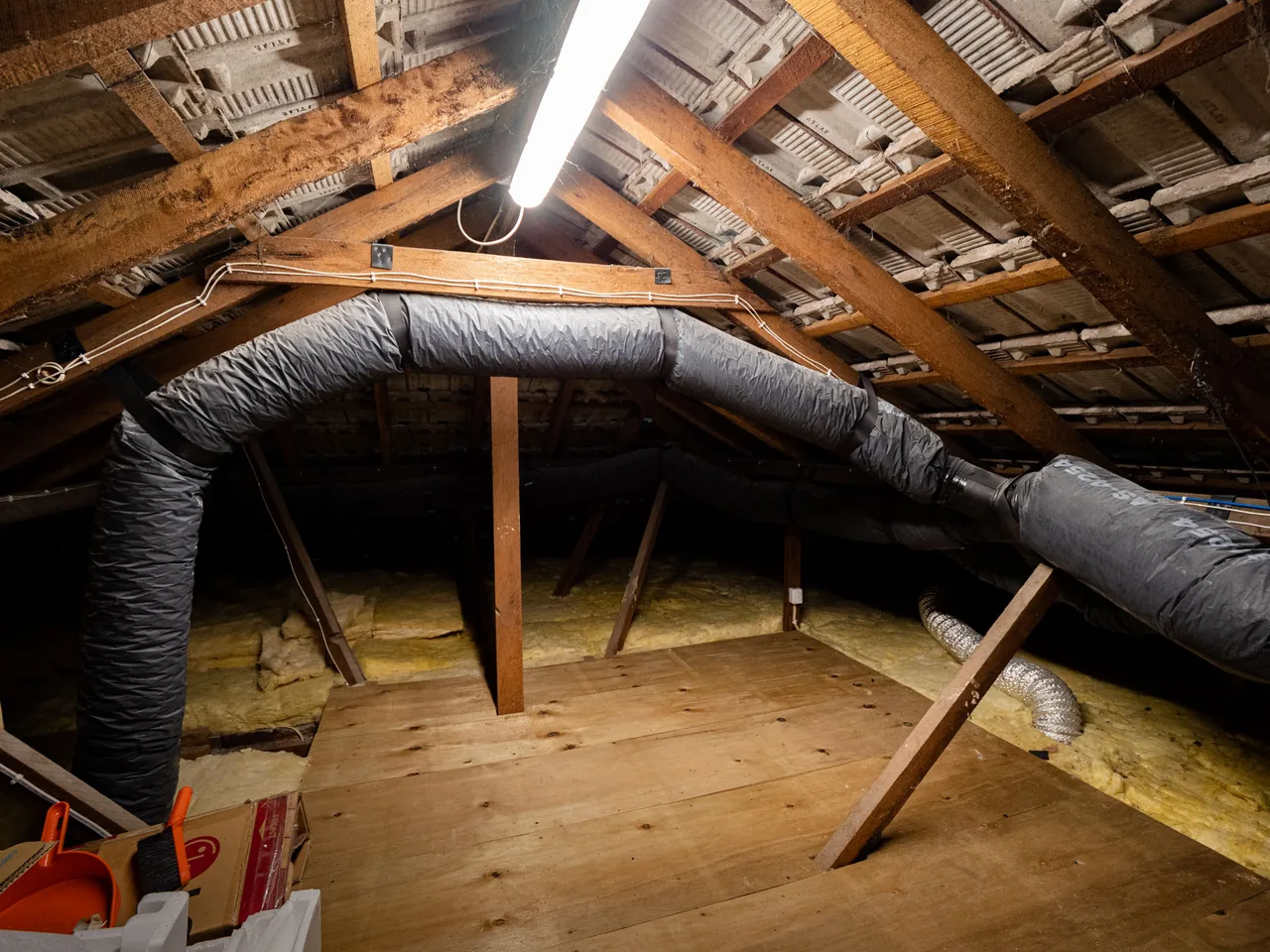
Yes, and this is the line most people miss. The regulation says "the fan and all exhaust ducting". A 150 mm fan reduced down to a 100 mm duct in the ceiling has not met the size route, and The Conduction Company sees that exact reducer on jobs regularly.
It is an easy mistake to make, because the fan is the thing you buy and the ducting is the thing the installer picks. Ask what diameter the duct is, not just the fan.
Does a kitchen extractor fan have to be a range hood?
Not on the wording. Regulation 23 asks for "an extractor fan" in the kitchen and does not say what kind. A range hood is the usual answer because it sits over the cooktop, where the steam is. The Conduction Company's reading of the quoted text is that the same three methods it uses in bathrooms, an in-line fan in the ceiling void, a ceiling fan, or a through-wall fan, satisfy a kitchen too, provided the fan and all of its ducting are sized to the kitchen minimum: 150 mm across, or 50 litres a second. That matters in a kitchen where a ducted range hood cannot go in.
A recirculating range hood does not count on its own. It vents nothing outdoors, so it is not an extractor fan as regulation 3 defines one, however well it deals with smoke and grease.
Where a ducted range hood will not go in, The Conduction Company leaves the recirculating hood for grease and odour and fits a separate ceiling or wall extractor. A separate extractor fan sized to the kitchen minimum meets regulation 23, whether or not a recirculating hood stays in place. Where in the kitchen it sits still affects how well it clears the steam, but that is a performance question, not a compliance one.
What if the fan was already there before 1 July 2019?
Then the size and capacity rules do not apply to it at all. Schedule 1, clause 8 of the regulations says that if an extractor fan was installed before 1 July 2019, regulation 23(2) and (3) do not apply.
MBIE puts it in plain words in its ventilation guidance: fans installed before 1 July 2019 have "no minimum size or performance requirements but fans must be in a good working order and ventilate to outdoors."
So a small old fan that still works and still vents outside is compliant. The Conduction Company will tell you that rather than sell you a replacement you do not need. What changes is the day it dies: regulation 6(2)(d) requires installed things to be maintained in good working order, or replaced within a reasonable time if they cannot be, and MBIE is explicit that the replacement has to meet the full requirement.
That is worth planning for rather than being surprised by. An old 100 mm fan with 100 mm ducting is a bigger job to replace properly than a like-for-like swap, because the ducting has to come up to size too. What each kind of extractor fan job costs, from The Conduction Company's own completed Auckland jobs, is on its own page.
Does a bathroom still need a fan if it has a window?
Yes. This is the single most common misunderstanding The Conduction Company hears, and the answer is in the way the standards are built.
There are two separate ventilation standards. Regulation 21 is the openable windows standard, and it applies to each "habitable space". Regulation 23 is the mechanical ventilation standard, and it applies to each kitchen and bathroom. They are different rooms and different rules.
Regulation 3 defines a habitable space as a domestic living space "excluding any bathroom, laundry, toilet, pantry, walk-in wardrobe, corridor, hallway, lobby, clothes-drying room". Your bathroom is not a habitable space, so the window rule was never about it in the first place. The fan rule is, and a window is not a fan.
Does a laundry or a separate toilet need an extractor fan?
Under the ventilation standard, no. Regulation 23 names kitchens and bathrooms only, and regulation 3 defines both narrowly:
"bathroom means a domestic living space in which a bath or shower is installed"
"kitchen means a domestic living space in which an indoor cooktop is installed"
A separate toilet with no shower in it is not a bathroom for this purpose. A laundry is neither. A kitchenette with a sink and no cooktop is not a kitchen. The Conduction Company still recommends extraction in a laundry, because a dryer and a wet floor put a lot of moisture into a small room, but that is advice rather than a legal requirement.
What counts as "qualifying ventilation" instead of a fan?
Regulation 3 defines it, and the definition turns on extraction. Qualifying ventilation is mechanical ventilation "designed to vent extracted air continuously from residential premises to the outdoors" which, for a kitchen or bathroom, "extracts the air directly from the room". It then has to be either part of the original building consent for a place first consented on or after 1 November 2019, or a system serving multiple rooms at a minimum of 12 litres a second for a kitchen and 10 litres a second for a bathroom.
Read that definition against what is actually in most Auckland homes. A positive pressure system, the common roof-mounted type that pushes filtered air into the house, works the other way round. It supplies air, it does not extract it from the room. The Conduction Company's reading is that a positive pressure system does not stand in for an extractor fan in the kitchen or the bathroom, and if a property is relying on one, that position is worth confirming before you rely on it in a tenancy agreement.
That is not a case against positive pressure. The Conduction Company recommends both, because the two work together in a push and pull. Extraction is the most important part, pulling steam and moisture out of the kitchen and bathroom as it is made. A positive pressure system ventilates the rest of the house.
"Extraction does tend to ventilate only the wet areas, whereas positive pressure systems ventilate the entire home." Jordan Statham, director of The Conduction Company.
For a landlord, the case for both is protecting the investment. The Conduction Company recommends extraction and positive pressure together as the best protection for a rental: a warm, dry home where nobody has to keep going back to treat mould and repaint, and where tenants are happier to stay for longer.
Why the number on the box is not the number your bathroom gets
This is the most useful thing on this page and it appears on none of the pages currently ranking for it.
Fan airflow is published as a free-air figure, measured with nothing attached. Put the fan in a real ceiling with a real duct and real bends, and the figure falls. Simx, which supplies the SmartVent brand The Conduction Company installs, says in its own fan selection guide that the free-air figure is usable only "after a large downgrading allowance is made for the considerable slowing effect of a complete installed system".
Its own numbers show what that means. Simx's 100 mm Contour toilet fan is rated 49 litres a second in free air, nearly double the 25 litre bathroom threshold, and Simx's own Healthy Homes selection guide does not list it as adequate for a bathroom at any duct length or bend count.
HPM publishes the same effect measured at the duct. Its 100 mm wall fan with a draught stopper moves 68 cubic metres an hour with no duct, and 33 with one metre of duct attached. That is half the airflow lost to a single metre. Its 150 mm equivalent moves 204 with no duct and 158 at three metres, a loss of under a quarter.
MBIE says the same thing, more gently: "the fan's performance is reduced where ducting is required, depending on factors such as the type of ducting used, its length and the number of bends in the ducting."
So The Conduction Company sizes the fan for the duct run it is actually going into, not for the number printed on the carton.
Is a 100 mm fan good enough?
It depends on two things, and neither of them is the fan's age.
If it went in before 1 July 2019, it is compliant as long as it works and vents outside. If it went in after, 100 mm does not satisfy the size route, so it has to prove 25 litres a second instead. Plenty of 100 mm fans are rated well above that on paper. What The Conduction Company finds failing in practice is the cheap flat disc axial fan: Simx publishes a maximum static pressure of 20 Pa for a 100 mm axial and states that "at 20 Pa of pressure the 100 mm axial fan airflow has stopped whereas the 100 mm centrifugal fan is still moving 29 litres a second". Simx's published maximum duct run for a 100 mm axial is two to three metres.
A few metres of ducting will produce 20 Pa on its own. That is the fan that is not moving the air its box says it is.
What happens if the fan vents into the roof space?
It is not an extractor fan. Regulation 3 defines the term as "an extractor fan that vents extracted air to the outdoors", so venting outside is not an extra rule bolted onto the standard. It is inside the definition of the thing itself.
A fan discharging into a roof cavity fails regulation 23 no matter how big it is, and it is also moving your bathroom's moisture into your ceiling, which is where it does the most expensive damage. The Conduction Company terminates through the soffit, a wall, or the roof, depending on the building.
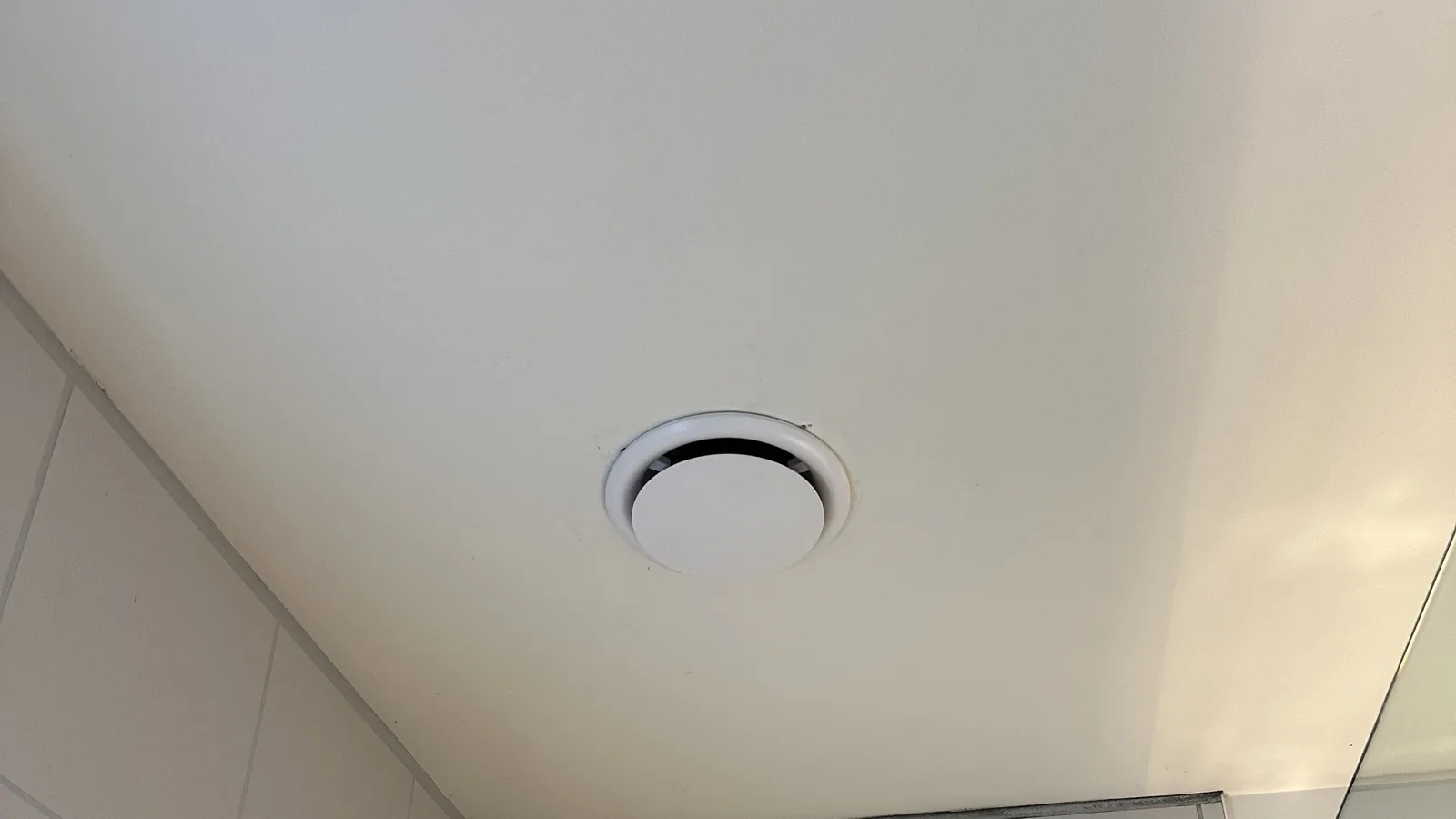
The Conduction Company finds a fan venting into the ceiling space in about one in ten of the older Auckland homes it is called to. What happens next depends on the fan. A modern fan with plenty of life left gets adapters and new ducting run to the exterior. An older one comes out, and in its place goes a large easy-clean diffuser in the ceiling with a modern in-line fan above it. Either way, the void gets a look while the ceiling is open. After years of moisture being pushed into it, rotten timber or mould can turn out to be the expensive part of the job, which is the whole reason the moisture has to leave the building rather than stop in the roof.
What should a landlord actually get in writing?
The fan diameter, the ducting, and the flow rate. Tenancy Services says landlords "should ask installers for the details of the fan diameters, ducting and flowrate in writing", and the reason is on the compliance statement: where a landlord complies by extractor fans, the statement must include the diameter or exhaust capacity of each extractor fan installed in any kitchen or bathroom.
That is a figure only the installer can give you. Every quote and invoice from The Conduction Company names the specific fan it installs. On request, it supplies a document with the fan's diameter, the duct size and run, and the rated flow, so the figures are there when the tenancy agreement needs them rather than being reconstructed a year later.
What are the deadlines, and what is the penalty?
Every deadline has passed. Boarding houses had to comply by 1 July 2021, public and community housing by 1 July 2024, and every private rental by 1 July 2025. Tenancy Services states it plainly: "All rental properties must comply with the healthy homes standards as of 1 July 2025."
Failing to meet the standards is an unlawful act under section 45(1A) of the Residential Tenancies Act 1986, and the Tenancy Tribunal can order exemplary damages of up to $7,200 for it. The Conduction Company is not the right party to advise you on penalties or on your tenancy agreement. Tenancy Services is, and it publishes the position at tenancy.govt.nz. The heating standard's sizing rules are in The Conduction Company's guide to what size heat pump a rental needs for Healthy Homes.
"It's mandatory, and although it can be a real hassle, and a significant expense, and you can be installing something that's going to detract from the look of your property, it just has to be done." Jordan Statham, director of The Conduction Company, a registered electrician and registered electrical inspector.
What if a fan genuinely will not fit?
There is an exemption in regulation 24, and it is much narrower than most people expect. It has four conditions and all four have to be met. Cost is not one of them, and neither is how it will look.
It is also the landlord's declaration to make, not the contractor's. What The Conduction Company supplies is the written evidence: what was tried, what the building will and will not allow, and why. How that works, and what to do when there is no obvious route outside, is a longer story.
In most of the properties The Conduction Company is called to, there is a route. It is just not the obvious one.
The Conduction Company installs extractor fans and home ventilation systems across Auckland, for landlords, property managers, and owners who simply want a dry bathroom. If you want to know where your property stands, tell us the rooms and we will tell you what they need.
Frequently asked questions
What are the extractor fan requirements for healthy homes?
Every kitchen and bathroom in a rental must have an extractor fan that vents outdoors, or qualifying ventilation. Regulation 23 of the Residential Tenancies (Healthy Homes Standards) Regulations 2019 requires a kitchen fan and all its exhaust ducting to be at least 150 mm in diameter, or to have an exhaust capacity of at least 50 litres a second. For a bathroom the figures are 120 mm or 25 litres a second. The Conduction Company measures the fan and the ducting together, because the regulation applies the test to both.
Do bathroom extractor fans need to vent outside in New Zealand?
Yes, and it is not an extra rule. Regulation 3 of the healthy homes regulations defines an extractor fan as one that vents extracted air to the outdoors, so a fan discharging into a roof cavity is not an extractor fan for the standard at all, whatever its size. The Conduction Company terminates through the soffit, a wall or the roof depending on the building. A fan venting into a ceiling space also puts the bathroom's moisture where it does the most damage.
Does a bathroom need an extractor fan if it has a window?
Yes. The healthy homes standards contain two separate ventilation rules. The openable windows standard in regulation 21 applies to habitable spaces, and regulation 3 expressly excludes bathrooms, laundries and toilets from the definition of a habitable space. The mechanical ventilation standard in regulation 23 is the one that covers kitchens and bathrooms, and it requires a fan or qualifying ventilation. A window does not satisfy it.
Is a 100mm extractor fan legal in a rental bathroom?
It depends on when it was installed. A fan installed before 1 July 2019 has no minimum size or capacity requirement under Schedule 1 clause 8 of the regulations, so it is compliant while it vents outside and works. A fan installed on or after that date does not meet the 120 mm size route at 100 mm, so it has to prove at least 25 litres a second instead. The Conduction Company checks the installed performance rather than the free-air rating, because Simx's own selection guide does not list its 49 litre 100 mm fan as adequate for a bathroom at any duct length.
Does a laundry need an extractor fan under the healthy homes standards?
No. Regulation 23 applies to kitchens and bathrooms only. Regulation 3 defines a bathroom as a space with a bath or shower installed and a kitchen as a space with an indoor cooktop installed, so a laundry is neither, and a separate toilet with no shower is not a bathroom for this purpose. The Conduction Company still recommends extraction in a laundry, because a dryer and a wet floor put a lot of moisture into a small room, but that is advice and not a legal requirement.
Does the 150mm rule apply to the ducting as well as the fan?
Yes. Regulation 23 says the fan and all exhaust ducting must meet the diameter. A 150 mm fan reduced to 100 mm ducting in the ceiling has not met the size route, and The Conduction Company finds that reducer on Auckland jobs regularly. Ask what diameter the duct is, not only what diameter the fan is.